
In Paul Abraham and Abdulla Al-Hor’s tender 18-minute short film “Alkaline,” what initially appears as a simple story about generational disconnect reveals itself to be a profound meditation on loneliness, aging, and the complex bonds between parents and children in contemporary Kerala.
Set against the lush backdrop of central Kerala—a landscape that has witnessed powerful family dramas from “Irakal” to “Joji“—”Alkaline” takes a gentler approach to family (dys)function.
The film centers on a son’s visit from Doha to his father, who has embraced an almost rigorous organic lifestyle following a personal trauma: witnessing his own father’s fatal heart attack.
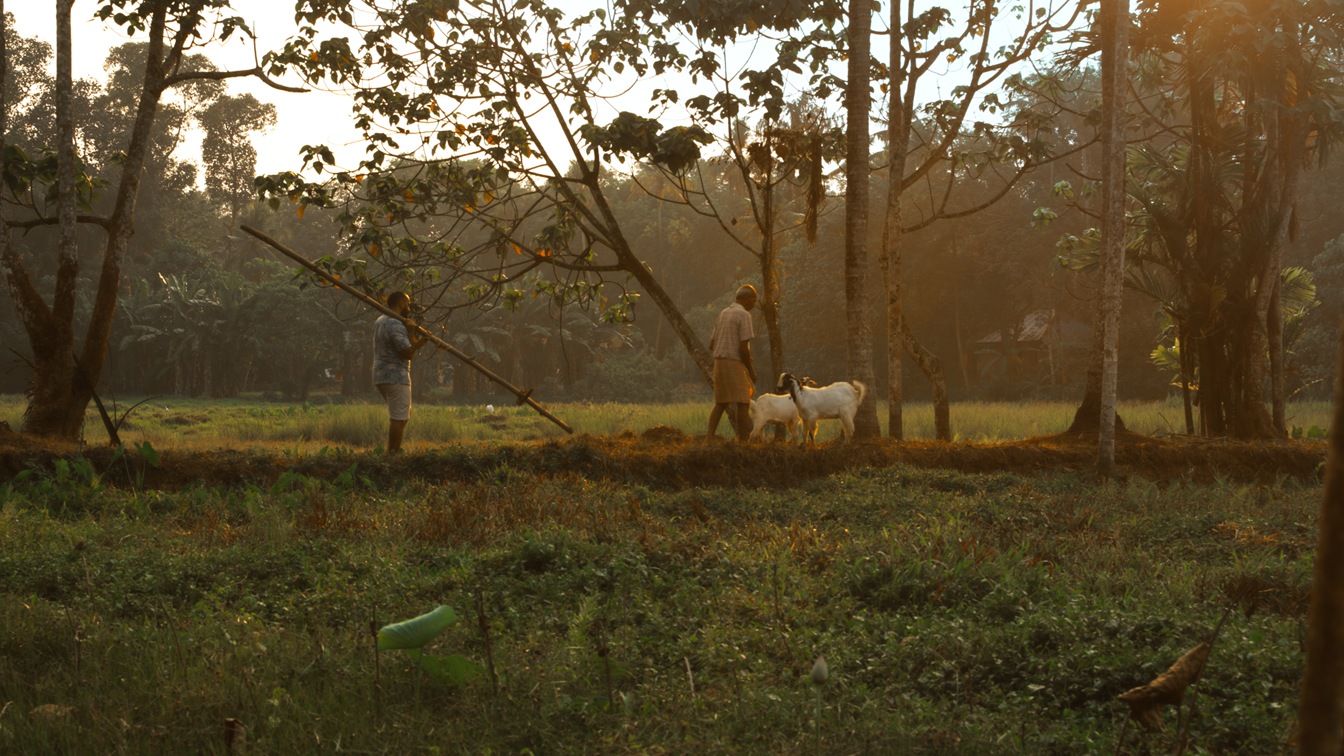
The film’s visual language speaks volumes through its setting: a somewhat dilapidated house embraced by verdant greenery, symbolizing both the father’s chosen isolation and his deep connection to nature.
This environment becomes a character in itself, with the camera lingering over it, and echoing cinematographic sensibilities of Malayalam films like “Thondimuthalum Driksakshiyum,” and ‘Joji’ particularly in its use of the pond setting.
What distinguishes “Alkaline” is its delicate handling of the father-son relationship. The father’s gentle use of “mone” (son in Malayalam) carries years of (probably) unspoken affection, while his obsessive focus on alkaline foods and natural living reveals a deeper wisdom.
The film’s title, referencing the alkaline diet he advocates, becomes a metaphor for finding balance in life.
The absence of women in the narrative also points to a prevalent social reality in Kerala— elderly parents living in solitude while their children pursue lives abroad.
The father’s choice to remain rooted in nature could be construed as both his salvation and his isolation. His statement that “life just went away” carries a poignant resignation that would resonate with many.
Despite occasional moments where the dialogue might feel forced, the film’s authenticity shines through, especially in scenes showing primal connections to nature—sleeping on floor mats, eating from plantain leaves, and the father’s simple instruction to “bend and eat.”


These moments transcend their apparent simplicity to become powerful statements about sustainable living and our connection to the earth. Probably, this must be the advice our children need.
The film’s most affecting layer is what remains unsaid — the son’s inability to explicitly express his own fears to his father, and the quiet melancholy that surrounds the elderly father’s existence.
In its deliberately measured pace, “Alkaline” achieves something remarkable: it transforms a story about health consciousness into a touching exploration of love, loneliness, and the yearning for connection across generations.
Through its 18 minutes, the film balances its messages about health and sustainability with deeper emotional resonance, ultimately leaving viewers with a haunting portrait of elderly solitude that lingers long after its health-conscious messaging fades.




നിങ്ങളുടെ അഭിപ്രായങ്ങൾ രേഖപ്പെടുത്തുക