
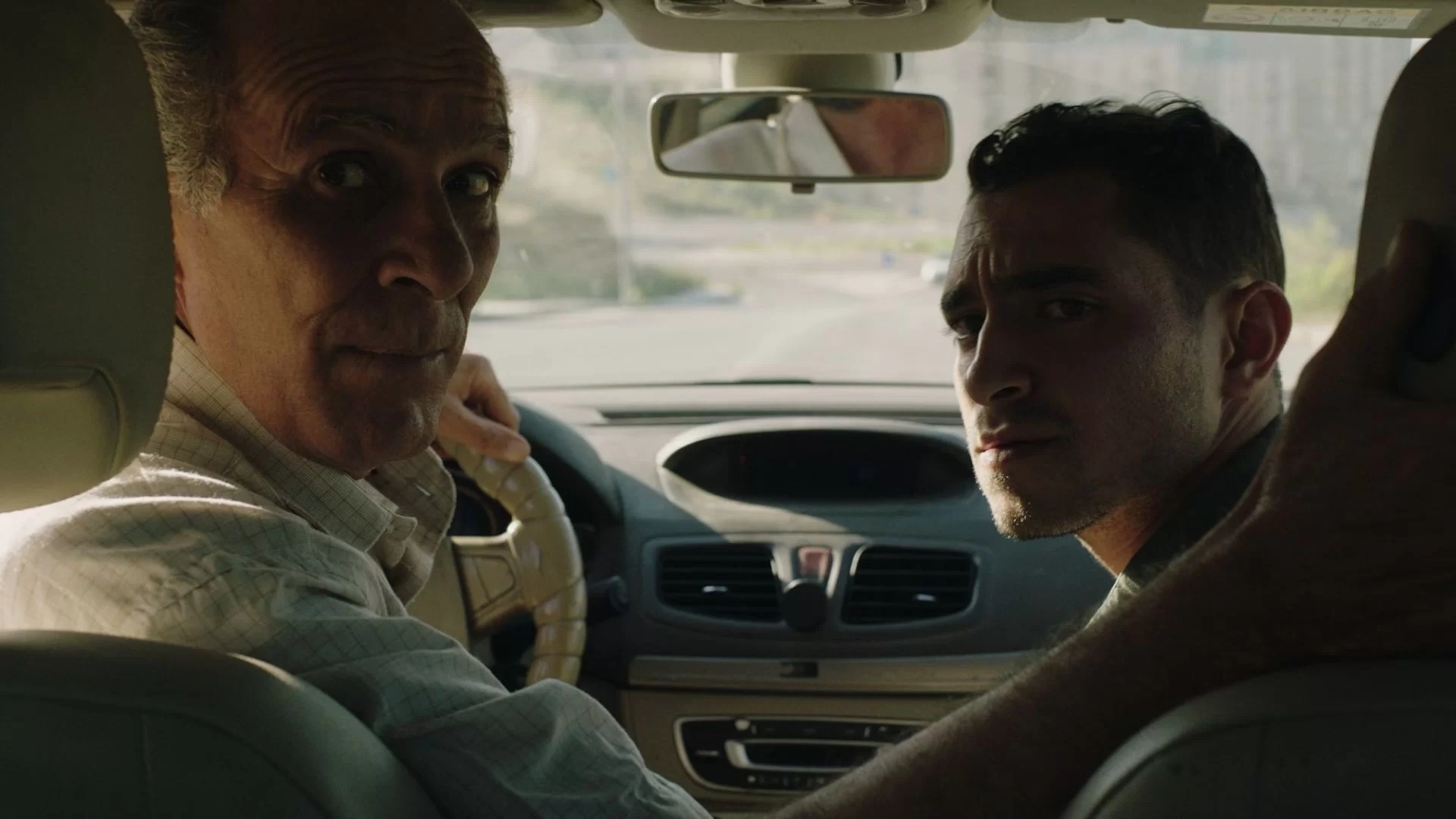
Mohammed Almughanni’s award-winning short film “An Orange from Jaffa” transforms a seemingly simple checkpoint crossing into an inspiring meditation on Palestinian identity, human connection, and the painful realities of life under occupation.
Through the lens of a young Palestinian’s attempt to cross an Israeli checkpoint using a Polish residency card, the film unravels layers of historical irony, shared humanity, and the deep wounds of displacement.
The narrative follows Mohammed (portrayed with vulnerability by Samer Bisharat) as he encounters Farouk, a compassionate taxi driver played with remarkable nuance by Kamel El Basha.
Their journey transcends a mere physical passage; it evolves into an exploration of Palestinian fragmentation and resilience. The film portrays how checkpoints serve not merely as physical barriers but as instruments of division, splitting Palestinian identity into distinct fragments – from Gaza to the West Bank to the diaspora.
What sets Almughanni’s work apart is its unique perspective, informed by his position as a Palestinian filmmaker based in Poland.
This dual consciousness adds depth to the film’s examination of displacement and belonging. The irony is subtly highlighted when Farouk mistakes Poland for Holland, leading to a conversation about Jews who emigrated from Poland to Israel – a pointed commentary on the paradox of freedom of movement and the right to return.
The film’s emotional core lies in its exploration of universal connections, particularly through the motif of motherhood.
Mohammed’s constant phone calls with his worried mother parallel the Israeli officer’s own family communications, suggesting a shared human experience that must ideally bridge the political divide. These maternal bonds serve as a quiet reminder of our common humanity amid the dehumanizing checkpoint system.
El Basha’s portrayal of the taxi driver is particularly noteworthy, bringing warmth and authenticity to a character who chooses compassion despite potential consequences.
The relationship between driver and passenger evolves naturally, punctuated by moments of genuine connection and humor that provide brief respite from the mounting tension.
When their situation deteriorates – leading to a physical altercation and revealing the driver’s heart condition and family responsibilities – the human cost of the occupation becomes painfully clear.

The film reaches its emotional crescendo through the symbolic sharing of a Jaffa orange, a moment that encapsulates Palestinian longing and loss without resorting to heavy-handed symbolism.
This simple act becomes a powerful statement about cultural memory and the persistence of Palestinian identity despite displacement and restriction.
Almughanni’s direction, supported by Maciej Edelman’s cinematography and Natalia Jacheć’s precise editing, creates a taut narrative that never loses sight of its humanity.
The film succeeds in making the everyday ordeal of checkpoint crossing – something many take for granted – into a lens through which to view larger questions of identity, dignity, and resistance.
“An Orange from Jaffa” reminds us that the Palestinian experience cannot be reduced to headlines or political discourse.
Through its intimate portrayal of human connection amid systemic oppression, the film challenges viewers to move beyond armchair analysis and confront the daily reality of lives shaped by occupation.
Image courtesy: https://www.almughanni.com/portfolio/an-orange-from-jaffa/



നിങ്ങളുടെ അഭിപ്രായങ്ങൾ രേഖപ്പെടുത്തുക