
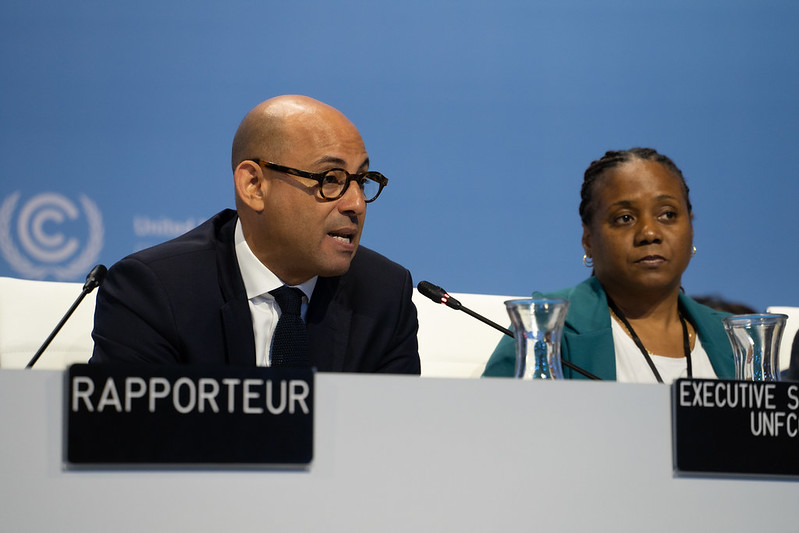
UN Climate Change Executive Secretary Simon Stiell opened the 62nd Subsidiary Bodies (SB62) session in Bonn by reaffirming the Paris Agreement’s legacy: “The Paris Agreement showed the world that multilateralism can deliver.”
Addressing the audience, he said: “The world we live in today is different because of Paris. Today’s event gives us an opportunity to explore how it is a different place because of it. And crucially what that means about the decisions we make in this process today, to create the world we want and we need.”

Photo: UN Climate Change – Lara Murillo
His statement, delivered against a backdrop of record-breaking global temperatures and geopolitical tensions, framed the conference as a test of international cooperation. Running from June 16-26, SB62 serves as the primary technical negotiation platform before COP30 in Belém, Brazil.
Urging all to go further, faster and fairer, he said the world has reached an inflection point. “A moment where we step it up on multiple fronts. This must be the decade of delivery. Of acceleration. Of implementation on the ground. And I’m not talking about grand gestures or virtue signaling – I’m talking about blueprints for real-world economic opportunity; for security; for resilience; for growth. Backed up by real delivery.
“And we know what will make the difference: Finance – the great enabler of climate action in real economies – especially for those who need it most. People often ask: what will the next decade of climate action look like and how must our process evolve?
“The short answer is: over the next decade we must move our intergovernmental process much closer to the real economy and to climate action and the 8 billion people around the world, to accelerate and to implement. We must go further, faster, fairer.”

(Photo: UN Climate Change – Peter Kronish)
The conference spotlighted agricultural producers, with the UNFCCC Farmers’ Constituency—representing 70+ global organizations—issuing a forceful call for inclusive policymaking. Elizabeth Nsimadala of the Eastern Africa Farmers Federation emphasized frontline realities: “From droughts and floods to shifting seasons […] farmers are on the frontlines of climate change impacts”.
This push aligns with Brazil’s COP30 strategy positioning sustainable agriculture as a cornerstone, including a Global Climate-Smart Agriculture Conference in Brasília preceding the November summit.
Adaptation Finance and Policy Gaps Dominate Negotiations
Key negotiation tracks revealed critical challenges:
- Global Goal on Adaptation (GGA): Delegates worked to finalize ≤100 indicators measuring resilience progress across health, food systems, and infrastructure.
- Climate Finance: The Climate Policy Initiative reported that small-scale agrifood systems received just 0.8% ($5.53B) of total climate finance in 2019/20—a 44% drop from 2017/189.
- Agenda Delays: Disputes over the agenda delayed the conference opening, reflecting broader tensions around equity and fossil fuel lobbying influence.
Research presented at SB62 highlighted scalable solutions:
- Methane Reduction: WRI identified DSM-Firmenich’s feed additive Bovaer (approved in 55+ countries) as reducing dairy cattle emissions by 30%9.
- Climate-Resilient Crops: ICARDA Morocco unveiled drought-tolerant durum wheat and barley varieties amid Morocco’s 69% cereal production decline9.
- Hybrid Rice: IRRI studies showed 19% lower methane emissions from hybrid rice due to shorter flooding periods9.
Parallel to negotiations, the European Commission proposed weakening environmental conditions for farming subsidies, including:
- Doubling permanent grassland removal allowances to 10%
- Exempting small producers from conservation-linked subsidy rules
- Increasing lump-sum payments to €2,500 annually
Critics argue these changes contradict the EU’s 55% emissions reduction target by 20309.
Road to COP30
Brazil’s COP30 Presidency-Designate André Aranha Corrêa do Lago outlined a “unified Action Agenda” prioritizing implementation. With SB62 concluding June 26, outcomes will shape Belém’s focus on adaptation finance, farmer-centered solutions, and methane mitigation.
As Teresa Anderson of ActionAid noted: “Every month this year, a new temperature record has been brutally smashed, yet political appetite for climate action feels lower than ever”. The conference’s ability to bridge this gap remains pivotal for COP30’s success.





നിങ്ങളുടെ അഭിപ്രായങ്ങൾ രേഖപ്പെടുത്തുക