
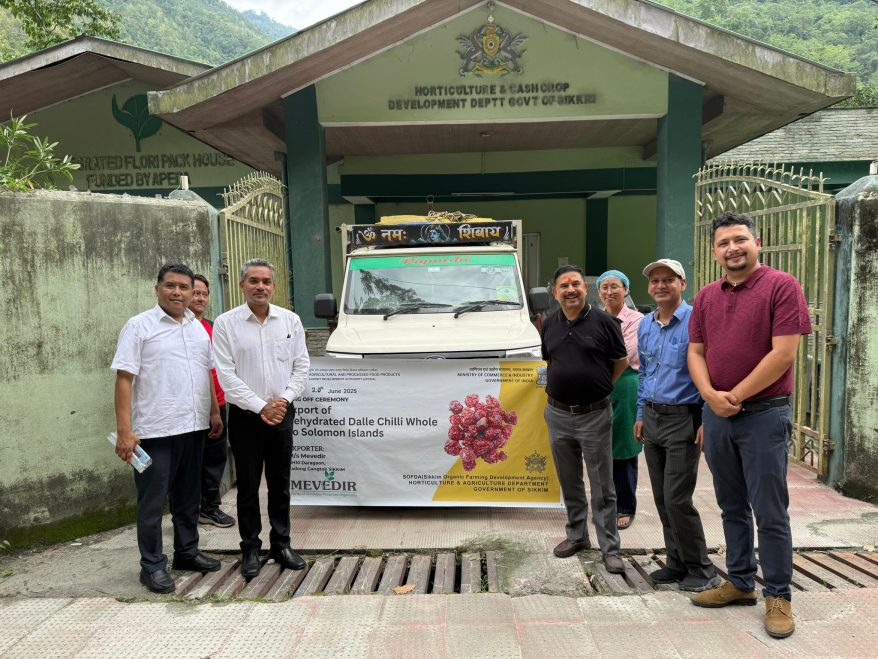
In a small processing facility in Melli, South Sikkim, workers carefully monitor the dehydration of thousands of bright red chillies.
The final product, about 200 kilograms of dried Dalle Khorsani, will soon travel 6,000 miles to the Solomon Islands, marking a milestone for India’s smallest state and its ambitious organic agriculture strategy.
The first export of GI-tagged Dalle chilli in March 2025 to the Solomon Islands in fact marks the culmination of decades of agricultural transformation in Sikkim, a state that declared itself 100% organic in the recent past, and has since been striving to translate that environmental achievement into economic prosperity for its farmers.

“We are extension workers,” explains B.L. Dahal, Principal Director of Horticulture for the Government of Sikkim, reflecting on his department’s role in the state’s agricultural evolution. “New findings come from the lab, we take them to the land, to farmers’ fields, and implement the same.”
Dahal, who has spent 32 years in the department and about 18 months in his current role, oversees a complex ecosystem of 66,000 to 70,000 farmers cultivating across 76,000 acres—a significant expansion from the 50,000 acres under cultivation just years earlier.
But perhaps the most significant transformation under his leadership, which he readily acknowledges is due to the support of myriad government schemes, has been the influx of young farmers into agriculture. This is phenomenon that runs counter to global trends of youth abandoning rural livelihoods.
Dahal says there is continuous support from the government, with the entire team at the Department of Horticulture – from the Secretary to all levels of employees – “always in action to make the program a grand success.”
“Now more young people are coming to agriculture through such government efforts,” Dahal adds. “They give price incentives, cash prizes for young farmers coming to agriculture.”

This youth engagement in farming is potentially a model for the world, where young people are increasingly turning away from agricultural careers. Through continuous extension work, training programs, and financial incentives, Dahal’s department, along with other government entities, has managed to reverse this trend.
His department now focuses on what he calls “area expansion” of key crops: Sikkim mandarin, kiwi, avocado, guava, banana, and crucially, the high-value spices that have become the state’s signature exports.
“Large cardamom is our biggest income-earning crop; it’s life-saving for Sikkimese people,” Dahal says. “Along with ginger, turmeric, and now cherry pepper, we are exporting to Solomon Islands and planning to expand to Dubai and the US.”
The journey of Dalle Khorsani, also known as Fire Ball Chilly, to international markets illustrates both the potential and the challenges of Sikkim’s agricultural transformation.

With Scoville Heat Units ranging from 100,000 to 350,000, the chilli is among the world’s hottest. Rich in vitamins A, C, and E, it has found favour not just for its intense heat but for its nutritional properties.
The export transaction, facilitated by the Agricultural and Processed Food Products Export Development Authority (APEDA), involved a complex supply chain that began with farmers in South Sikkim’s Tinkitam and Tarku regions.
Mevedir, a leading agri-export enterprise, sourced approximately 15,000 kg of fresh chillies from local farmers and Farmer Producer Organizations (FPOs), paying premium prices of ₹250-300 per kg compared to the usual ₹180-200 per kg.
“The premium price is what makes the difference,” explains one farmer from Tinkitam. “We finally see the value of our organic certification in our bank accounts.”
The success stories have attracted more young farmers to the sector. “I see my friends earning good money from spice exports,” says a young farmer from Tarku region who recently joined his family’s agricultural operations. “This is not the old farming anymore; it has become truly an agro-business.”
The processing revealed the economics of spice export: of the 15,000 kg procured, 9,000 kg was dehydrated while 6,000 kg was preserved for further processing. The dehydration process yielded just 200 kg of dried chillies from 1,600 kg of fresh produce. This is 12.5% recovery rate that underscores the value addition potential of processing.
This first export built on a foundation laid in 2020 when Dalle Khorsani received its Geographical Indication (GI) tag, a recognition that strengthened its identity and marketability. The North Eastern Regional Agricultural Marketing Corporation (NERAMAC) facilitated the GI registration, part of a broader government strategy to unlock premium markets for northeastern produce.
The success came despite significant challenges that Dahal readily acknowledges. “There are many challenges. Our hilly region is very difficult for mechanization,” he says. Climate change has added another layer of complexity, with uneven rainfall distribution creating “five to six months dry spell” in winter after summer rains.
Infrastructure remains a persistent constraint. “We have very difficult areas—far away from cities. and transportation of perishable items is a problem,” Dahal notes. The airport in Pakyong has been largely non-operational, and the promised railway connection is expected to materialize soon.
Yet the department has adapted, creating farmer clusters and providing continuous training and support. “We made groups, clusters, and trained the farmers, visited continuously. They started doing agriculture,” Dahal explains.
The strategy has not only attracted younger farmers but has begun to transform entire villages. Such clusters include: Damlakha,Mamjay, Pachak Ashangthang, Work Sosing Niya Mangzing, Lingi ,Chouridara, Total Bermipk, Nessa Arithang Chongrang Gerethang, Bhaluthang Martam and Malbassay. “The government proposes to give big cash to clusters; whole villages becoming clusters, cultivating fruit, vegetables and spices,” he says.
The Solomon Islands export followed an unexpected route to market. The buyer was first introduced to Sikkim’s Dalle chilli during its international debut in Singapore in 2023, then sought direct sourcing from Mevedir. The chilli has found particular favour in the Solomon Islands’ Western Province, where it is used to prepare tuna, a local staple.
“The locals use this chilli for preparing tuna, and they prefer its pungent and aromatic flavour,” explains an official. The company exported 200 kg in March, followed by 300 kg in June, with plans to reach 700 kg by early 2026.
The export success reflects broader policy initiatives. Prime Minister Narendra Modi has emphasised that “the North East holds the key to India’s vision for a healthier and more sustainable future,” noting that GI tags represent “transformative opportunities for farmers and artisans.” The Government of India’s Mission Organic Value Chain Development for North Eastern Region (MOVCD-NER) has played a crucial role in enhancing production quality.
The numbers tell the story of transformation: the exported chillies generated premium dollar revenues while supporting rural livelihoods. Each kilogram exported helps “uplift rural communities and adds to the country’s export basket,” according to Lepcha.

However, the export achievement highlights persistent structural challenges. Despite the premium prices for exports, local farmers often struggle with what Dahal calls the “organic paradox”, the difficulty of competing with cheaper, non-organic produce from neighbouring states that “finds a way in” to local markets.
The youth engagement strategy has become central to addressing these challenges. By demonstrating that agriculture can be profitable and technology-driven, Dahal’s extension work has begun to change perceptions about farming as a career choice.
This transformation of agriculture into an attractive livelihood option for young people represents a significant shift in a region where rural youth migration has long been a concern.
The department has also invested in farmer education, sending field officers to universities, research stations, and international locations including the Netherlands and Thailand to acquire new technologies. This knowledge transfer represents a systematic approach to upgrading agricultural practices across the state.
The Dalle chilli export has broader implications for Sikkim’s agricultural strategy. The state’s 100% organic certification, once seen as a constraint on productivity, is increasingly viewed as a competitive advantage in premium markets. The successful export demonstrates that small-scale, organic production can access high-value international markets when supported by appropriate infrastructure and market linkages.
The success has not gone unnoticed at the highest levels. During a visit to Bagdogra, Prime Minister Modi specifically acknowledged the significance of Sikkim’s Dalle chilli, further underlining its growing national and international recognition.
As Sikkim prepares for expanded exports to Dubai and the United States, the Dalle chilli story offers a template for other northeastern states seeking to leverage their unique agricultural products. The key ingredients such as organic certification, GI tagging, farmer organization, and strategic market development provide a replicable model for agricultural transformation.
“This is historic for the brand of Organic Sikkim,” Dahal reflects, emphasizing the broader significance of the export achievement. For a state that has bet its agricultural future on organic farming, the journey of the Dalle chilli from the hills of South Sikkim to the markets of the Solomon Islands represents both vindication and a roadmap for the future.
The success suggests that despite infrastructure constraints and market challenges, Sikkim’s agricultural transformation, particularly its ability to attract young farmers back to the land, is gaining momentum.
As climate change and food security concerns grow globally, the state’s organic model and youth engagement strategy, exemplified by the fiery Dalle chilli, may yet prove to be not just environmentally sustainable but economically transformative and socially revolutionary.
Watch the story here



നിങ്ങളുടെ അഭിപ്രായങ്ങൾ രേഖപ്പെടുത്തുക