
By Dr. Mukul Kr. Deka
When I joined the All India Coordinated Research Project on Honey Bees and Pollinators at Assam Agricultural University in 2004, the state’s beekeeping landscape was vastly different from what we see today.
Twenty years later, as I reflect on our journey, particularly since I began leading this project in 2020, I’m struck by how far we’ve come in transforming honey production in Assam and the broader Northeast region.
Perhaps our most significant breakthrough came with the successful introduction and acclimatization of the European honey bee, Apis mellifera, to Assam’s conditions. This represented a fundamental shift in the state’s honey production capacity. Through years of careful breeding, artificial insemination techniques, and selective colony development, we created a viable A. mellifera population adapted to local conditions.
The impact has been remarkable. While Assam traditionally produced modest quantities of honey, we now contribute 1,000-1,400 metric tons annually, which represents 37% of the Northeast’s total production.
Baksa district alone produces 46 metric tons yearly, with ambitious plans to reach 100 metric tons by 2026. This success story was even highlighted by Mongabay-India in 2024, recognizing how our work has fundamentally transformed the region’s apicultural landscape.

Bridging Science and Practice
Our research extends far beyond honey production. We’ve conducted comprehensive pollination studies across 17 different crops, from field crops such as rapeseed and mustard to fruits like mango and litchi. Through rigorous experimentation, we’ve standardized pollination requirements, recommending 4-5 Apis cerana colonies per hectare for optimal crop yields.
One of our most exciting innovations involves stingless bees (Tetragonula iridipennis). We’ve developed novel bamboo hive designs specifically for meliponiculture and demonstrated their effectiveness in protected cultivation systems. Our research revealed that stingless bee honey contains exceptional levels of phenolic compounds and flavonoids – 597.92 mg GAE/kg and 99.85 mg CEQ/kg respectively – with superior antimicrobial properties against human pathogens.
Innovation in Pollinator Management
We’ve also pioneered work with carpenter bees (Xylocopa fenestrata), becoming the first in India to standardize their rearing techniques. Our “portable device for xylocopiculture” has earned a patent, and field trials show that proper vine support systems can increase sponge gourd yields by over 14%. This work represents a crucial step toward diversifying our pollinator resources beyond traditional honey bees.
Our vigilance has led to critical pest discoveries. We were the first to identify the invasive small hive beetle (Aethina tumida) in Assam, documenting its presence in Goalpara and Jorhat districts. This finding prompted immediate collaboration with ICAR headquarters and ongoing molecular identification work. Similarly, we’ve documented the small wax beetle (Platybolium spp.) across upper Assam, contributing valuable data on emerging threats to bee colonies.

Community Impact and Extension
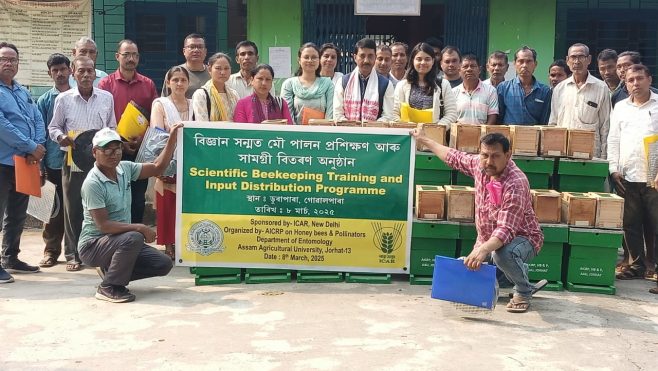
Since 2019, we’ve trained over 700 beekeepers across Assam and parts of Arunachal Pradesh, distributing essential equipment including hives, colonies, protective gear, and extractors. Our baseline data indicates approximately 200,000 beekeepers now operate 300,000 viable colonies across Assam an increase from the 127 registered beekeepers with 4,335 colonies recorded in 2019.
This reflects our commitment to making scientific beekeeping accessible to small-scale farmers. We’ve maintained three operational apiaries and conduct both in-house and field training programs targeting farmers, unemployed youth, women, and government officials. Our work spans almost every district in Assam, from Tinsukia in the east to Goalpara in the west.
Our project has also contributed significantly to human resource development in apiculture. We’ve successfully guided 17 Ph.D. students and 24 post-graduate students through research programs focused on honey bees, honey chemistry, and pollinator biology. This academic output ensures that our knowledge base continues expanding while training the next generation of apiculture scientists.

Looking Forward
Our current initiatives reflect both scientific advancement and practical application. We’re working toward Geographic Indication (GI) tags for unique regional honey varieties, developing therapeutic applications for different honey types, and creating attractant-based management systems for predatory wasps. Our bee venom extraction research opens new possibilities for medical applications, while our ongoing pesticide residue studies ensure honey safety in an era of intensive agriculture.
Climate change presents new challenges, and our controlled environment studies examining elevated temperature and CO₂ effects on bee foraging behavior provide crucial data for adaptation strategies. These findings will help beekeepers adjust their practices as environmental conditions shift.

A Vision Realized
The Assam Beekeepers Association, formed with our active guidance, now provides a platform for knowledge sharing and collective advocacy. Honey has been designated as the primary product under the One District One Product (ODOP) program for Baksa district, validating our region’s potential.
What began as a scientific endeavor has evolved into a comprehensive ecosystem supporting thousands of livelihoods. Our work demonstrates that rigorous research, combined with dedicated extension efforts, can transform entire agricultural sectors.
The success of A. melliferaacclimatization, the development of novel pollinator management techniques, and the creation of a robust beekeeper network represent more than scientific achievements—they embody a vision of sustainable rural development.
As we continue this work, I’m reminded that our greatest success lies not in the tons of honey produced or the papers published, but in the transformed lives of beekeepers across Assam who now have access to scientific knowledge, quality equipment, and sustainable livelihoods. This is the true measure of our impact—and the foundation for future growth.

Dr. Mukul Kr. Deka is Principal Scientist at the AICRP on Honey Bees and Pollinators, Department of Entomology, Assam Agricultural University, Jorhat. He has led the project since 2020 and has been associated with it since 2004.





നിങ്ങളുടെ അഭിപ്രായങ്ങൾ രേഖപ്പെടുത്തുക