
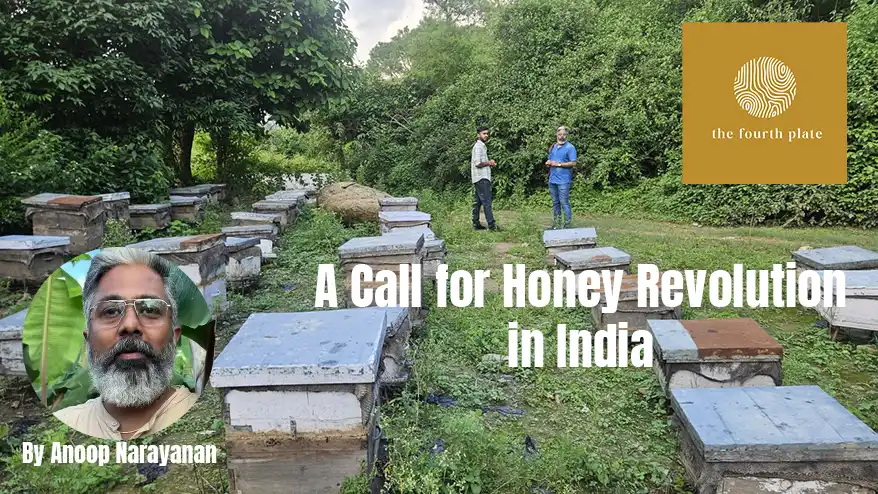
How a decade of chasing profit led to discovering purpose in India’s broken honey ecosystem
In the serene village of Ichhi, Himachal Pradesh. I watched Vishal carefully tend to his bee colonies during the chilling cold winter. His weathered hands moved with the gentleness of a father checking on sleeping children, smoke rising from his improvised smoker made from old newspaper and dried leaves. Despite his devotion, working through rains, heatwaves, and floods, with his hives always taking priority, Vishal earns less than a construction worker in Delhi.
This scene repeated itself across India as I spent ten years trying to answer one seemingly simple question: Why is Indian honey so undervalued? What I discovered wasn’t just an industry problem but a complex web of disconnected systems, broken trust, and missed opportunities that reveals fundamental flaws in how we approach agricultural value chains.

India is the world’s sixth-largest honey exporter, sending sweet gold to the United States, Saudi Arabia, and the UAE. Yet this impressive statistic masks a troubling reality: we’ve built an entire industry on the systematic undervaluation of our own resources, and the cost extends far beyond economics into the realms of biodiversity, rural livelihoods, and food security.
The Great Disconnect: When Agriculture Forgets Its Partners
The relationship between beekeeping and farming represents one of agriculture’s most essential partnerships, yet in India, these two worlds operate in complete isolation. Beekeepers don’t understand crop cycles, while farmers remain unaware of pollination’s transformative power. This disconnect isn’t merely inefficient—it’s economically devastating.
Consider the numbers: pollination services can improve crop yields by 20-40%, enhance seed quality, and increase fruit size. In developed agricultural systems, beekeepers earn substantial income from pollination contracts. However, in India, this service remains largely unrecognized and uncompensated, forcing beekeepers to depend entirely on honey sales while farmers miss opportunities to optimize their harvests.
This separation reflects a broader challenge in agricultural systems worldwide: the tendency to view farming practices in isolation rather than as interconnected ecosystems. When we fragment these relationships, we lose both economic value and ecological resilience.

The Price of Perception: Why Geography Doesn’t Determine Value
The pricing disparity in the global honey market reveals uncomfortable truths about how agricultural products gain value. Indian honey sells internationally at approximately $1.50 per kilogram, while New Zealand’s Manuka honey commands $17.50 or more. This tenfold difference isn’t explained by quality alone, India’s vast, florally diverse landscape should theoretically produce honey of extraordinary variety and character.
Instead, the gap reflects the power of storytelling and brand positioning in agricultural markets. New Zealand has successfully created a narrative around Manuka honey’s unique properties, its pristine island origins, and its artisanal production methods. India, despite possessing greater floral diversity and ancient beekeeping traditions, has failed to communicate its honey’s distinctive qualities to global markets.
This phenomenon extends beyond honey to many agricultural products from developing nations. The challenge isn’t just producing quality goods, it’s developing the capacity to articulate value, build trust with consumers, and capture premium pricing through effective positioning.
The Broken Chain: Trust, Transparency, and Systemic Fraud
Walking through honey processing facilities across different states, I encountered a disturbing pattern of intentional adulteration. Rice syrup, corn syrup, and synthetic flavors are routinely mixed with genuine honey, then relabeled as “natural.” One processor openly diluted honey and blamed the beekeeper when quality issues arose.
This systematic fraud creates a cascade of distrust throughout the value chain. Beekeepers don’t receive fair prices from processors, who hoard margins while gatekeeping export access. Traders inflate prices, discouraging new market entrants. International buyers focus solely on cost, often knowingly purchasing adulterated products.
The result is a race to the bottom that punishes honest participants while rewarding deceptive practices. This dynamic isn’t unique to honey—it reflects broader challenges in agricultural value chains where lack of traceability and quality assurance creates perverse incentives.

The Export Illusion: When Volume Doesn’t Equal Value
India’s status as a major honey exporter masks a fundamental problem: we export raw materials and import value-added products. The “barrels in, bottles out” approach means India performs 20% of the value creation but captures only 10% of the final product’s worth.
This pattern reflects a colonial-era economic structure that many developing nations haven’t successfully evolved beyond. Raw material exports appear profitable in the short term but create economic dependency and limit domestic industry development. Meanwhile, importing nations add value through processing, packaging, branding, and marketing—activities that generate higher margins and more stable returns.
Breaking this cycle requires building domestic processing capabilities, developing direct market relationships, and creating branded products that capture more value within the originating country.
The Missing Ingredient: Domestic Demand and Cultural Habits
Perhaps the most revealing insight from my decade of research is this: India doesn’t consume honey. Domestic consumption represents less than 1% of production, and honey remains largely absent from Indian dietary habits. We view it as medicine or seasonal syrup rather than food.
This absence of domestic demand fundamentally weakens the entire industry. Without local consumers who understand quality differences and will pay premium prices, producers have no incentive to improve standards. The lack of domestic appreciation also means India can’t develop the quality benchmarks and consumer education necessary to command respect in international markets.
Creating domestic demand requires more than marketing, it demands product innovation. Portion packs, honey sticks, crystallized slabs, and honey-based beverages could make this ancient food convenient for modern lifestyles. Convenience creates habits, habits generate demand, and demand drives prices.
Technology’s Unfulfilled Promise
Advanced technologies like floral mapping, digital traceability, and quality testing systems exist but remain underutilized in Indian honey production. This represents a critical missed opportunity, as these tools could address many industry challenges simultaneously.
Digital traceability could restore trust by providing transparent supply chain documentation. Floral mapping could help position Indian honey varieties based on their unique botanical origins. Quality testing systems could differentiate premium products from commodity honey.
However, technology adoption requires more than just introducing new tools, it demands educational programs, infrastructure development, and business model innovation. The failure to effectively implement these solutions reflects broader challenges in agricultural technology transfer.
The Path Forward: Collaborative Diagnosis and Customized Strategy
After ten years of witnessing system failures, I’ve developed an approach that prioritizes collaborative diagnosis over cookie-cutter solutions. Each stakeholder—whether beekeeper, farmer, processor, or exporter, faces unique challenges that require customized strategies.
This approach involves bringing together specialists from beekeeping (nectar flow and hive health), farming (pollination optimization and forage mapping), honey production (pricing and value addition), business strategy (positioning and sales channels), and export operations (compliance and buyer relationships).
The goal isn’t just to solve individual problems but to rebuild trust and communication across the entire value chain. When beekeepers understand market requirements, farmers appreciate pollination services, and processors prioritize quality over volume, the entire system can evolve towards sustainability.
From Dignity to Revolution: Redefining Success
My original goal was simple: increase honey prices. But ten years of deep engagement with this industry has revealed that price is merely a symptom. The real challenge is restoring dignity to rural livelihoods, building sustainable agricultural systems, and creating value chains that reward quality and environmental stewardship.
True revolution in Indian honey, or any agricultural sector, requires fundamental shifts in how we measure success. Instead of focusing solely on export volumes or production increases, we need metrics that capture ecosystem health, rural prosperity, and domestic food system resilience.
This means supporting beekeepers to become decision-makers rather than price-takers, helping farmers understand their role in biodiversity conservation, and building processing systems that add value rather than extract it.

The Broader Implications: Lessons for Agricultural Systems
The honey industry’s challenges reflect broader patterns in global agricultural systems. The disconnect between producers and consumers, the race to the bottom in commodity markets, the failure to value ecosystem services, and the persistent colonial structures in international trade all appear across different crops and regions.
However, honey also represents unique opportunities. Bees provide measurable ecosystem services through pollination. Honey can command premium prices when properly positioned. Beekeeping requires relatively low capital investment compared to other agricultural enterprises. And consumer awareness of bee conservation is growing globally.
These factors suggest that transforming the honey sector could serve as a model for broader agricultural reform. Success here could demonstrate how to build value chains that reward quality, support rural livelihoods, and maintain ecological balance.
A Call to Action: Building the Movement
The transformation of India’s honey industry cannot be accomplished by individuals working in isolation. It requires researchers who can document and quantify the industry’s potential, policymakers who can create supportive regulatory frameworks, entrepreneurs who can develop innovative products and marketing approaches, and consumers who demand transparency and quality.
For researchers and academics, this represents an opportunity to study how agricultural value chains can evolve from extractive to regenerative models. For practitioners, it offers a chance to develop and test new approaches to rural development and agricultural marketing.
The ultimate goal extends beyond honey: we’re working to prove that developing nations can move beyond raw material exports to capture value through quality, branding, and direct marketing relationships. Success would demonstrate that agricultural industries can support both rural prosperity and environmental sustainability.
The sweet revolution starts with one question: Are we willing to value what we grow? The answer will determine not just the future of Indian honey but the broader possibility of agricultural systems that serve people, communities, and ecosystems rather than extracting from them.
If you’re working in food systems, agricultural development, or rural economics, I invite you to engage with this challenge. The solutions we develop for honey could transform how we approach agricultural value chains globally. Together, we can build systems that honor both the ancient wisdom of beekeeping and the urgent need for sustainable agricultural futures.

Anoop is a decade-long honey consultant who has worked across the Indian honey value chain, from grassroots beekeepers and FPOs to exporters and international buyers. He specializes in honey exports, traceability systems, and building high-integrity supply chains that connect farmers to global markets.
Connect with Anoop on Linkedin: linkedin.com/in/anonaray
Email: n.anoop@globaljoby.com
Call: +91 8826 454 588





നിങ്ങളുടെ അഭിപ്രായങ്ങൾ രേഖപ്പെടുത്തുക