
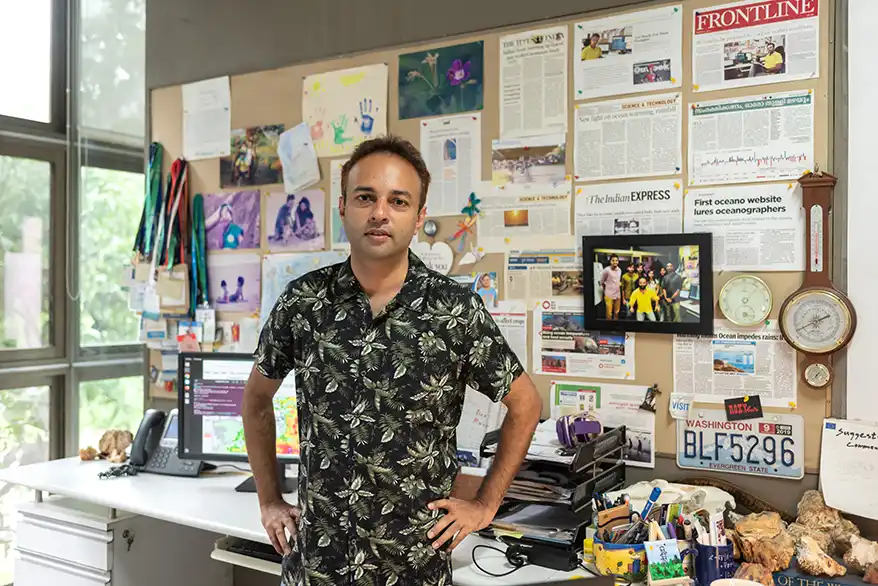
When Roxy Mathew Koll speaks about the monsoon, there’s both the precision of a scientist and the nostalgia of someone who grew up with it. Born and raised in Pala in Kerala, he remembers childhood evenings when the sky darkened suddenly, thunder rolled in from the sea, and walls of rain transformed the landscape in minutes. Those seasonal rhythms, both nurturing and unpredictable, shaped his early curiosity. “I often wondered where these clouds came from, why the rains sometimes failed, and why the sea changed its moods,” he recalls.
That boyhood wonder would take him far—from Kerala’s coast to the corridors of the Indian Institute of Tropical Meteorology (IITM), Pune, where he is now a senior scientist and one of India’s foremost climate voices. Over the past two decades, Koll’s pioneering work has revealed how the Indian Ocean is heating faster than any other tropical ocean, reshaping monsoon patterns and fuelling the extremes India is grappling with today—erratic rains, sudden cloudbursts, devastating floods, rising seas, and marine heatwaves.

Koll is not just a scientist working with models and satellite data; he’s also a communicator who connects climate findings with the lived realities of farmers, fisherfolk, and ordinary households. He is the lead author of the Intergovernmental Panel on Climate Change (IPCC), the winner of the American Geophysical Union’s Devendra Lal Memorial Medal, and a recipient of India’s National Award for Popularisation of Science.
Despite the global honours, Koll remains rooted in his Kerala upbringing, often drawing on conversations with coastal communities and farmers to guide his work. He also invests in mentoring young scientists, building a new generation of researchers who will carry forward the fight to understand and adapt to a warming world.
At a time when India faces record-breaking heatwaves, back-to-back cloudbursts, and relentless floods, Koll’s voice combines authority with urgency. In this exclusive interview, he unpacks the science behind these extremes, reflects on fragile mountains and drowning cities, and speaks candidly about the road ahead. Excerpts:
Q: Are cloudbursts becoming more frequent and intense in India due to climate change, or is it more about improved detection and reporting?
Roxy Mathew Koll: We are definitely seeing more short, violent bursts of rain. Warmer oceans and a warmer atmosphere mean the monsoon carries more moisture. When that moist air is forced up over steep terrain like the Himalayas or Western Ghats, it can unleash sudden torrents.
By definition, a cloudburst is 100 mm or more of rain in an hour over a very small region—just 20–30 square kilometres, maybe two or three villages. To confirm it, we need high-frequency rain-gauge data right in the footprint. Many events reported as “cloudbursts” in the media are not validated because we don’t have dense monitoring in the right places.
Still, our research shows these cloudburst-scale extremes are on the rise—even if underreported. We urgently need better monitoring, forecasting, and adaptation.
Q: India seems to be receiving rainfall in short, intense bursts instead of steady patterns. What’s driving this shift, and what does it mean for agriculture and water security?
Koll: The monsoon is shifting toward short spells of extreme rains followed by long dry gaps. Ocean warming is central—warm air holds more moisture for longer. That means entire seasonal rainfall sometimes pours down in just a few days.
We’ve shown in our studies that extreme rains across India have increased three-fold in the last seven decades. Moderate, well-spread rains recharge groundwater and reservoirs. But extreme downpours mostly run off into rivers and the sea, doing little for water security. This pattern is devastating for farmers, who now struggle with both drought and flood in the same season.

Q: What role do warming oceans—especially the Arabian Sea—play in intensifying monsoon depressions and extreme rainfall over the Western Ghats and Himalayas?
Koll: The Arabian Sea is heating rapidly. Warm seas supply more heat and moisture to weather systems, so cyclones and heavy rain events intensify more than before. That’s why we’ve seen stronger cyclones making landfall in recent years.
Another effect is sea-level rise. More than half of the rise in the Arabian Sea is from thermal expansion—water expanding as it warms—rather than melting glaciers. For India’s coastal cities, this combination of storm surges, extreme rains, and rising seas is a ticking time bomb.
Q: Kerala, Himachal Pradesh, and Uttarakhand are repeatedly hit by landslides during monsoon spells. How much of this is climate-driven extreme rainfall, and how much is linked to human interventions like deforestation and unplanned construction?
Koll: It’s both. Climate change loads the dice by bringing heavier rains. But human activities—quarrying, deforestation, hydropower projects, roads—make the slopes more fragile. Much of these regions already sit on steep slopes over 20 degrees, naturally prone to landslides. When development weakens them, even moderate rains can trigger disaster. Climate change turns that risk into certainty.
Q: Can science accurately predict cloudburst-like events in the Himalayas and Western Ghats, or are we still far from reliable early warning systems?
Koll: Cloudbursts are extremely difficult to predict—they’re small-scale and short-lived. But advances in radar, dense monitoring networks, and “nowcasting” can give 2–3 hours’ warning. That’s enough to save lives, if local authorities and communities act quickly.
We must also build resilience: no construction in hazard-prone zones, climate-proofed infrastructure, and better enforcement of land-use policies.
Q: Do we need region-specific adaptation policies for fragile ecosystems like the Himalayas and the Western Ghats, rather than one-size-fits-all plans?
Koll: Absolutely. Adaptation has to be local. Every district, every panchayat needs a risk assessment and action plan. The risks are hyperlocal; the responses must be too. This requires political will, interdepartmental cooperation, and scientific input—but it’s achievable.
Q: India has faced unprecedented heatwaves in recent years. Are heatwaves now a bigger silent killer—especially for the poor and elderly—than floods or cyclones?
Koll: Yes. Heat is a silent killer, particularly for outdoor workers, the elderly, and the urban poor. Deaths are underreported because hospitals don’t systematically track heat-related illness.
But the solutions are straightforward: shade, water, rest breaks, cooling centers, and robust Heat Action Plans. Every district should have one, tied to local temperature thresholds and last-mile communication.

Q: Are we entering a cycle of compounding extremes, where one disaster amplifies another?
Koll: Compound extremes are a growing threat. When storm surges, heavy rain, and high tide coincide—as during Cyclone Amphan—coastal flooding lasts longer and penetrates farther inland.
Similarly, heatwaves often overlap with droughts, air pollution, or crop failures. In 2022, north India saw all these at once—heat, drought, and pollution—resulting in crop losses, water scarcity, and higher mortality. These overlaps multiply risks and strain our response systems.
We don’t yet see a direct causal link between north India’s heat and south India’s floods, but sometimes the same region suffers back-to-back extremes in one season. That’s worrying.
Q: Cities like Delhi, Mumbai, Chennai, and Bengaluru face a dual crisis—extreme heat and extreme rainfall. How prepared are our mega cities?
Koll: Not prepared at all. Concretisation, loss of wetlands, and clogged drainage magnify risks. Cities need blue–green networks—wetlands, rivers, floodplains, parks, tree cover—integrated with modern drainage and early warning systems.
The bigger issue is that most climate action plans are backward-looking. They use past data. We must plan for future projections—more heatwaves, heavier rains, stronger cyclones, higher seas. Otherwise, our infrastructure becomes tomorrow’s ruins.
Q: Despite repeated disasters, India’s adaptation efforts remain fragmented. What are policymakers ignoring?
Koll: The pace of global warming is accelerating. We need urgent local action—disaster-proof every district, every city. We have the data and tools; what’s missing is political urgency. I also believe India needs a dedicated center for studying severe weather events—heatwaves, cyclones, extreme rains. At present, we don’t have one.
Q: Looking ahead, what keeps you awake at night—heatwaves, extreme rainfall, sea-level rise?
Koll: I don’t need to look a decade ahead—climate change already keeps me awake. In Pune, nights once mild are now hot and humid. My children return from school exhausted in peak heat. Yet India has no clear policy for school safety during heatwaves—no adjusted hours, no mandated shade or cooling.
In Kerala, where my parents live, a neighbor’s wall collapsed into our house during a recent storm. That’s the reality: the heat and rain are already here. Preparedness is the only sleep aid we have left.

K.A. Shaji is an independent journalist from South India, known for his in-depth reporting on rural distress, caste, tribal affairs, environment, and development. Over the past two decades, he has worked with leading publications including The Hindu, The Times of India, The Indian Express, The Hindustan Times, The Telegraph, Dainik Bhaskar, Tehelka, HuffPost India, Open, Outlook, and South First, while also contributing to international outlets such as The Guardian, BBC, Financial Times, and Mongabay. Based in Kerala, he continues to chronicle stories from the ground that connect local struggles with national and global debates on justice, ecology, and governance.
Email: shajiwayanad@gmail.com Tel: 00 91 8921018884
Follow on: LinkedIn




നിങ്ങളുടെ അഭിപ്രായങ്ങൾ രേഖപ്പെടുത്തുക