
In August 2018, Kerala witnessed a flood that changed everything.
The water rose faster than anyone could comprehend; rivers spilled into homes, hillsides collapsed, and early warnings failed to reach the people who needed them most.
Despite the presence of vast scientific data — rainfall maps, discharge models, forecasts — the deluge revealed a painful gap: the absence of local, lived data. Data that spoke the language of people and places.
The official systems had warned of rain, but not of what that rain meant for a particular neighbourhood, field, or family. That disconnect between science and community became the question that drove us to act.
What if the people who live closest to the floods could also help define how we forecast and respond to them? What if local knowledge and scientific modelling could meet halfway?
That question became the foundation of our work at EQUINOCT Community Sourced Modelling Solutions — a platform dedicated to reimagining climate intelligence through community agency.

CoS-IT-FloWS: When Communities turn Sentinels
Out of the lessons that the Kerala floods of 2018 taught us was born our flagship project CoS-IT-FloWS —Community-Sourced Impact-based Flood Forecast and Warning System, which received the support of UNICEF Office of Innovation through their maiden climate action venture fund cohort.
The idea was deceptively simple: instead of waiting for warnings from distant agencies, communities themselves could feed hyper-local climate and resource data into a shared digital platform, building a richer, real-time understanding of local risks.
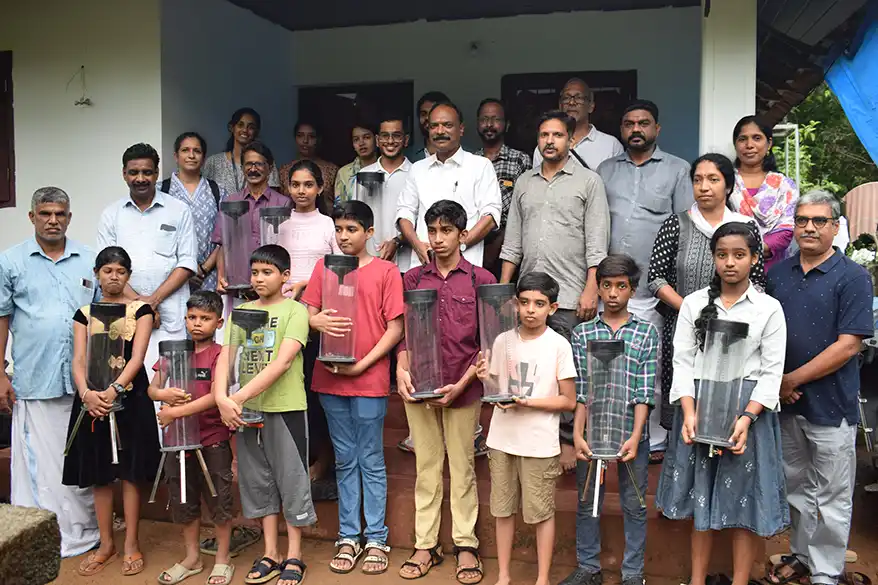
We began small. A network of fishers, students, and local residents across Ernakulam district started collecting rainfall data using low-cost gauges and logging them through a Whatsapp group that was then hosted on an opensource web platform Climate Watch- https://weather.equinoct.com/
We also integrated other data in the public domain into this visualisation so that soon we began recognizing patterns long before formal alerts arrived. For instance, a downstream disaster was avoided due to information relied through our community network when in the early hours of October 12, 2021, there was an unannounced release from the Parambikulam dam that sent a sudden surge down the Chalakudy River, with no official warning to downstream communities.

We also began to monitor climate aggravated coastal flooding through community networks which later led to a district wide campaign to understand and map the changed nature and intensity of tidal flooding with the participation of impacted communities and to advocate for community co-created solutions.
Using a tidal calendar developed with support from the Fulbright Alumni Engagement Innovation Fund, communities documented the timing and extent of flooding. Over time, this effort evolved into Tidal Watch, part of Climate Watch, mapping tidal flooding to provide actionable intelligence to residents and local governments.
The Gather Student Scientist Network, now active across the two highly flood prone river basins of Chalakudy and Periyar in central Kerala, is a vibrant example of what co-learning looks like.
These young volunteers collect rainfall data, and discuss trends with the residents of their village and with other students in their schools. They are not simply users of a system — they are co-creators of it. As one student once told us, “When we measure rain, we also measure change.”

But EQUINOCT’s work doesn’t stop at collecting data with communities. The real innovation is co-creating decision support systems with the people themselves and local self-governments.
Data is collected, yes, but always with a purpose: to visualize impacts, guide anticipatory actions, and inform planning at the hyper-local level. The goal is not data for the sake of data — it is data for impact.
From Data to Dialogue
Through CoS-IT-FloWS and associated dashboards such as Insight Gather and SeaSight (https://seasight.vercel.app/map) each crowd-sourced input transforms into impact-based forecasts that local governments can use to make timely decisions.
Support from the UNICEF Office of Innovation Venture Fund helped us strengthen this digital backbone — improving data pipelines, integrating predictive models, and creating visualization tools accessible to local institutions.
Our platforms are open-source, transparent, and designed to be co-created with communities. By making climate intelligence a common good, EQUINOCT ensures that resilience is not locked behind proprietary tools, but grows organically wherever it is needed.
Alongside building systems for communities to collect hyper-local climate and water data, we started conversations with local governments and disaster management teams on how people’s knowledge and participation could shape disaster preparedness and resilience planning.
We ran hands-on workshops for panchayats, women’s self-help groups, and students—introducing them to simple climate monitoring tools, helping them understand local climate impacts, and exploring how resilience can grow from the ground up.
In designing our tools and products, we learned deeply from the situated knowledge of communities—their observations, seasonal rhythms, and lived experiences shaped how our systems evolved.
We also worked closely with the District Panchayat, the District Administration and the Disaster Management Authority, bringing together affected communities and officials to talk openly about problems, co-create science-based solutions, and find practical ways to act on them.

Recognition and Reach
This year, EQUINOCT was shortlisted as a finalist for the Local Adaptation Champions Awards by the Global Center on Adaptation in the Citizen Science category. For us, this recognition is not about technology alone — it is about community ownership of knowledge.
It celebrates the hundreds of citizen scientists, students, and fishers who have turned their observations into early action. It affirms that the future of early warning systems lies not just in satellites and sensors, but in people who can interpret and act upon what they see around them.
Over these years, we have learned that floods are not just disasters — they are signals. The rivers and the sea speak to us in their own ways; our job is to listen, measure, and respond together.
Adaptation cannot be delivered to a community — it must be built with them. When people create and interpret their own data, that data becomes agency. And agency, over time, becomes resilience.
What began in the aftermath of disaster has become a movement — one that treats information as a common good, and resilience as a shared craft. Through EQUINOCT’s CoS-IT-FloWS, we are proving that the most reliable early warning system is not a satellite in orbit, but a network of people grounded in place, knowledge, and care.
Our work affirms that the future of climate adaptation depends on the people closest to the risks, not just the experts far away.

Dr. Sreeja KG is Research Director at ‘EQUINOCT –Community Sourced Modelling Solutions, a tech startup working in climate solutions. She is also co-founder, Dharaa Livelihood Initiative, a social enterprise supporting indigenous women’s enterprises and Resilient Destinations Foundation(RDF), a not-for-profit company working towards co- creation of Climate Resilient and ClimateResponsible Destinations with multi-sectoral partnerships. An Agricultural Economist by training, she holds aPhD in Agro-ecology & Agricultural Systems fromthe National Institute of Advanced Studies (NIAS),Bangalore and a post-doctoral fellowship in climate change impact assessment from the Indian Institute of Technology Bombay, India.
Follow her on LinkedIn
Email: kg.sreeja@equinoct.com
http://www.equinoct.com




നിങ്ങളുടെ അഭിപ്രായങ്ങൾ രേഖപ്പെടുത്തുക