
“Help me, please. I am scared… I am alone.”
The voice is small, but it cuts through the noise. It belongs to Hind Rajab, a six-year-old girl trapped in a car on a street in Gaza. Her words, captured in a real emergency call, are the heart of the film The Voice of Hind Rajab. Director Kaouther Ben Hania doesn’t try to recreate the moment or dress it up for the screen. Instead, she lets Hind’s real voice tell the story, raw and in the present tense. The film offers no easy comfort, no sense that a tidy narrative can make sense of a tragedy that should never have happened.

Now, the film has been nominated for an Academy Award for Best International Feature Film at the 98th Oscars – a recognition that brings Hind’s story to one of the world’s biggest stages. The nomination, announced in January 2026, comes after the film won the prestigious Silver Lion Grand Jury Prize at the 82nd Venice International Film Festival in 2025. It’s a moment that validates the power of bearing witness, of refusing to look away.
Instead of showing the ruined streets where Hind was trapped and her family was killed, the film takes us somewhere else: the tense operations room of the Palestine Red Crescent Society. The camera stays there, creating a feeling of being boxed in, just as the dispatchers were.
“I could have made the film from Hind’s perspective, or her mother’s – even the tank,” director Kaouther Ben Hania explained after a screening. “But I chose a single space because it was the most honest frame for what happened. The story was already there; reality went beyond fiction.”
This choice forces us to confront the impossible decisions faced by the dispatchers and medics. Every minute, they had to weigh the risk of sending their colleagues into a deadly situation. The film is about the life-and-death struggle hidden within procedures and permissions, and what it means to attempt a rescue when the rescuers themselves become targets.
A representative from the Red Crescent brought this reality into sharp focus, recalling, “We lost 54 paramedics in Gaza.” That number is more than a statistic; it’s a measure of the fear that the film makes you feel.
Within the confines of the operations room, the camera catches the small, quiet signs of people trying to hold on: a cigarette lit and put out, only to be lit again. These details show how the staff teetered on the edge of breaking down while trying to remain professional. You can see it in the dispatchers who keep their composure even as their voices begin to crack. You can hear it in their short, tense conversations as they wait for a “clearance” to go in, a permission that might never arrive. The language of their work is stripped down to the basics: yes or no, go or hold, live or die.
These life-or-death choices create the film’s tension. We see it in the conflict between Mahdi, a senior dispatcher who has seen too much to risk another life, and Omar, a younger, more impulsive medic who is desperate to act. Their disagreement isn’t just for dramatic effect; it’s the clash between the wisdom of experience and the urgent energy of youth.
In this high-pressure world, it’s the women who hold everything together. An early glimpse of lipstick might seem out of place, but it takes on new meaning when the staff recalls a ten-year-old girl delivering her own baby sister, guided by a dispatcher over the phone, the newborn’s cry a tiny signal of life amidst the chaos.
Ben Hania refused to hire an actor to play Hind. “It would have been in poor taste,” she said. “Her voice is alive and that is the heart of the film.” The director first heard the recording on the news. “I felt she was talking to me, irrational as that is. That voice stayed with me and became the spine of everything.” This decision makes the film more than just a movie about an issue; it becomes a direct, personal plea. “There is nothing stronger than cinema for empathy,” Ben Hania stated. “It’s not about explanation; it’s about impact so that audiences do not forget.”
The film avoids easy sentimentality, even as it shows a situation that is heartbreaking. The real audio of Hind’s calls plays over scenes of actors who are not trying to dramatize the event, but simply to bear witness to it. “I’ve been acting for 16 years,” said actor Motaz Malhees, “but this was the greatest honour.” The honour, he suggests, was in portraying people who couldn’t afford the luxury of a performance while they were on the front lines, counting down the minutes and begging for a safe path for an ambulance.
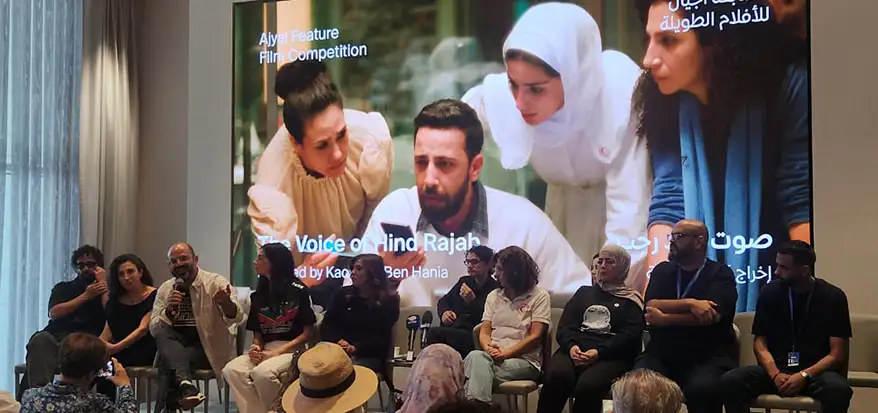
The film’s premiere in Doha was made more powerful by the presence of the real Red Crescent team. Their stories were both professional and deeply personal. “When a child asks for help, you are moved,” said Omar Alqam, one of the dispatchers, “especially when she pleads, for God’s sake.” Another staff member shared a quiet, haunting confession: after hearing Hind’s call, he couldn’t hold his own newborn child without hearing that little girl’s voice in his head.
The only escape from the tense operations room is the image of the sea. In brief, sun-drenched flashes of memory, we are reminded that Hind just wanted to go to the beach. These moments aren’t meant to soften the tragedy. They are a reminder of what has been stolen: the simple freedom to run towards the water, to feel the sun, to breathe.
The Voice of Hind Rajab is a film that remembers, but it also questions. It shows that sometimes the “right” decision is the one that prevents an even greater disaster, even if it looks like doing nothing at all. “People have an idea of purity,” Ben Hania said, but the film’s truth lies in its refusal to pretend that heroism is ever simple or clean.
The film’s production was guided by the same principle. Producer Nadim Cheikhrouha explained that their goal was to “amplify Hind’s voice,” not to create a polished project. Well-known figures joined as executive producers, not to fund the film, but to help it reach a wider audience and protect it in a world where telling such stories can have consequences.
The Oscar nomination amplifies that voice even further. It means that on March 15, 2026, when the Academy Awards ceremony takes place, millions around the world will hear Hind’s name. For a film that began with a director who felt a child was speaking directly to her through a news broadcast, the nomination is more than an honour—it’s a megaphone.

The press conference in Doha was filled with heavy silence and the film’s moral centre gains weight from the presence of those who lived it. On stage in Doha, the cast flanked the Red Crescent team: President Dr Younis Al‑Khatib, Director General Khaled Abu Ghoush and staff including Nisreen Jiries Eid, Rana H.I. Faqih, Omar Ahmed Alqam, Mahdi Jamal, Mohammed Ayyad and Nibal Farsakh.
A Red Crescent representative, his voice thick with emotion, described it as their duty: to carry the voices of children like Hind, to honour the memory of those they couldn’t save, and to document a pattern of violence where ambulances are stopped and rescuers are targeted.
A quiet scene of prayer captures this tension perfectly. The film doesn’t use it as a moment of spiritual release or a plot device. It’s simply a human response to a room filled with impossible choices. It’s one of the many ways people endure: they pray, they smoke, they check the map one more time. The film trusts that the meaning will come through without the director forcing it.
The film’s argument builds slowly, through a series of quiet, insistent questions. How many times was clearance to rescue denied? How many times did a request to “stand by” become a death sentence? How many children?
The film doesn’t give us a number, because numbers can’t capture the reality. “The human brain does not accept numbers,” Ben Hania observed. “It accepts stories.” In this film, that idea is a profound truth. Statistics are for reports; stories are for the soul. Hind’s voice is both a judgment and an invitation – to look past the numbers and see the value of a single, irreplaceable life.
The film leaves us with the questions it cannot answer: Why this conflict, on this scale? And what will it take to fix what history has broken? It shows how power works on the ground -through a radio, a permit, a line of sight – and how the bureaucracy of war can turn the wounded into prisoners.
At one point, a dispatcher asks Hind for her school’s name. She replies, “Happy Childhood Nursery”- a heartbreakingly ironic detail in a moment of terror, with her family dead around her. At the briefing, the real-life team avoided making grand speeches. “We are ready; we are trained,” one said. “But this case was different.” The difference is not just that Hind’s calls were recorded, but that we are made to listen to them directly, without the filter of a reenactment.
Watching the actors listen is a deeply unsettling experience. We are witnessing the event twice: once through the sound of a child’s voice, and again through the faces of the adults who are powerless to help. The Voice of Hind Rajab holds us in that discomfort for nearly 90 minutes and refuses to let us go. It doesn’t offer a neat conclusion or a clear conscience. It offers something much more rare and demanding: a story that cannot be erased, a portrait of moral courage under fire, and a film that knows it cannot change the past.
It cannot take Hind to the sea. But it makes sure we hear her desire to go there, a desire shared by millions of others who live in a world of stifled silence.




നിങ്ങളുടെ അഭിപ്രായങ്ങൾ രേഖപ്പെടുത്തുക