
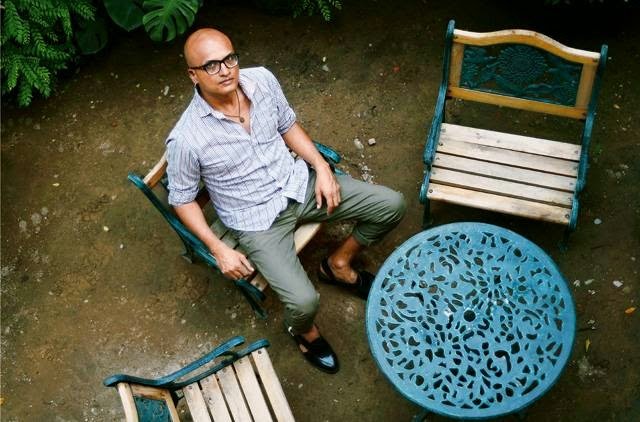

Jeet Thayil, Man Booker-shortlisted author of Narcopolis, drew on his own experiences as a ‘functional junkie’ for his award-winning novel
Coming out of drug abuse is, at best, providential. But to come clean and then relive the experience in almost every conversation can be unnerving, even for an author whose award-winning novel takes inspiration and characters from an opium den that was once part and parcel of his life.
Jeet Thayil, author of Narcopolis -— which was short-listed for the Man Booker Prize 2012, vied for the Man Asian Literary Prize 2013, and won the DSC Prize for South Asian Literature 2013 — is, however, nonchalant.
“It is fine,” says Jeet, after a hectic day of book signing at the recently concluded Emirates Airline Festival of Literature in Dubai. “I think of it very often and I can’t forget it easily.” He counts himself incredibly lucky to have come out of the “functional junkie” days alive. “I am always grateful and surprised that I made it, when so many people I knew did not.”
Jeet tried drugs for the sheer experience. “I had a happy childhood. I had parents who looked after me. I was given whatever I wanted and I had no reason to go the way I did. I just wanted the experience and the problem is that once you experience it, it is very difficult to come out. I got sucked in like everybody.”
He tried over 20 times to quit drugs until he joined a methadone programme in the US and came clean. To those who want to kick the habit, and is trying hard, all he says is: “Don’t lose heart.”
But Jeet says he is disappointed that Narcopolis is referred to as a book on drugs. “The book hangs its hat on drugs, but it is not an ?accurate thing to say it is a book on drugs. It is about Indian society.”
Writing Narcopolis, traversing the wide canvas of ‘Old Bombay’ from the 1970s to the early 90s, was not a cathartic experience for Jeet. For almost a year and half after he wrote it, he admits to being practically paralysed.
Apart from the money fetched by the book’s recognition, Narcopolis today gives Jeet the feeling of having put those years as a drug addict to use. “Some value has come out of those years, which otherwise was pretty much wasted time.”

He doesn’t regret those years. “Regret is for amateurs,” he says emphatically. “If anything, those years, living the life I did, taught me that I am the last person to make a moral judgment on anybody. This ?is what comes across in Narcopolis too. There is never a moral, holier than thou attitude about any character, which is maybe something the readers respond to…”
Jeet says the response to Narcopolis, going by the long queues that formed for his book signing in Dubai, doesn’t surprise him. “It is a book about a small space, a small street, but it is also universal in many ways. It is a human story that can travel to readers in any culture.”
Narcopolis opened to hostile reviews in India, but was feted by the international literary comm-unity, before the mass adulation began in his home country. “It is not a coincidence. In many ways, Indians are the last colonialists.” Jeet adds that the younger generation has a newfound self confidence. “They are not looking for cultural touchstones from the West.”
The son of illustrious journalist TJS George, Jeet grew up in India and Hong Kong, where he was once jailed for shoplifting a Grateful Dead record. He was sent to Mumbai, where he discovered comfort in the opium dens and its life, that he recreated in Narcopolis. His own jail experience finds expression in the novel, which also serves as a first-of-its-kind reference in fiction to the opium trade orchestrated by the British, when they ruled India, to “turn a generation of the Chinese into drug addicts and to make profits out of it.” Jeet says money from the opium trade “made Bombay one of the greatest cities of the world. That was the foundation of the modern metropolis that we call Mumbai.”
For his next work, he draws on a real-life character that makes a fleeting appearance in Narcopolis: “Newton Xavier, the poet. There are things in him that need to be told. He is a very compelling character. He lies, cheats and is utterly selfish. But he is also a great talent.”
Much like Narcopolis, his new work also will have “no moral strings attached. I don’t belie-ve in the conventional idea of morality. It is much deeper and profound. There are compulsions, motivations that drive people to do the things they do.”
Having published four works of poems, Jeet says that Charles Baudelaire, the French poet, could also have influenced him into a life of drugs. Although he begins his poem, To Baudelaire, with the lines “I am over you,” Jeet says he is still under his spell. “If you are over someone and you don’t miss someone, you don’t have to proclaim it loudly.”
But for now, he is content with reading, writing and ?music. “Music for me is the anti-cancer agent.”
After the experience of participating in the Jaipur Literature Festival under police protection last year, following threats to his life after he read portions of a controversial banned book, Jeet says he is enjoying Dubai.
“The (Emirates Literature) ?festival’s scale is enormous and it is much better organised than many festivals I have been to. It is like clockwork… and it is very nice not to have to worry about people in the audience throwing shoes.”
ENDS
Published here: http://bit.ly/14nCVLl