
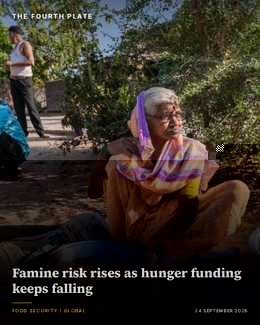
Somalia, South Sudan and Sudan face a renewed risk of famine, according to a mid-year update to the Global Report on Food Crises published by the European Commission’s Joint Research Centre on 21 September. The update, drawing on data collected through August, also names the Gaza Strip, Yemen, Haiti and Afghanistan among the areas with the highest concentrations of acutely food-insecure people.
The global hunger crisis 2026 picture the update paints is one of deepening need meeting shrinking resources. Net official development assistance is projected to fall 6.9% to $152 billion (roughly £126 billion) in 2026, the lowest level since 2014. Humanitarian aid specifically is projected to fall 40.3% between 2024 and 2026, with food aid alone expected to decline 44.5% over the same period, according to the update’s figures.
Kenya, Somalia and South Sudan are separately classified as facing “very severe” nutrition crises, a category reserved for the most extreme malnutrition burdens tracked by the report. The update also flags El Niño, now forecast to persist through February 2027, as a compounding risk across already vulnerable regions, layering weather disruption on top of conflict and funding shortfalls.

A June warning that has not eased
The September figures build on a June assessment by the Food and Agriculture Organization and World Food Programme, which found 266 million people across 13 hotspot countries facing high levels of acute food insecurity. Sudan alone accounted for 19.5 million people in acute food insecurity, 41% of its population, while South Sudan’s figure of 7.8 million represented 55% of its population in Crisis-level food insecurity or worse.
That June report also documented a 59% decline in humanitarian funding for food assistance between 2022 and 2025, a trend the September update suggests has continued rather than reversed in the months since. FAO deputy director-general Beth Bechdol said at the time that “early investment in emergency agricultural assistance and resilience is one of the most cost-effective ways to protect livelihoods,” a point that funding cuts have made harder to act on with each passing quarter.
WFP’s then-acting executive director, Carl Skau, put the human cost more bluntly: “Conflict, shocks, and disasters are forcing families to make impossible decisions about who gets to eat.” The hotspot list spanned Sudan, South Sudan, Yemen, Palestine, northeast Nigeria, Somalia, Afghanistan, the Democratic Republic of the Congo, Haiti, Myanmar, Mali, Lebanon and Madagascar, a geography that touches nearly every region of the Global South.
The persistence of El Niño through early 2027 adds a further complication, since the weather pattern typically brings uneven rainfall, drought in some regions and flooding in others, directly on top of countries already stretched by conflict and funding shortfalls. A separate World Meteorological Organization forecast this month described the current El Niño as exceptional in strength, raising the odds that its agricultural disruption compounds rather than merely coincides with the funding gap already under way.
A record wheat harvest in India, and the country’s decision this year to lift a four-year export ban, offers one small counterweight to the supply side of that picture, even if it does nothing to address the funding shortfalls driving hunger in conflict zones. Additional grain reaching global markets can ease prices for import-dependent buyers, but it cannot substitute for the humanitarian logistics, cash transfers and agricultural support that famine-risk countries need directly.
Whether donor governments reverse the broader funding decline before conditions harden further in Somalia, South Sudan or Sudan remains the open question the report leaves for policymakers, rather than one its data alone can answer. The report’s authors have historically used mid-year updates to press exactly that point, framing each successive funding shortfall as a choice rather than an inevitability.