
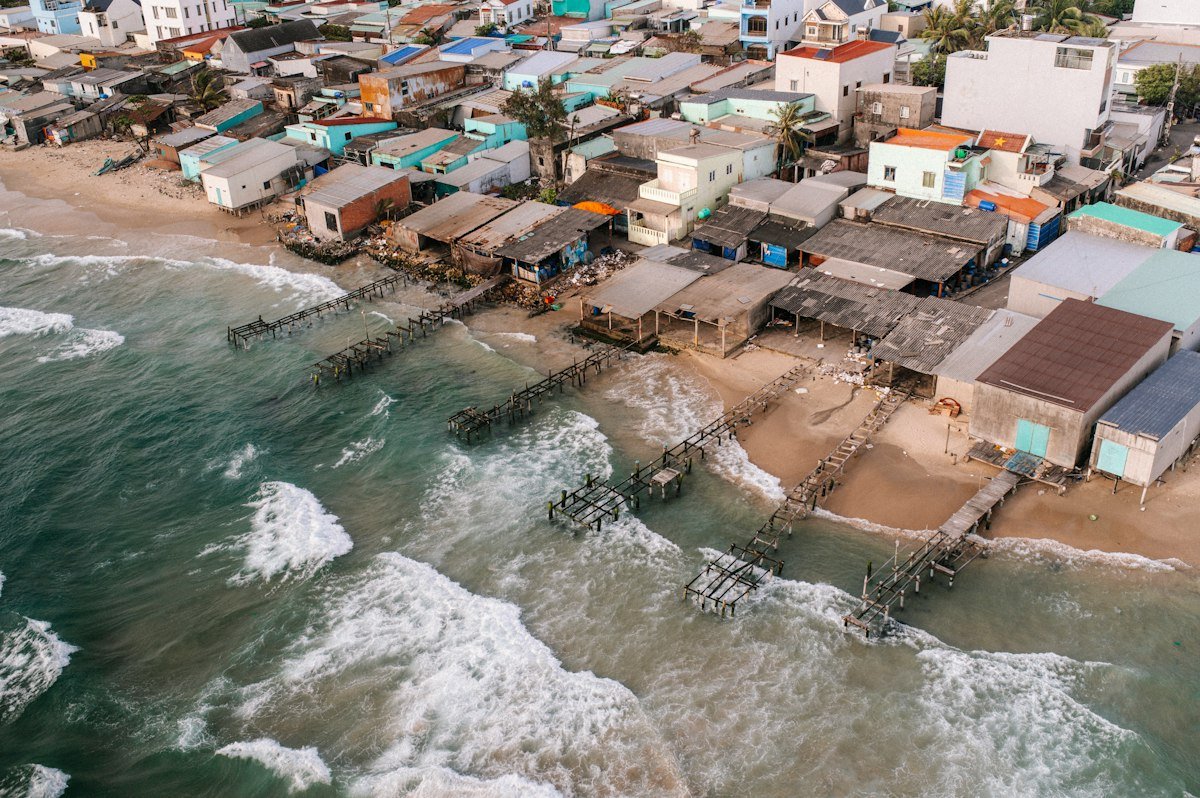
Ayetoro coastal erosion has claimed more than half of this Nigerian town over the past six decades. Residents and local officials in Ondo State say the Atlantic is still advancing on what remains, at a pace that has sped up sharply in recent years.
Ayetoro means “town of peace” in Yoruba. It was once a thriving fishing and boat-building settlement home to tens of thousands of people. Local accounts and state government records describe the shoreline retreating by well over a kilometre since the 1970s. Successive rows of homes, schools, a palace and church buildings have been abandoned and rebuilt further inland, only to be lost again.
A wetland disappearing along with the town
The erosion is not only a human crisis. Ondo State’s coastline sits within a chain of estuarine wetlands and mangrove systems. Environmental researchers identify these as an important stopover for migratory shorebirds moving along the West African flyway each year. Mangrove loss tied to the advancing shoreline has reduced roosting and feeding habitat. That compounds pressure on bird populations already affected by habitat loss elsewhere along the flyway.

Local and state authorities have proposed shoreline protection measures over the years. These include rock revetments and a long-discussed seawall project. Residents say implementation has been slow and patchy relative to the scale of the erosion. Nigeria’s federal government has previously pledged support for coastal defences in Ondo State, though community leaders say funding commitments have not matched the pace of loss on the ground.
A pattern repeated along West Africa’s coast
Ayetoro is one of several West African coastal communities facing comparable erosion. Climate researchers link the trend to a combination of rising sea levels, reduced sediment deposition and intensifying storm patterns along the Gulf of Guinea. Similar erosion has been documented in parts of coastal Togo, Benin and Ghana, where communities have also been forced to relocate as the shoreline retreats.
For Ayetoro’s remaining residents, many of whom depend on fishing for their livelihoods, mangrove loss compounds the direct threat of displacement. Degraded wetlands also support fewer of the fish stocks the community depends on. Conservationists say the town’s experience illustrates a broader pattern across the region. The human and ecological costs of coastal erosion are increasingly intertwined rather than separate crises.
Calls for a coordinated shoreline management plan covering the wider Ondo coastline have grown louder. Environmental groups argue that piecemeal sea defence work in Ayetoro alone will do little without addressing sediment and mangrove loss along the broader coast. For now, the sea keeps advancing faster than the rebuilding can keep pace.
Researchers studying Ayetoro coastal erosion say satellite imagery over the past decade shows the shoreline retreat accelerating rather than levelling off, a trend they attribute partly to reduced sediment supply from upstream rivers that once replenished the coast naturally. Dams and sand mining further inland have been identified as contributing factors, cutting off the flow of material that historically helped stabilise the shore.
Community leaders in Ayetoro say the psychological toll of repeated displacement is also mounting, with some families now rebuilding for a third or fourth time within living memory. Local schools have been relocated more than once as the water advanced, disrupting children’s education even as the town’s fishing economy continues to shrink alongside its shrinking footprint.
Fishermen who once worked from Ayetoro’s waterfront say the retreating mangroves have already thinned catches of juvenile fish that depend on the roots for shelter, forcing longer trips further offshore to find comparable yields. Several described switching to smaller boats and shorter trips as fuel costs rose, a change that has reduced household income even before accounting for the cost of rebuilding homes lost to the advancing water.



