
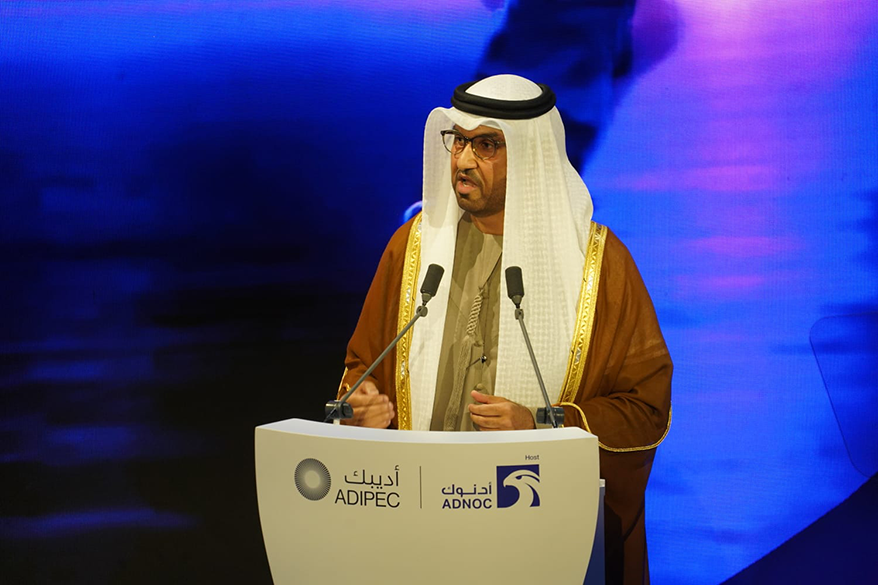
Energy security has become a question for “every family, every farmer, every industry and every business owner,” H.E. Sultan Ahmed Al Jaber said at the opening of ADIPEC 2026 in Abu Dhabi. Al Jaber is the UAE’s Minister of Industry and Advanced Technology and Managing Director and Group CEO of the Abu Dhabi National Oil Company (ADNOC).
He said the industry must rethink how it builds, protects and delivers energy. Nearly one billion barrels of crude have been drawn from global inventories since shipping through the Strait of Hormuz was disrupted.

Al Jaber sets out five priorities
Al Jaber spoke in the presence of Sheikh Mansour bin Zayed Al Nahyan, Vice President of the UAE. He said that diesel stocks in some markets are at their lowest seasonal level in 35 years. Other markets face a liquefied natural gas (LNG) supply gap of 600 billion cubic feet, about 17 billion cubic metres. Shipping and logistics were under 5% of the cost of a barrel before the disruption and now exceed 30%. “Simply put, the world has eroded its supply buffers,” Al Jaber said. He argued that energy security is now measured at the point of delivery as well as production.
He set out five priorities. The first is accessible supply, through expanded strategic storage, larger product stockpiles and flexible refining capacity closer to consumer markets. The second is routes to market, with infrastructure built before it is needed. “Supply only counts when it arrives,” he said. The third is operational intelligence, a move from automated operations to systems that anticipate risk and cut the cost of each barrel. The fourth is investment confidence, which he said policy, finance and insurance must each support. The fifth, and in his view the most important, is people.
Al Jaber said the UAE had prepared for the shock years in advance, and that talent, capital and investment stayed through it. He paid tribute to the UAE Armed Forces, Civil Defence, firefighters, first responders and ADNOC frontline teams. He said the UAE would keep pressing for dialogue, diplomacy and political solutions to bring stability to markets and energy flows.
The organisers expect more than 239,000 visitors from over 170 countries. The show has 2,260 exhibiting companies, a record, along with 1,800 speakers and 30 country pavilions.

ADNOC signs OpenAI and G42 agreement
Al Jaber announced the day’s main signed deal in the same speech. ADNOC, OpenAI and G42, through its subsidiary Inception42, agreed that ADNOC will deploy OpenAI Frontier, a platform for AI agents. ADNOC will be the first energy company to use it. ADNOC said the partnership will change its field development, well management and commercial operations. It will run on OpenAI’s GPT models using inference infrastructure inside the UAE. No financial terms were disclosed.
“Now, together, we will find out what AI can do for energy,” Al Jaber said. Sam Altman, chief executive of OpenAI, who attended the opening, called it a “first-of-its-kind partnership.” Asked on stage about the biggest challenge facing AI, Altman named energy.
Abu Dhabi signed three more OpenAI agreements the same day. Mubadala, Inception42 and OpenAI will apply AI to investment analysis and risk assessment. Inception42 and OpenAI signed a five-year agreement covering government, business and education. The Department of Government Enablement and OpenAI launched a Machine-Readable Government initiative, which turns regulations into a form AI systems can check.
What the first day means for food and farming
Al Jaber named farmers among the people now asking about energy security, and his figures explain why. Diesel runs tractors, irrigation pumps and the trucks that move harvests. Natural gas is the main feedstock for nitrogen fertilisers such as urea. Low diesel stocks and an LNG shortfall raise costs for farm economies that import fuel, including India, a large importer of crude oil and LNG. Higher freight costs also fall on every cargo crossing the Gulf’s sea lanes, food and fertiliser included.
The first pilot of the Machine-Readable Government initiative is already running with the Abu Dhabi Agriculture and Food Safety Authority, on food imports, The National reported. No details of its scope or results have been published.
India is well represented. At the Indian Pavilion, Hindustan Petroleum Corporation Limited (HPCL) said it had come to build partnerships.
As ADIPEC 2026 opens, the industry’s host has put stockpiles, safe routes and delivery costs at the top of the agenda. For farmers across the Global South, the prices of diesel, gas and freight are the figures to watch this week.



