Mary Oliver wrote that “… poems are not words, after all, but fires for the cold, ropes let down to the lost, something as necessary as bread in the pockets of the hungry.” And yet, how much bread do poets make from their poems? Well, that’s a question for another day. Here’s reflecting on poems and poetics through the Bengaluru Poetry Festival (BPF) that happened at the Indiranagar Sangeetha Sabha earlier this year.
Celebrating poetry through books, stories, songs, dances and, of course – poems and poets across languages and locations, the Bengaluru Poetry Festival highlighted how poetry pervades diverse artistic expressions. Along the way, the festival celebrated a whole decade of spotlighting poetry over and above all other literary forms.
The festival stalls at the venue were packed with books for children and adults – the cherry on the cake being the company of other book browsers as you picked up books you weren’t planning to buy. Tsundoku, by the way, is the Japanese word for piling up books around you, whether or not you get to reading them. As anyone who enjoys this condition would know, it is benign, not malignant, because books offer hope and solace just by being around. At the Bengaluru Poetry Festival – hope and solace, empathy and tears, wonder and anger, grief, laughter and connection – all flowed abundantly.
Believing that “the gentle voice of poetry needs to be heard loud and clear,” the festival team brings together poets from different parts of the country and world to read poems and reflect on their source – possibly pain, joy and other mysteries intertwined in the unknowable human imagination? The specialty of the Bengaluru Poetry Festival is a whole section dedicated to children, held in the venue’s green outdoors. The intent of catching them young seems to be working, as indicated by the happy faces of participating children and parents. The dark interiors of the venue’s auditorium contained poetry enthusiasts witnessing back-to-back sessions for adults who, it appears, are doing their own growing up on varied forms of poetic sustenance.

A festival built only for poetry
Festival co-founders Lakshmi Subodh and Subodh Shankar shared that “The festival was born of the observation that poetry, while very popular among all age groups, was not getting enough attention.” Even “in other literary forums,” it was not getting enough stage time when “programmed with fiction and non-fiction writing.” As the creators of Atta Galatta, the independent bookstore focusing on Indian publications, they observed this firsthand at open mics, workshops and other events conducted at the store. This is why they created a festival exclusively dedicated to and anchored in poetry.
Over the last ten years, they’ve “been amazed at the magic created on stage, and the amazing response from the citizens of Bangalore, who have overwhelmingly supported the festival with their participation.” Despite challenges in allocating time, managing space, planning programming, choosing poets (balancing poets with “name recognition” and those lesser known) and dealing with “the fear – will the audience show up?,” they’ve managed to grow a dedicated and burgeoning audience, not just for classical poetry but also for online poetry that blossomed after the pandemic. The pandemic was when “the audience for spoken word, prose poetry, haiku, haibun and senryu… increased tremendously,” they added.
Subodh pointed out that “poetry in Indian languages is going through a similar transition. For example, we now have the Japanese inspired haiku, haibun and senryu being written in various Indian languages – something that hasn’t happened till very recently. As organizers, we try and listen carefully to what is being written, what is being consumed and what is being written about the forms to try and make sure the BPF as a platform is open to all these changing trends.” The festival caters to diverse age groups, weaving in “a range of topics and styles.”
This year’s edition focused on “the breadth, depth and beauty of Indian language poetry.” Fifteen languages were included – “from the not so well represented languages of the North East like Bodo to tribal languages like Santhali,” alongside “Sanskrit, Kannada, Tamil, Malayalam, Marathi, Gujarati, Bengali, Hindi and more.” The intent was to initiate “conversations rather than competition” between the languages.
Speaking of the relevance of poetry in the troubled times the world now sees, Subodh and Lakshmi said, “Poetry has always been a voice for resistance, introspection, love and hope. In times of uncertainty, poetry becomes both a witness and a refuge to both poet and listener. Poetry that came out of times of turmoil long survived the crises that sparked them and continued to provide succour to succeeding generations.” Calling poetry “the gentlest form of writing,” they pointed to its “power to move and shape generations.”

Poets on the sound and politics of verse
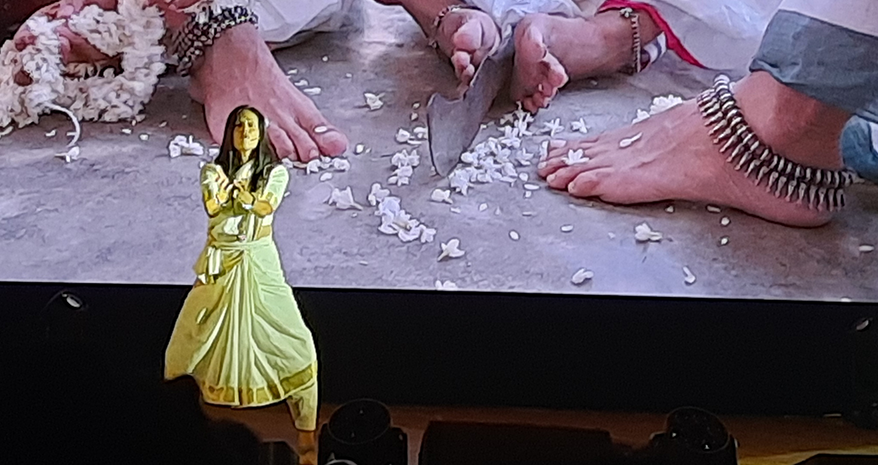
Poet and dancer Tishani Doshi, who performed at the festival, spoke of “the sound and orality of poetry” that has the ability to affect even a poetry novice. “Sometimes people are afraid that poetry is difficult or abstract. So, there is a resistance to it. Perhaps, it also has to do with the way it is taught. But my experience with readings and events is that… most of the time, poetry is very immediate and draws a very strong response because of its sonic effects, because of the way that you don’t have to understand everything as you hear it.” Poetry when read or experienced can deem meaning incidental. Poetry creates “a sense of mood just by syllables, by utterance.”
Poetry, according to Tishani, becomes a container to hold “the many dissonances of contemporary life” and a way of “meaning making.” She clarifies that one doesn’t have to be a practitioner or poet to feel this power of poetry. “Even as a reader, I have felt myself changed by encounters with poetry,” she said. “Such a small architecture of words is able to do so much. It is quite magical,” she said. “In these times when we are so strapped for our attentions and are so bombarded with so many images; when there is just overstimulation, small as it is – a poem has the ability to slow down time or stop time or just put you into a different mode. It is an embodied experience. It lands in your body and that to me is really wonderful because I also work as a dancer. For me, these two things go together. Language, movement, time, breath, rhythm – all these things are held in the body and poems to me feel the most agile and elastic of all literary forms.”
Natasha Badhwar, journalist, poet and social activist, who also presented her poems at the festival, highlighted how “poetry creates space for expressing the unspeakable.” She said, “Its pithy structure and rhythm is a nourishing soil for creating connections between dissent, dissonance, humour, rage, lamentation and celebration.” Pointing to how “poetry is also political,” she said, “It scoffs at the imbalance of power and calls out injustice.” At the poetry workshop she conducted in the festival, they “read many poems and wrote in response to prompts that emerged from them,” she said, adding that “Reading Harlem by Langston Hughes created a spell in our cohort, as we were struck by the timeless relevance of this short poem constructed entirely of questions that all have answers embedded within them.”
Natasha also referred to poetry as “an embodied form that demands attention and offers insights.” According to her, “Anyone willing and motivated to follow the trail will find that poetry comes to them. Reading and writing poems is both a promise and a risk; it is a door within all of us waiting to be open and explored. Reading and listening to poems, verses, couplets and songs is the route to discovering the poet within each one of us.”
Ursula K. Le Guin wrote that “Hard times are coming, when we’ll be wanting the voices of writers who can see alternatives to how we live now, can see through our fear-stricken society and its obsessive technologies to other ways of being, and even imagine real grounds for hope. We’ll need writers who can remember freedom – poets, visionaries – realists of a larger reality.” More than a slice of that reality was reflected at the Bengaluru Poetry Festival that brought home the healing power of poetry in many voices and languages.