
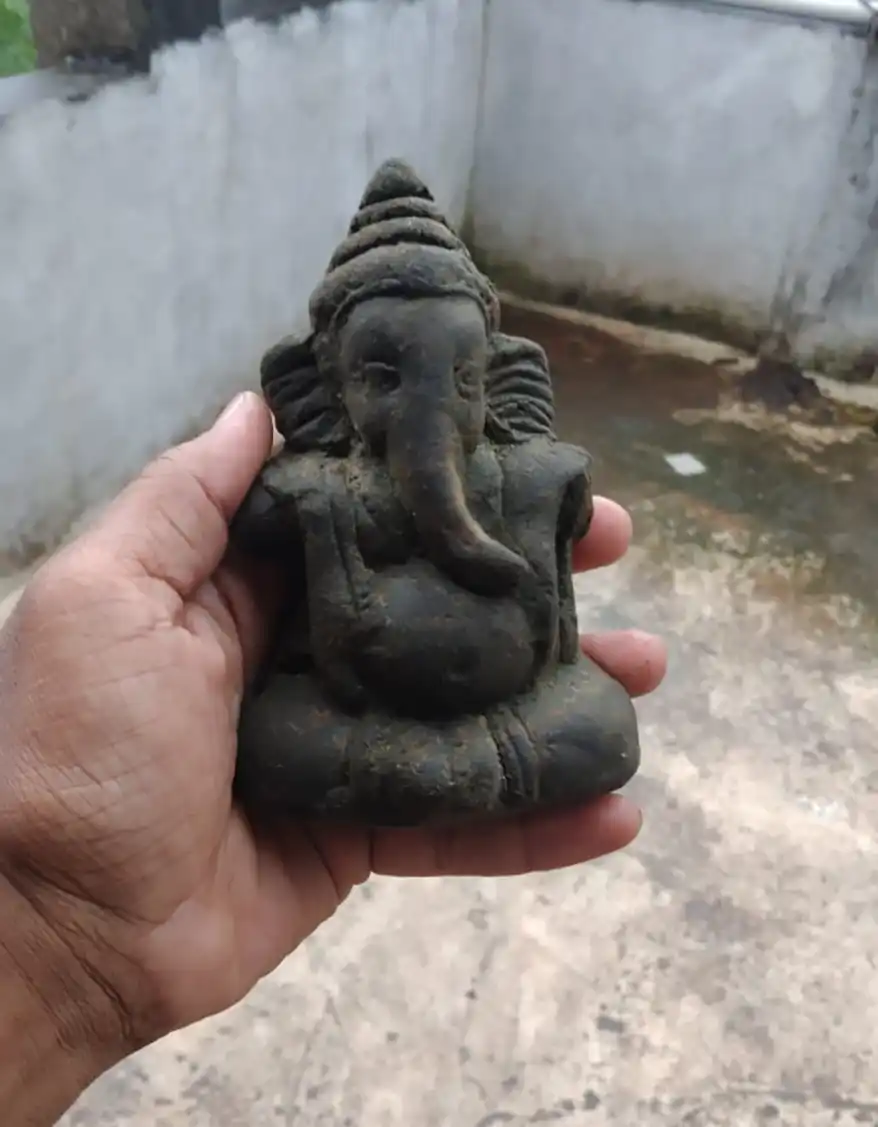
In a small workshop in Jaisinghpur near Kolhapur, a breakthrough is taking shape. Under the guidance of organic moringa farmer S. Umesh Rao, a team of eco-concious innovators, led by Roshan Salati, International Specialist at Quality Power Electrical Equipments Pvt Ltd, has successfully created what environmentalists have dreamed of: a fully biodegradable Ganesh idol that dissolves completely in water while nourishing aquatic life.
The Harit Ganapati, made from moringa pod fiber and natural binding agents, is a direct response to one of India’s most pressing environmental challenges. Each year, during Ganesh Chaturthi, millions of Plaster of Paris (PoP) idols are immersed in water bodies across India, releasing toxic chemicals and heavy metals that devastate aquatic ecosystems.

“When we first started experimenting with moringa fiber, many people were skeptical,” says Umesh, under whose guidance, Roshan and her team spent months perfecting the formula. “But reminded ourselves that tradition should nurture nature, not harm it.”
The environmental impact of traditional Ganesh idols is severe. According to recent studies by the Central Pollution Control Board, the immersion of PoP idols significantly increases water toxicity, with dissolved oxygen levels plummeting while heavy metal concentrations soar. The synthetic paints used on these idols contain lead, mercury, and chromium, creating a toxic legacy that persists long after the festivities end.
The Harit Ganapati offers a revolutionary alternative. Made from moringa pod fiber, which is a by-product from Umesh’s organic farming, bound with rice flour paste and colored using turmeric and beetroot, these idols completely dissolve within hours of immersion.
“What makes our innovation special is that it actually feeds the fish,” explains Umesh. “The moringa fiber is rich in nutrients, turning what was once an environmental challenge into a blessing.”
The journey wasn’t easy. The team faced numerous challenges in achieving the right consistency and durability. “The idol needs to be strong enough to withstand the puja ceremonies but dissolve naturally in water,” explained Umesh. “Finding that balance took countless attempts.”

Their persistence has paid off. As India prepares for this year’s Ganesh Chaturthi, interest in the Harit Ganapati is growing. Several environmental groups and community organizations have recognised its potential to transform one of India’s most beloved festivals into a more sustainable celebration.
With many cities now implementing restrictions on PoP idols, the demand for eco-friendly alternatives is surging. The Central Pollution Control Board’s guidelines increasingly favor biodegradable materials, though implementation remains a challenge in many areas.

“This is not about creating an eco-friendly product,” says Umesh Rao. “It’s about showing young people that they can innovate within tradition, that preserving our environment and celebrating our culture can go hand in hand.” Their plan now is to create a one-foot Ganapati.
The transformation of visarjan practices is particularly crucial given the ritual’s profound spiritual significance. “Visarjan isn’t just about immersion; it symbolizes the cycle of creation and dissolution, teaching us about impermanence,” explains Umesh. “When we pollute water bodies during this sacred act, we’re missing the ritual’s core message.”
Some communities have begun practicing symbolic visarjan, where one large community idol is immersed while individual households return their eco-friendly idols to the soil as fertilizer.
For Umesh, Roshan and her team, the Harit Ganapati represents hope: It is proof that with determination and guidance, young innovators can create solutions that honor both faith and nature.
As Ganesh Chaturthi approaches, their creation offers a glimpse of how ancient traditions can evolve to meet modern environmental challenges, one biodegradable idol at a time.