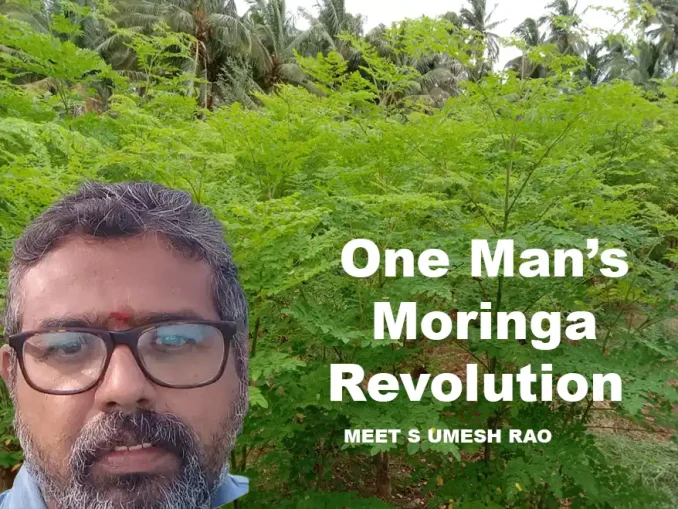
The morning mist hangs low over the red earth in Gauribidanur, Karnataka. Umesh Rao walks through rows of moringa trees, their slender trunks reaching skyward like green promises.
His phone buzzes with WhatsApp messages from customers across Karnataka and Tamil Nadu, all seeking his organic drumsticks, moringa powder, and seeds.
“I don’t own any land,” he says with a quiet smile, running his weathered hand through the delicate moringa leaves. It’s a statement that would puzzle many, considering he manages ten acres of thriving farmland.
But for Umesh, this journey has never been about ownership—it’s about awakening sleeping soil.

From Mumbai to Moringa
Years ago, Umesh was living in Mumbai when he was called home to manage their ancestral land in Karnataka. With only a tenth-standard education and farming in his blood, he returned, ready to work the family fields. But litigation struck, tangling the property in legal battles that continue to this day.
Instead of waiting for courts to decide his family’s fate, Umesh made a bold decision. “Meanwhile, all around our village, I saw barren fields. Everyone was leaving for cities. The young didn’t want to farm. The old couldn’t manage alone. Good land was just… dying.”
This vacant land haunted him. As he would later write: “Vacant Land Is a Sleeping Giant. Wake It Up Before It’s Too Late.” He saw millions of acres across India lying idle – land inherited, purchased, or gifted, now covered in weeds, lost under neglect. “Why? Because the owners are busy elsewhere. Careers, cities, families… And that’s understandable. But what if your land could thrive without you being there?”
Starting with just small parcels of rented land, he began what many called a fool’s experiment. He chose moringa (ODC-3 variety) – the humble drumstick tree -along with velvet beans as intercrops and ashwagandha for its medicinal value.
Each morning at 5:45am, he catches the train from Yeswanthpur Railway Station in Bangalore, making the daily journey to his fields in Gauribidanur.

The Science of Simplicity
“We farmers don’t put anything to the soil,” Umesh explains, his eyes lighting up with the passion that keeps him in the fields from dawn to dusk. “Everything the production has comes from the soil itself.”
His hands, permanently stained with earth, gesture expressively as he talks. No chemicals. No synthetic fertilizers. Just Jeevamrut, beneficial microbes, and the wisdom passed down through generations. “This is what I love: watching life grow from earth. I’m not in this for awards or recognition. I’m just a small farmer doing what farmers do.”
His approach is both ancient and modern. While following traditional organic practices, Umesh stays connected to the scientific community through LinkedIn, learning from researchers and agronomists who share studies on plant metabolism, soil health, and sustainable farming.
He times his foliar sprays of neem oil to match photosynthesis hours, understanding that healthy metabolism produces the powerful compounds such as polyphenols, antioxidants, and alkaloids, which make medicinal plants truly valuable.
Today, his farm produces 20 tons of dried moringa leaves and about 4-5 tons of moringa powder annually. It is a superfood increasingly sought after for everything from hospital nutrition programs to high-end wellness brands. The transformation is remarkable: what started as two rented acres now spans ten, with plans to expand to another twelve.

The Green Revolution
The Tamil Nadu Moringa Export Facilitation Center has reached out, recognizing the potential in his chemical-free approach. International buyers are interested.
He pauses, looking at his thriving moringa trees. “My joy is here, in the field. When I see these trees heavy with drumsticks, when customers tell me how fresh the produce tastes, that’s my profit. I don’t need to become something I’m not.”
His evolution as a farmer tells its own story. Initially, he sold drumsticks to traders at wholesale rates. Now, customers drive directly to his farm
“Sometimes I can’t believe it,” he says. “People driving hours just for my drumsticks! But you know what makes me happiest? When they bring their children and I can show them how moringa grows. That moment when a city child sees where their food comes from…that’s everything.”
He wakes up early because he can’t wait. “The morning mist, the bird calls, the smell of earth—you don’t get this in any office,” he says. “From morning harvest to overnight dispatch,” he promises, ensuring fresh drumsticks reach kitchens within 24 hours.
But Umesh’s vision extends beyond vegetables. His farm has become a full-fledged ecosystem. A new nursery offers moringa saplings, vegetable plants, flowering plants for pooja needs, fruit trees, and medicinal herbs.
He’s developed a special potting mix using farm soil, cocopeat, and bio-nutrients. For bulk buyers, such as hospitals, community kitchens, NGOs, he provides not just produce but guidance on incorporating moringa into nutrition programs.
Innovation Beyond the Field
Despite calling himself “just a small farmer,” Umesh’s curiosity drives constant innovation. He experiments with bamboo tubes filled with compost near plant roots, produces biochar using traditional methods, and stays connected with agricultural scientists online. “But I learn most from the soil,” he emphasizes. “Every season teaches something new. That’s the beauty of farming: you’re always a student.”
For those interested in growing moringa, he offers consultancy services at cost, sharing his expertise in sustainable cultivation methods.
His most creative innovation addresses an environmental crisis close to his heart.

The Harit Ganpati Innovation
During Ganesh Chaturthi, Mumbai’s beaches and water bodies are choked with Plaster of Paris idols that poison aquatic life. Umesh’s solution? “Harit Ganpati”—eco-friendly Ganesh idols made from moringa pod fiber, bound with rice flour paste and colored with turmeric and beetroot.
“During Ganesh Chaturthi, tons of toxic idols pollute our water bodies,” he explains. “Our Harit Ganpati dissolves completely in water, becomes food for fish, or can even be fed to cows. It’s devotion without destruction.”
The idols represent more than environmental consciousness: They’re a potential livelihood source. Local self-help groups and women’s collectives have shown interest in manufacturing them. “It could provide employment for rural women and tribal communities,” Umesh notes. “We turn farm waste into faith, creating jobs while protecting our waters.”
Already one girl in Mumbai, fascinated by the concept, is making a Harit Ganapati. “She is getting there; She has not completed it , it is still in prototype… But I am sure she will succeed. This change is happening and people should be encouraged.”

The Feathered Farmhands
Perhaps the most charming aspect of Umesh’s farm is his “staff” of chickens and occasional peacock visitors. He keeps poultry not for meat or eggs but as ‘natural farm workers’. They scratch and aerate the soil, eat pests and weed seeds, process fallen moringa leaves, and provide nitrogen-rich manure, all while requiring just scattered grain and freedom to roam.
“They don’t ask for a salary, but they work every day,” he smiles. The peacocks, when they visit, hunt snakes and add what he calls “spiritual calm” to the landscape. It’s permaculture in practice: every element supporting the whole.
A Message to Youth
“The land is there for those willing to work it,” Umesh says, surveying his green revolution. “Yes, farming is hard. Yes, the system doesn’t always help. But if a tenth-standard dropout can do this, anyone can.”
His message resonates beyond agriculture. In Umesh’s story, young Indians see an alternative to the urban rat race: a path that offers purpose, sustainability, and dignity. He’s proving that farming can be innovative, profitable, and fulfilling without compromising principles.
The dirt under his fingernails a badge of honor. “But you have to love it. Really love it. Not the money, not the idea of being a ‘successful farmer’, but the actual work. The sweat. The uncertainty. The joy when rain finally comes.”
“People ask why I don’t expand faster, why I don’t chase bigger contracts. They don’t understand. When you love what you do, when you sleep peacefully knowing your work feeds people clean food, what more is success?”
His message resonates precisely because he doesn’t try to glamorize farming. “It’s hard work. Some days, everything goes wrong. But I’d rather be a small farmer with soil under my nails than anything else. This is who I am.”

Looking Forward
Today, Umesh’s WhatsApp stays busy with orders: moringa seeds for farmers wanting to start their own organic plots, dried leaves for health-conscious families, ashwagandha roots for Ayurvedic practitioners, and fresh drumsticks for local kitchens.He posts research-backed information about moringa’s benefits, right from its potential in fighting malnutrition to emerging studies on its anti-cancer properties.
“India grows 80% of the world’s moringa, but we export it raw in sacks while others make the profit,” he observes. It’s why he advocates for value addition: moringa ice cream, superfood sauces, protein supplements, even moringa-enriched fish feed for cleaner aquaculture.
His vision extends beyond his own fields. “Food will be the new gold,” he says. “And cultivable land will be the new gold mine. Don’t let your gold stay buried under weeds.”
For landowners with idle property, he offers a respectful solution: let him develop and cultivate their land on a yearly rental basis, using regenerative farming methods that protect and improve the soil. “You stay the owner. We just become caretakers—with deep respect for your soil.”
For now, he’s content being what he is: a farmer who proves that with dedication, even rented land can bloom. His story challenges the narrative of agricultural decline in India. While his peers chase corporate dreams in cities, Umesh has found abundance in abandoned fields.
As evening approaches and his workers head home, Umesh remains in the field a bit longer. Tomorrow, he’ll wake before dawn to tend to these trees again. No regrets. No looking back. Just a young farmer and his green revolution, one moringa tree at a time.
In a country where farmers often make headlines for tragedies, Umesh Rao is writing a different story. Not a story of grand ambitions or revolutionary technology, but something simpler and more profound: a small farmer who loves his land, who finds joy in every sunrise over his fields, and who proves that sometimes the greatest success is knowing exactly who you are and being content with it.
“I’m just a small farmer,” he repeats. But in those words lies a universe of passion, purpose, and peace that no city job could ever provide.

For more information about Umesh’s organic moringa products and vacant land development consultancy: S. Umesh Rao; Call/WhatsApp –
0091 8310 457 215;
Email: umeshraomoringa
@gmail.com
Watch the story here: