
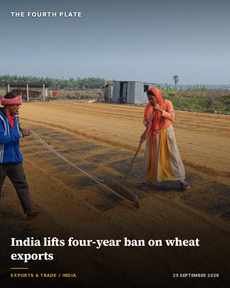
India has lifted all remaining restrictions on wheat and durum wheat exports, ending a ban first imposed in 2022 to protect domestic supply during a period of global market disruption. The India wheat export ban had already been partly eased in January, when the government allowed a government-monitored 2.5 million tonnes of wheat and 1 million tonnes of wheat products to leave the country under an allocation system.
The decision follows a fourth consecutive record harvest, with production for the 2026-27 marketing season expected to reach 120 million tonnes, according to the US Department of Agriculture’s Foreign Agricultural Service. Officials judged the resulting grain stocks unmanageable under continued export limits, prompting the full removal of restrictions in late August, months earlier than some trade analysts had expected.
Wheat flour products, including atta, maida and rava, can now be exported freely, subject to India’s normal trade regulations. The wheat itself will go mainly to Bangladesh, Nepal, Bhutan and Southeast Asian buyers, markets that rely on India as a lower-cost regional supplier whenever its harvest allows for exports, rather than as a year-round trading partner.

A diaspora market, distinct from the grain trade
Wheat products carry a different trade logic to raw wheat. Much of that flour, the US agricultural service noted, is destined for Indian diaspora communities in the Middle East and Southeast Asia, buyers who prize specific atta grades for everyday cooking rather than treating wheat as an interchangeable commodity. That distinction matters for Gulf grocers and importers who stock Indian-milled flour brands rather than generic wheat sourced from whichever exporter offers the lowest price that week.
India’s role in global wheat markets has long been described as opportunistic rather than strategic. “India is a sporadic player in the global wheat market, importing wheat in years of tight domestic supplies… and exporting in years of domestic surplus,” the Foreign Agricultural Service noted, a pattern this year’s harvest fits precisely and one that has repeated across several previous cycles.
That unpredictability carries costs for trading partners who cannot rely on India as a consistent supplier the way they might rely on exporters such as Australia or Argentina, whose export policies change less abruptly. Still, when India’s harvest allows exports, its lower shipping costs to South Asian and Gulf markets give it an edge over more distant competitors, a competitive advantage its 2022 ban had suspended for four years running.
The timing also lands amid wider concern about global food security, with a separate United Nations update this month warning that famine risk is rising in parts of Africa and the Middle East even as humanitarian food aid budgets shrink further. Additional wheat supply reaching international markets from India will not resolve that funding gap, but it does ease pressure on global wheat prices at a moment when several import-dependent economies can use the relief, however marginal.
Whether India’s surplus persists into future seasons, or the government reimposes restrictions at the first sign of a weaker harvest, will determine whether this reopening marks a lasting shift or another temporary window. Four consecutive record harvests suggest favourable conditions for now, but the country’s history of abrupt policy reversals means importers are unlikely to plan around Indian wheat as a permanent fixture in their supply chains.
Domestic politics play a role in that unpredictability. Indian governments have historically restricted exports quickly whenever local flour prices rise, a sensitivity rooted in wheat’s place as a staple across much of the country. Any sign of a weaker 2027 harvest, or a domestic price spike, could see restrictions return with little warning, regardless of how buyers in Dhaka, Kathmandu or Dubai have adjusted their sourcing in the meantime.