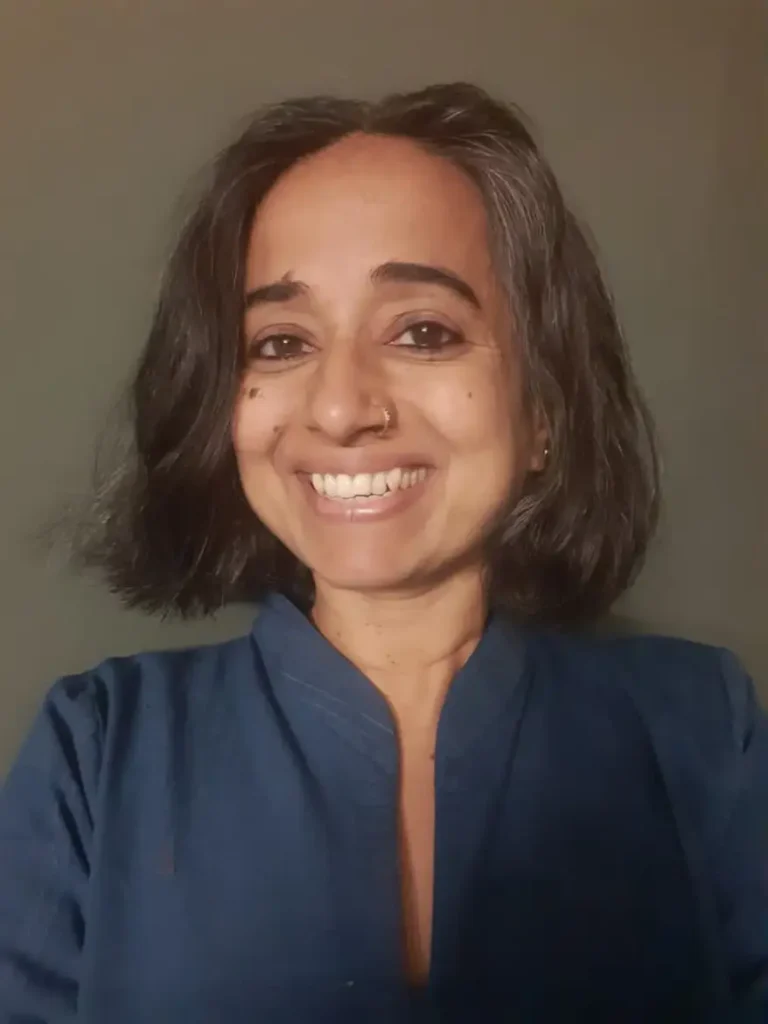
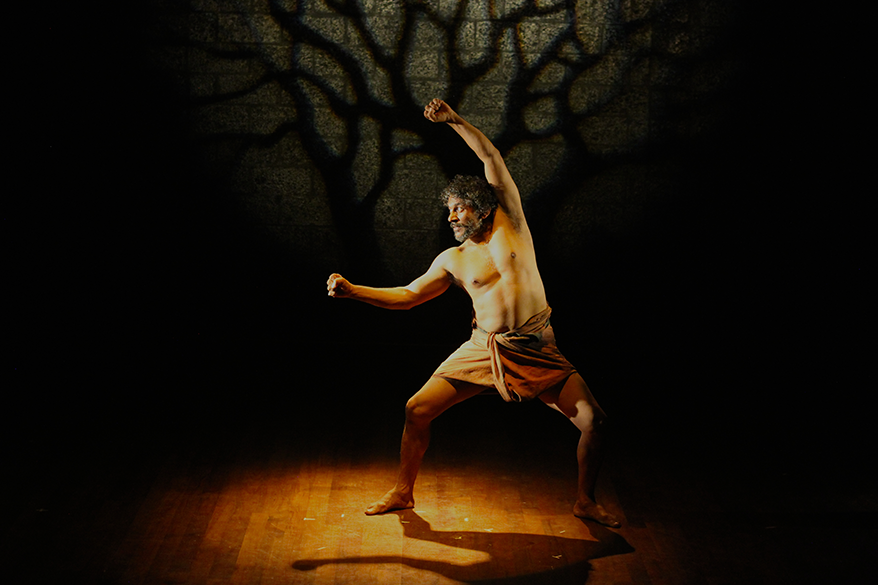
At a time when Artificial Intelligence (AI) is threatening to take over many kinds of human work and expression, there are still some domains that only the human body can occupy. The stage is one of them. I recently met and interacted with Vinay Kumar, veteran theatre practitioner and artistic director of Adishakti Theatre, Auroville.
He started his journey in theatre at the age of seven, quite accidentally too. It was a political theatre repertory in Kerala that first gave him the taste of performing on stage. He would go on to make theatre his life’s work. Meeting Veenapani Chawla, then an English teacher from Bombay who had also unexpectedly deep dived into martials arts, stagecraft and acting, was a significant milestone in his path.
They would both go to Pondicherry (for different reasons) and later co-found Adishakti Theatre in Auroville – the theatre school that has trained some of India’s most well known actors on stage and in cinema. Adishakti Theatre’s performance energy workshops and plays reflect craft, content and artistic vocabularies that are unique and sought after by a global audience.
I spoke to Vinay Kumar about his journey in theatre, his passion for teaching and, among other things, asked him how caring for the land trains one to become a better actor…
Excerpts from the interview…
Adishakti Theatre includes music and dance performances in the Remembering Veenapani Festival every year. Going by the turnout, it looks like audiences really enjoy that integrated view of theatre as Adishakti sees it…
Integrating other art forms is part of Adishakti’s own art practice. We do not restrict theatre to theatre. The concept of only plays being theatre is very Eurocentric. For us in the Indian tradition, dance and music are very integral parts of theatre. Those forms already belong in the theatre. Veenapani taught us that “anything and everything can be theatre.”
Could you share some of your earliest memories of theatre? I read that you were seven years old when you joined the Communist Party’s theatre repertory.
It was around that time, yes… I was like any boy that age but when you get into theatre, your thoughts start developing much faster. After two years of theatre exposure, I could not see any other world. I was exposed to multiple people in multiple capacities; also diverse thought processes from people across ages. They all brought abundant knowledge, shaped my aspiration till I wanted only to be in theatre.
I am so grateful to my mother and my teachers that I grew up in the theatre. From when I was 11 to now – my textbook has been theatre. It has defined me as a human being. Theatre for me was a magical world then and is a magical world now. I see it not as a performance but as a process. Theatre is not the end product. The process is very important and unique to theatre. No art-making through collective interaction exists anywhere else. Cinema has forgotten that. Actors come out of a caravan and perform. They don’t even know the actors they’re working with. Theatre makes me feel, “Oh, there is so much I need to catch up on, so much I need to rectify and unlearn.”
Do you think theatre and politics are inseparable?
In this polarized world, we each have our own politics and believe that that politics is right. Politics is a byproduct of how we define righteousness. Differences come up because our notions of righteousness depend on our personal perspectives. Who is right? How do you define right? Each person can argue that only they are right.
As a theatre practitioner and artiste, I see that as problematic. So, I sit with my critical thinking abilities. That is my politics. I may take a position today but tomorrow it may be reconstructed or eliminated. I would rather that my creative piece decides the politics rather than my frame.
So you’re saying that theatre prepares you to be more flexible?
Actually, the problem with theatre is you can become very rigid too. When you cast the ideological mooring and set out to create artistic work, it can be quite problematic. The question is – why are you making art? Are you using art to translate your political vision or does the art you make inherently create politics? Both are two different things. I would go with the second one because the work decides the politics whether about gender, egalitarian society or anything. Let the work speak rather than me screaming from the top of a branch.
One of the first Chief Ministers of Kerala, EMS Namboodiripad critically analyzed plays used for politics. He said you can make propaganda or political content. You can talk about the downtrodden but your form needs to be critically new and fresh because theatre is art. He said this sixty years ago.
Could you share a bit about your earliest interactions with Veenapani Chawla (VP) who went on to become your mentor and with whom you created Adishakti Theatre and much of the distinctive work it stands for?
After a certain point of my joining the Communist theatre repertory, my mother, (celebrated Malayalam writer Sarah Joseph) felt that I needed to study theatre seriously. That is how I joined School of Drama, Thrissur, where I finished my graduation. By then I knew that I needed to do theatre – not wanted to do theatre. I wanted to be occupied in theatre work from 6 am to late night – again the next day and again the next. Such avenues were very limited in Kerala then. I had heard of people in the cities – eating theatre, sleeping theatre and raising the resources for that.
I met VP at exactly that juncture. She was collaborating with my director at that time – KC Manavedranath. He asked me to work with her on certain aspects like martial arts, voice exercises and other things. I didn’t think much of interacting with her. Language was also a problem. I just ignored her for three months (laughs). I used to love western classical music but didn’t have money to buy cassettes. One day, I met VP and was talking. It was unusual because I had slotted her as a very uninteresting woman (laughs). She requested me to go to her room and pick up something because I had a bike. I went with my friend and when I opened her cupboard, I saw stacks of western classical music like I had never seen before.

Suddenly, my perception of VP changed. That day, with only 20% linguistic skill and 70 % physicality, I had a conversation with her for the next three hours. From that moment we knew we could work well together and that our thought processes are aligned. We both were looking for something different in theatre. We did not want to follow existing paths. We felt we had the potential to conduct research and discover something new.
Then, she invited me to Bombay. We worked on the play Savithri till 1995. Dealing with actors, working in a city like Bombay was a lot. At some point she said she was done. She decided to join the Aurobindo Ashram for spiritual work and shifted to Pondicherry. I had already been displaced from Kerala so I chose to do a theatre Post Graduation in Pondicherry University. I soon realized it was nothing more than my degree course. VP by that time had got involved in seva and other Ashram work. I went to meet her one day and said, “VP, this is not on. You need to make a play for me.” I think by that time she had also started missing the creative field. She agreed to do a play and that’s how VP’s spiritual ashram life that lasted one year ended. We started working together and made Impressions of Bhima.
That process of play creation opened lots of possibilities. It brought up a lot of research questions. It was the beginning of Adishakti Theatre’s research phase. A lot of material was generated. In the next 30 years, each production opened a plethora of knowledge and all of it was then brought into our methodology. That’s how the journey started. In 2014 once VP died, we started developing our own ideas, our own notions of how the performance should be; how the research should be and hopefully that will continue.
You clearly have such a passion for teaching. What has teaching taught you and what is at the root of that strong connection you have to teaching?
It is the subject that is interesting to me. My primary area of teaching is emotion. We all carry archetypes. People try to figure out their existence in different ways. I figure out my existence by trying to understand the archetypes that exist in the world.

So, in your class you are looking for archetypes?
We are archetypes. We have only stories. The idea of Navarasa is not about doing the dance but telling stories in different ways. We see parallels through art because we are all archetypes. Art can surpass geographies because we are archetypes. Human interaction has a pattern. Increasingly, we are going to become more archetypal because we now have a world to observe this. Earlier, you never realized you are archetypal because your story and existence was within 10 km. Now the world is open, you travel and see the human being. You see the commonality in emotion.
To understand emotion is what excites me in classes. As much as I am teaching, I learn. I have taught three to four generations of students. I observe how the perception of emotion has changed from when I started taking classes in 1992. This has very exciting prospects for performance. That is why I never get tired.
You and your co-actors literally built Adishakti brick by brick in the early years. You watered the land and buildings. You planted saplings – grew the ferns and trees. What does caring for land – touching mud and working with plants teach you about creative work, especially theatre?
I would say it is very important to be in love with nature. Taking care of a plant requires much patience. It is very time consuming. I think every actor needs to do it. I also believe that if you are working in a space, you need to keep it spic and span. If you are working in a theatre space where the land is dry, litter and dust is everywhere – I don’t think work can emerge. All of us in Adishakti care about the space, the land and believe it affects us and our artistic processes.
In my exposure to traditional theatre, even a 10 by 20 ft space would be wiped clean and swabbed with cow-dung water. I have also done many street plays in the past and there too, preparing the defined space is a very important ritual. From there we step out – look at trees, the shades of green, the rain when it comes. The seasons become visible to us through plants. The seasons teach us.
In Adishakti, you will sit under 20 trees at least and enjoy the seasons; enjoy multiple kinds of breeze passing through trees that grow their own way – not in manicured ways. Some people may not care about all this and might be comfortable with being unaware. I am not cut out for that, neither is Nimmy (co-actor and Managing Trustee of Adishakti Theatre) and neither was VP.
If even a centimeter or inch went out of perfection, VP would scold us. That is the training we had. We tried to achieve perfection not to prove anything outside but to prove to ourselves that we have the ability and patience. Watering the land, sweeping the land gives me sometimes, more meditative power and peace than sitting for hours in meditation.

You are rigorous in your theatre practice and bring lot of references from films, books etc. in your teaching. How do you build watching, reading and experiencing art into your routine as a theatre-maker and actor?
Except during physical work, every hour is spent learning. There is nothing like empty space. Once you are in theatre, everything is learning. I chalk out ten things to learn maybe but land up doing only 3 to 4. What is lacking is time not intent. I try to watch as many things, read as many things, listen to as many things and open my eyes to different political scenarios. All of it adds up. At the end of the day, critical thinking is not god given. You have to work on it – else you will be extreme left or extreme right. As a performer, I want to use my own critical thinking to find out how I respond to a given situation. That may not be fashionable or acceptable to some people but it is still my definition of myself. I would give my arms and legs for that to continue. The moment I lose that ability I have to depend on someone else’s arguments. Of course I can listen to arguments and ideas but I need to find the workings of my own thought processes. Dopamine is produced and rewards are generated internally when you’re in a constant learning mode. The idea is to constantly try to learn, learn and learn..
We live a very fast paced life. What’s your advice to actors on battling distractions – their own and that of the audience? Also, how do you advise actors to battle the stereotypes that could trap one in the arts?
Every performer can survive in the first 4 to 5 years purely relying on mannerisms, ability or physicality. The question comes in the 3rd or 4th year as to how to be different. You need to keep breaking the moulds and styles you created. For this you need rigorous riyaaz. How do you change predictability? This demands work. And that does not mean you need to work on your body – you can do that as much as makes you happy – but on many kinds of systematic knowledge. Again, I repeat – honing your critical thinking helps. That allows you to evolve a craft. All these factors depend on how disciplined you are.
How many people do you know who were doing theatre and have stopped? They approached theatre like an in-between passion. That cannot be the case if you are looking for long term. You can’t also get worried about how other people lead their actor/artiste life. In theatre, nothing is formulaic. Why you do theatre is a dialogue you need to have with yourself. Theatre is your spiritual, philosophical, political diary. At the end of the day, you are making politics. To all young actors setting out in this path, I would say that for some time passion can take you forward. If you’re hoping to be a long-term theatre practitioner, you need to dedicate your time. The more you age, the younger your mind needs to be. If your mind has already taken a position, you will not be able to see a fresh perspective. A true artiste and theatre performer will be much younger in their mind if they want to create something relevant in the art.
Regarding stereotypes – that’s also a very western notion that comes with notions of realism. They are pretty much looking at a physicality that matches the characters. That has never been the case in Indian art traditions. Here, a woman can perform Koodiyattam; she can play Ravana or any other role. We look at structural intention. In Adishakti, the primary idea is not about your physicality at all. Nobody cares about how you look or how tall you are. Lots of people don’t recognize me when they come backstage because they think I am very tall on stage. That is what theatre does. It is a simulative space. The story is happening in the head. Structure is immaterial when you have a character.
When I watch a play, I know this is not a mountain; that is not a palace; this is not a garden or a football ground. I know it is an empty stage. I may know you personally but allow my mind to lower its guard. I believe a reality that is being created in a very limited space. The human mind can do this. I am lowering the guard of my hippocampus that is always alert and saying, “Ok, enjoy yourself.” This can only happen when you watch a live performer. This is the magic of theatre.