
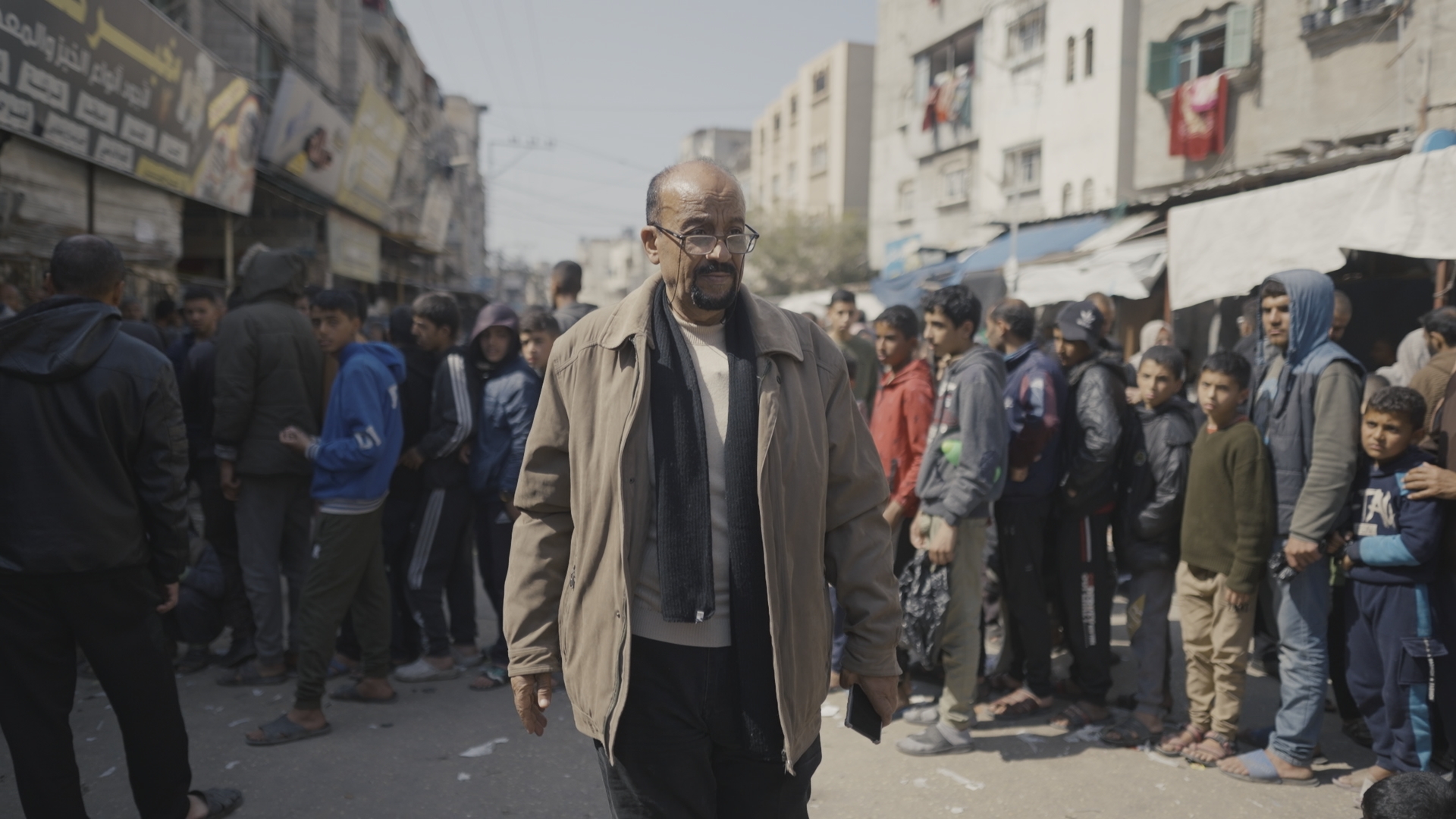
“The Teacher,” a short film from the “From Ground Zero” collection, curated by Palestinian filmmaker Rashid Masharawi, captures the quiet dignity amid devastation in Gaza through the eyes of a displaced educator. 

Director Tamer Nijim weaves a narrative that stands out for its subtlety, opening with a scene that sets the tone for the entire piece: the protagonist observing children playing with pebbles in a refugee camp. 

The imagery serves as a haunting reminder of how childhood innocence persists even as war strips away basic human rights and normalcy.

The film follows the teacher’s daily struggles, living in a tent camp, documenting the mundane yet challenges that define life in Gaza. 

Each step of his journey reveals an added layer of deprivation: the search for a working power outlet, where dozens of mobile phones cluster around a single charging point; the fruitless quest for water, that most basic necessity of life; the endless lines for bread that lead nowhere. 

Yet what makes these scenes particularly powerful is not their inherent drama, but rather the quiet resignation with which the teacher faces each disappointment.

That is also what elevates “The Teacher” above mere documentation of hardship – its nuanced portrayal of human dignity and connection. 

The protagonist carries himself with a grace that is almost oblivious to his circumstances, accepting each setback without losing his essential humanity. 

Director Tamer Nijim

This quality culminates in the film’s most moving scene, where he encounters a former student who offers assistance. His response – “No, I have everything” – speaks volumes about Palestinian resilience and pride, even in the face of systematic deprivation.

Nijim’s direction excels in its restraint, allowing the everyday realities of life in Gaza to speak for themselves without resorting to melodrama or overt political messaging. 

The film’s power lies in its presentation of basic human rights – access to water, food, electricity – not as abstract concepts but as daily battles fought and lost by real people. 

Through the teacher’s dignified resignation, we witness a profound commentary on the Palestinian condition: a people maintaining their humanity while being systematically denied the essentials of human existence.

“The Teacher” is an example of the power of understated storytelling in conveying profound truths about survival, dignity, and the human spirit under occupation. 

It reminds us that sometimes the quietest voices speak the loudest truths about injustice and resilience.

###


Discover more from The Fourth Plate

Subscribe to get the latest posts sent to your email.

Leave a Reply

Trending

Financial Literacy, Islamic Finance and the Future of Sustainable Agricultural Development

Financial literacy has increasingly been recognized as a critical factor in improving agricultural productivity and economic resilience. Farmers who possess strong financial literacy are more likely to manage resources efficiently, access credit responsibly, and invest in long-term agricultural development.

Varkala’s ‘Zero Waste’ Crown: A Model of Substance or a Convenient Label?

While many larger cities like Bangalore (10 million) and Dakar (5 million) are also on the list, Varkala’s potential inclusion is significant because it demonstrates that a comprehensive waste management system can be effectively implemented in a densely populated municipality, not just in smaller towns or villages.

 Signals to the Market: What Nigeria’s Ondo State is Getting Right About Industrialization

For agribusiness, infrastructure determines competitiveness. Efficient transport lowers post-harvest losses. Digital connectivity facilitates traceability and market access. Without these foundations, even well-designed agricultural investments struggle to scale sustainably. 

EmiratesGBC and UNESCO GEP Sustainable School Building Guidance Booklet champions call to build sustainable schools to further the greening of the education sector

EmiratesGBC has been hosting various roundtables and webinars to introduce the Sustainable School Building Guidance Booklet to key stakeholders

Honoring the unparalleled life and legacy of Saalumarada Thimmakka

Thimmakka was 114 years old when she died on 14th Nov, 2025 in a hospital in south Bangalore but only 37 years old when she and Chikkayya started planting trees to heal from the humiliation they faced for being childless.

AURAK Researcher Presents Breakthrough Integrated Solar-Driven Solution to Generate Electricity, Green Hydrogen and Freshwater 

The study, published online in the prestigious journal Process Safety and Environmental Protection, presents a novel multi-generation configuration designed to significantly enhance energy utilisation in urban environments, while reducing losses commonly associated with conventional energy systems.

Reclaiming the Midday Meal: How Muhammed Hadith Hussain is Cultivating a ‘Krishi Malayalam’

As a member of the Balasabha – the neighborhood-level children’s collective organized by the Kudumbashree Mission – Muhammed is part of a movement that empowers over 4.3 lakh children to solve community problems

“Young People Don’t Have the Space to Talk About Climate Grief,” Hemavathi Shekhar of Enact Earth on Building Community-Led Support Systems

“Our vision is a future where every individual and community is equipped with the knowledge, resources, and motivation to actively address climate change, promote environmental equity and foster resilient societies.”

Something went wrong. Please refresh the page and/or try again.

Discover more from The Fourth Plate

Subscribe now to keep reading and get access to the full archive.

Continue reading