
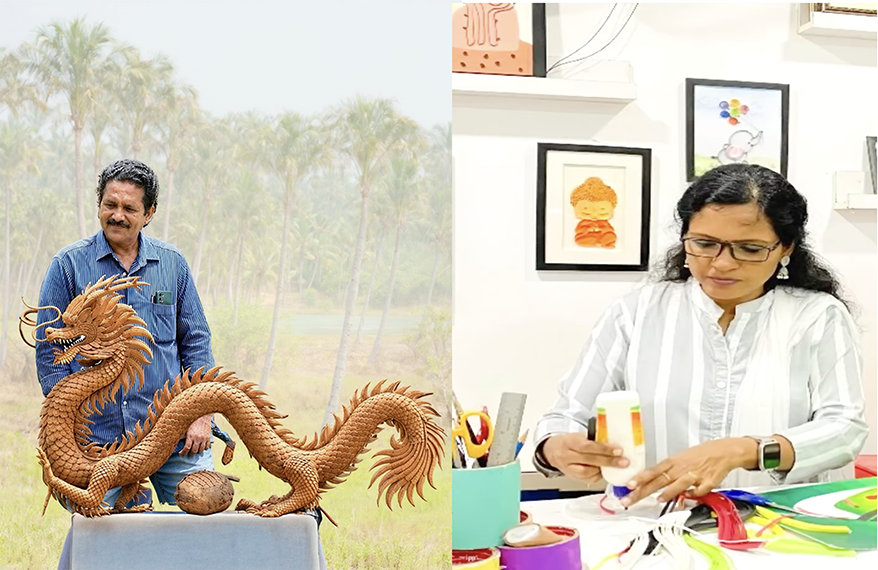
Coconut-husk carver A Prathap wins the Shilp Guru Award and quilling artist Asha G Krishna a National Award, both from the Ministry of Textiles.
Across Kerala’s coconut belt, the husk is the part of the nut most people have no use for. Much of it is discarded as farm waste. Some goes to the coir yards to be soaked and beaten into fibre. A Prathap carves it into figures.
A few kilometres south of Thiruvananthapuram, at the Kerala Arts and Crafts Village in Vellar, Asha G Krishna works in a lighter material still. She rolls narrow strips of paper into tight coils, pinches each one into shape and sets them on edge, side by side, until they become a picture.
The Ministry of Textiles has now honoured both. Prathap has received the Shilp Guru Award, given to master craftspeople for sustained excellence and for keeping traditional skills alive. Krishna has won a National Award for her quilled work on a Kathakali theme.
Krishna shared the news in a Malayalam note on social media. “This recognition of years of hard work and dedication brings me joy beyond words.”

Kathakali, coil by coil
Kathakali is Kerala’s classical dance-drama, and its faces tell the audience who each character is before a word is sung. The make-up falls into five types, Pacha, Kathi, Thaadi, Kari and Minukku, each chosen according to the character’s nature. Pacha, the green face, is reserved mostly for noble, virtuous characters.
Framing the face is the chutti, the white ridge that runs along the jaw from cheek to cheek. Kathakali has had paper on its faces for close to a century. Until the mid-20th century, chutti artists built the ridge from two or three layers of rice paste. In 1929, a fine arts teacher, Thiruvalla Ramakrishna Panicker, tried thick white bond paper instead during a performance, and paper chuttis have been standard ever since. The make-up still takes two to three hours, with the actors lying on their backs while it is applied.
Krishna’s piece carries that world into quilling, a technique more often seen on greeting cards and stationery. Every curve of costume and face in a work like hers has to be built from paper coils a few millimetres high, each rolled, shaped and fixed by hand. It is slow work. A single misplaced coil shows.

What a husk can hold
Coconut husk is the opposite of paper in almost every way. It is coarse, fibrous and uneven, and no two pieces are the same. Kerala’s coir industry has long valued it for its fibre. Prathap works with it raw, carving decorative and figurative pieces out of the husk itself.
The Kerala Arts and Crafts Village, which sells and promotes his work through its Instagram store, describes him as a recipient of both National and State Awards. The Shilp Guru adds the ministry’s honour for master craftspeople to that record. It typically goes to artisans with decades of practice behind them.
The people behind the coils
Krishna was clear about who shared the award. “This achievement belongs to me and equally to the loved ones who supported me,” she wrote. The award, she added, recognised her hard work and equally “the love and support of everyone who believed in me”.
She named them one by one. Her father “inspired my life in art”. Her mother “has always stood by me”. Her husband is “my greatest strength”. Her two children “gave my dreams their strength”. “Each of you is part of my success,” she told them.
She thanked Lenin, Assistant Director at the office of the Development Commissioner (Handicrafts), whom she called Lenin Sir, as Kerala addresses its teachers and senior officials. She credited him with encouragement, guidance and support for her work, and wrote that his backing had been “invaluable on my journey to this national honour”.
Her place of work mattered as much. Joining the Kerala Arts and Crafts Village as a quilled paper artist, she wrote, was “a major turning point in my life as an artist”. She thanked Sreeprasad, the village’s chief operating officer, along with the artists and friends she works beside.
Her thanks went wider still, to friends and relatives who had encouraged her, and to “everyone who loves my artwork”.

A village built for working artisans
The village stands on the coast at Vellar, near Kovalam. Spread over about 8.5 acres, it was designed and built by the Uralungal Labour Contract Co-operative Society for the Kerala Tourism Department, the same labour co-operative from Vadakara that has built roads and bridges across the state. Chief Minister Pinarayi Vijayan inaugurated its first phase by video conference in early 2021.
The design puts artisans at the centre. It gives dedicated space to craftspeople, mostly from south Kerala, to work and sell their products, and includes an amphitheatre, museums, studios, an art gallery and a handloom village. Visitors walk past open studios where carvers, weavers and painters work in full view. Coconut-husk and shell carving, wood carving and coir all have a place.
For Krishna, the village is where her quilling found a daily audience. For Prathap, it is one of the places where buyers find his carving. Two national awards in one cycle now hang on work that passes through the same few acres by the sea.
Krishna’s note returned to the coils themselves. “My journey of building big dreams from small coils of paper has today received national recognition,” she wrote.
Photos courtesy Asha G Krishna (@asha_g_krishna) and Kerala Arts and Crafts Village (@kacv_store) on Instagram


