
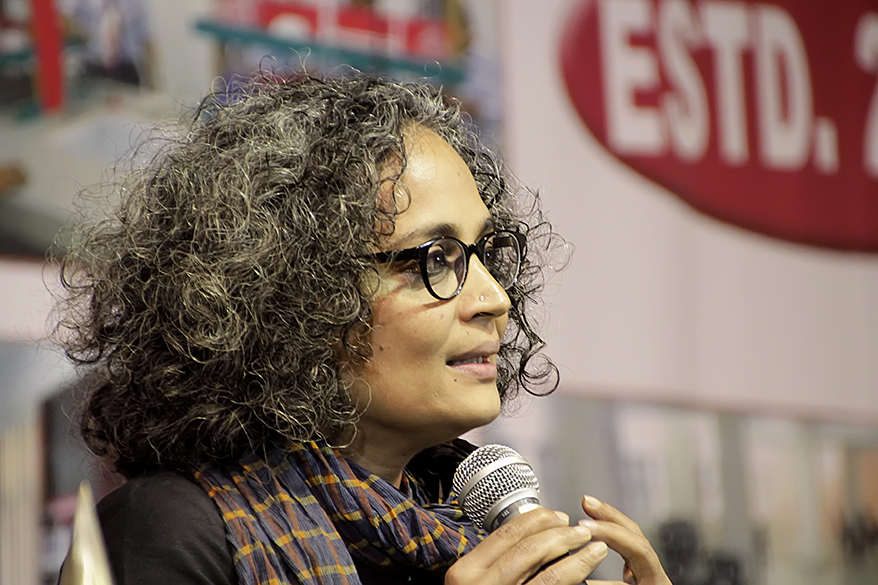
At a New York assembly on AI, Arundhati Roy read from a new essay, warned that India is courting data centres and closed with her writer’s manifesto.
Arundhati Roy says AI threatens the relationship between people and language, and with it “all semblance of social coherence”. The Booker Prize-winning novelist made the case at the People’s AI Assembly, a public symposium the AI Now Institute held at Webster Hall in New York on 19 October 2026.
Roy shared the evening’s final session, “Another World is Possible”, with the Canadian author Naomi Klein. Karen Hao, author of Empire of AI and a board member of AI Now, moderated. The AI Now Institute posted the recording on YouTube on 21 October. All quotes in this report are taken from that recording.
“Actual idiocy”
Roy opened by reading from “Apocalypse Now and Then”, her new essay in Equator magazine, subtitled “Artificial Intelligence Is Capitalism’s Final Destination”. She described the arrival of “the age of AI, actual idiocy, actual super idiocy, recursive snowballing idiocy”.
She said she had always been held by the first verse of the Gospel according to St John: “In the beginning was the word and the word was with God and the word was God.” She told the audience: “I believe this to be true and I believe that disrupting and vitiating the fundamental relationship between humans and language will undermine all semblance of social coherence.”
Writers, publishers, critics, teachers and students now “feel the ground give way under their feet”, she read. “Professors must now look at student assignments with distrust. Publishers have to evaluate new writers like detectives inspecting a potential crime scene.”
The essay turns to Jacob Coxon, a researcher who wrote on X on 9 September that he was leaving Anthropic because AI companies were “gambling with our lives”, according to Fast Company, which said it could not confirm his employment. Roy said Coxon described his workplace as “more or less the Manhattan Project on steroids”. The heads of the largest AI companies then rushed to respond, she read, telling the public “in somber, sepulchral tones” that their technology could end human civilisation, before pleading for government regulation.
“Is it that or is it just the inherent nature of capitalism?” she asked. “Helplessness in the face of untethered greed.”

“No anti-AI movement in India”
Hao asked how to answer people who say AI tools have helped them. Roy turned to India. “I just arrived from Delhi yesterday and truthfully there’s no anti-AI movement in India,” she said. “India’s gearing up to be one of the greatest suppliers of data of all time.” The attitude at home, she said, is: “If data centers can’t happen here, well, please bring them there. Please bring your toxic waste to us.”
She drew on her years with the movements against big dams, displacement and mining. “The science of AI is new, but the way it’s been foisted on us is very, very old,” she said. She compared the industry’s pitch to OxyContin, which does relieve pain, “but what happens next”. These industries, she said, are “very, very good at boosting the help and under-reporting the consequences”.
She read a second passage from the essay, likening the present to the 2004 Indian Ocean tsunami, when the sea drew back from the coasts of Thailand and Indonesia and people walked out onto the exposed sand. “We’re in that moment now. A towering wall of stupidity is about to inundate us.” The consumer applications “can be your mother, lover, therapist, doctor”, she read. “What they can do in the field of medicine is nothing short of a miracle, but it won’t stop the poor from continuing to die of cholera, malaria, tuberculosis, or simply hunger and poverty.”
She told the audience that some workers in India are now required “to wear a camera on their foreheads” to record their movements so that robots can replace them. The larger cost, she argued, falls on people’s minds. Public debate covers “what AI can do for human beings, but not much about what it does to human beings”, she said, pointing to studies of cognitive decline. Later in the session she said of the AI companies: “You want to privatize history and sell it back to us by the meter.”

“The bots are just the closers”
Klein, author of The Shock Doctrine and, with Astra Taylor, End Times Fascism, argued that AI is spreading because so many people are trying to get out of lives that already feel impossible. “The bots are just the closers in a bad deal stretching back decades,” she said. She told the audience the industry had found “somewhere around $8 trillion” to finance the AI build-out without a market for its products anywhere near that spending, and said the bubble’s collapse would open a narrow window for change.
Asked by Hao why she has given her life to writing, Roy said, “I write to stay sane. I write so that the blood flows easy in my body.” Growing up “in a country where there are 3,000 languages”, she said, “language is the skin on my thought.”
She recalled that her late friend, the art critic and novelist John Berger, once wrote to her that he had worked out why she kept writing despite being “blown down” every time. It was, he told her, to let her opponents know she would never be zero. “So it’s almost like really a sense of dignity and a sense of sanity,” Roy said. “That’s why I write.”
A writer’s manifesto
Hao closed by asking each speaker for “one little joyful nugget”. Roy chose a passage from “one of my first political essays”, which she called her writer’s manifesto. She read:
The only dream worth having is to dream that you will live while you’re alive and die only when you’re dead. To love, to be loved, to never forget your own insignificance, to never get used to the unspeakable violence and the vulgar disparity of life around you. To seek joy in the saddest places. To pursue beauty to its lair. To never simplify what is complicated or complicate what is simple. To respect strength, never power. Above all, to watch, to try and understand. To never look away. And never, never to forget.
Hao led the hall in a call and response: “When people rise, empires fall.” Roy’s last words from the stage were for India: “Inquilab Zindabad.”
You can watch the full video here:
Featured image of Arundhati Roy, courtesy: Wikipedia; By Vikramjit Kakati – Own work, CC BY-SA 3.0, https://commons.wikimedia.org/w/index.php?curid=23443304



