
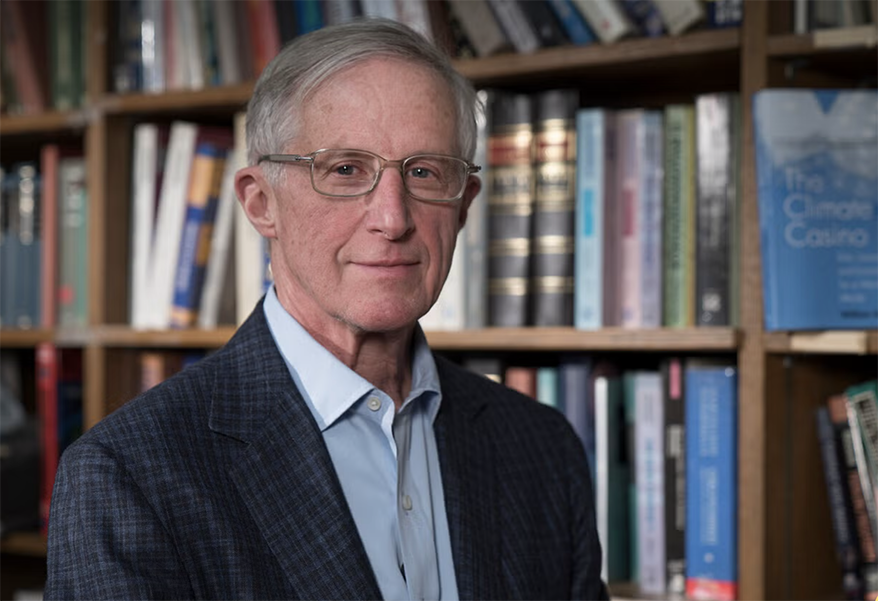
The economist William Nordhaus, who shared the 2018 Nobel Memorial Prize in Economic Sciences for bringing climate change into long-run economic analysis, died on 30 October. He was 85. Yale University, where he taught for more than five decades, said he died after a battle with an aggressive brain cancer.
Nordhaus started working on the economics of climate change in the 1970s, when few economists studied it. His Dynamic Integrated Climate-Economy model, known as DICE, joins a standard model of economic growth to a simple model of the climate. It traces how output drives emissions, how emissions raise temperature, and how warming feeds back as lost crops, rising seas and lower consumption. The model estimates the carbon tax that balances the cost of cutting emissions against the damage they cause. The Obama administration and other governments used it, alongside other models, in setting regulations.
The Royal Swedish Academy of Sciences awarded him half of the 2018 prize “for integrating climate change into long-run macroeconomic analysis”. Paul Romer of New York University received the other half. In his Nobel lecture, Nordhaus called climate change a harmful side effect of economic growth and named a carbon tax as the best remedy.

Farms, regions and India
In a 1993 paper in the Journal of Economic Perspectives, Nordhaus argued that sectors depending on natural rainfall, runoff and temperature would feel climate change most. He put farming, forestry, outdoor recreation and coastal activity in that group.
With Zili Yang, he built a regional version of DICE called RICE, the Regional Integrated model of Climate and the Economy. India was one of its regions. His 2010 paper on the Copenhagen Accord in the Proceedings of the National Academy of Sciences projected growth separately for India, China, Africa, the European Union and the United States.
Indian economists took up the framework and questioned its numbers. Writing in Ideas for India after the Nobel, the economist Dean Spears argued that India is more exposed than the models assumed. Many of the world’s rare days of extreme heat combined with high humidity fall in Uttar Pradesh and Bihar, and the models did not yet account for humidity. A commentary on the blog of the National Institute of Public Finance and Policy in New Delhi made the same point.
Other economists questioned how DICE measured damage. Martin Weitzman argued that it handled rare catastrophic outcomes poorly, and Nicholas Stern said its damage function missed many of the largest risks. Some climate scientists objected to the Nobel because Nordhaus had long favoured lower carbon taxes than they thought necessary. Nordhaus, for his part, criticised the Stern Review in 2007 for its low discount rate. In 2015 he proposed “climate clubs”: groups of countries that set a common carbon price and charge a fee on imports from countries that do not. Analysts have since compared the idea with the European Union’s carbon border levy.

Oil, OPEC and the cost of war in Iraq
His Brookings paper “The Allocation of Energy Resources” appeared in 1973 as the oil crisis took hold. It modelled how markets should allocate fossil fuels and nuclear energy far into the future, built around a “backstop technology”: an expensive but plentiful source that caps the long-run price of scarce fuels. A 1979 Cowles Foundation monograph examined OPEC’s pricing. A review published by the International Association for Energy Economics reported his conclusion that a wealth-maximising OPEC would raise real oil prices by about 2% a year between 1975 and 2005.
In late 2002, months before the United States invaded Iraq, Nordhaus estimated the economic consequences of the war. He put the cost to the United States over the following decade at between USD 100 billion and USD 1.9 trillion. A shorter version ran in The New York Review of Books on 5 December 2002, and the full paper formed the economics chapter of the American Academy of Arts and Sciences study “War with Iraq: Costs, Consequences, and Alternatives”.
William Dawbney Nordhaus was born in Albuquerque, New Mexico, on 31 May 1941. His father, a lawyer, built a firm that represented Native American tribes and founded what became the Sandia Peak Ski Area. Nordhaus graduated from Yale in 1963 and took his PhD at the Massachusetts Institute of Technology in 1967 under Robert Solow. He joined the Yale faculty the same year and stayed until he retired in 2024.
In the early 1970s he and his Yale colleague James Tobin wrote “Is Growth Obsolete?”. The paper proposed a Measure of Economic Welfare, an early attempt at environmental accounting. From 1985 he co-wrote Paul Samuelson’s textbook Economics, carrying it through its 19th edition. His later books include The Climate Casino (2013) and The Spirit of Green (2021).
He served on President Jimmy Carter’s Council of Economic Advisers from 1977 to 1979, was Yale’s provost from 1986 to 1988, chaired the board of the Federal Reserve Bank of Boston and was president of the American Economic Association. Yale says that in 2014 he helped design its internal carbon charge.
Photo of William Nordhaus courtesy of the BBVA Foundation and YalesNews



