
The Ezhuthachan award winner built his own world out of soil, insects, instruments and code, and viewed nature with a scientist’s eye
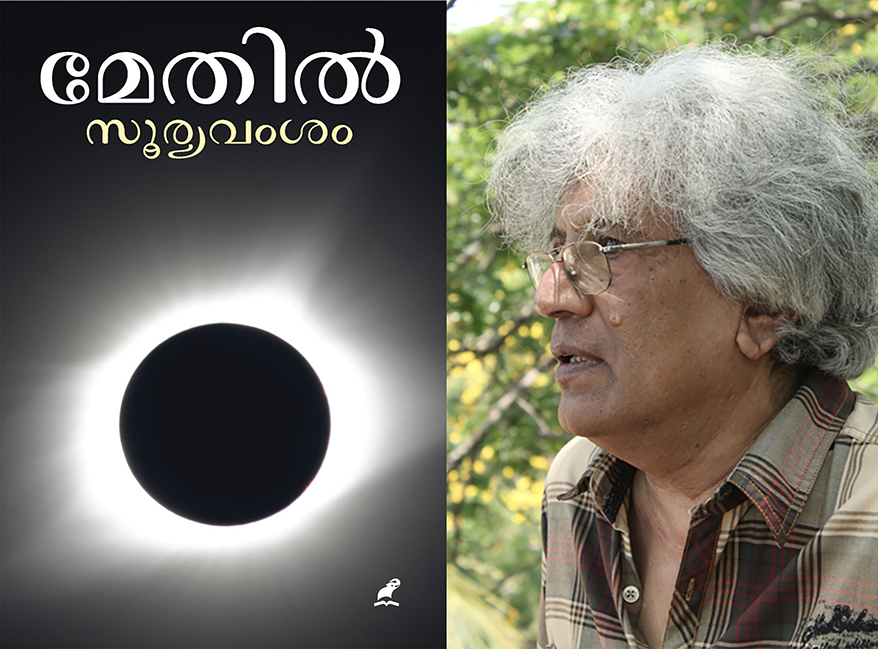
Sooryavamsam opens with a dedication of three lines by Salvatore Quasimodo, the Sicilian who won the Nobel Prize for Literature in 1959.
Everyone is alone on the heart of the earth
pierced by a ray of sun:
and suddenly it’s evening
The lines are among his best-known poems, a short meditation on solitude and how fast a life passes. Maythil was about 26 when he placed the Sicilian poet at the door of his first novel.
Then the sun rises, and it is an animal. Its hood of fire unfurls from the burrow of the night. It crawls across the crystal floor of the sky, spits yellow venom, and strikes the green flesh of the earth with white fangs.
Within three sentences the snake has become a spider. “The sun weaves a web of fire beneath the sky,” Maythil writes, and binds the spinning earth in threads of fire. The page closes on a Sanskrit verse from the Surya Ashtakam, bowing to the sun as lord of all the worlds. Maythil has joked that Sooryavamsam is his Sanskrit novel.
The novel came out in 1970. Maythil started it in the final year of his degree and took roughly two years to finish it. The critic Haridas Balakrishnan, writing in Kalakaumudi, calls it the biggest explosion in the Malayalam language since O.V. Vijayan’s Khasakkinte Ithihasam. K. Satchidanandan once wrote that very few in Indian fiction can match Maythil’s “artistic innovation, intellectual subtlety and original perception”.
On 1 November, a jury chaired by K.G. Sankara Pillai chose Maythil, 82, unanimously for the 2026 Ezhuthachan award, Kerala’s highest literary honour.
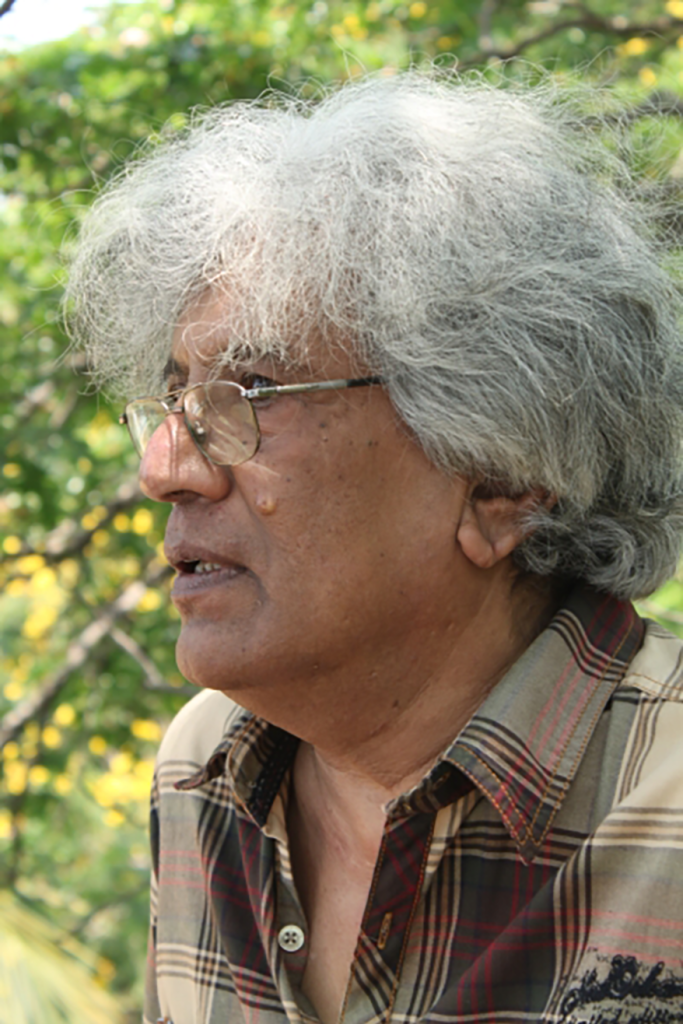
(Image courtesy: By Original uploaded by Vm devadas. – Transferred from ml.wikipedia by Sreejith K (talk), CC BY-SA 3.0, https://commons.wikimedia.org/w/index.php?curid=14797365)
One novel that opens the door to his world
On the surface, Sooryavamsam is a death and a set of explanations. A man called Chakrapani is found dead at the home of Dr Prasad after an overdose of sleeping pills. Yamuna, a young poet, spent a night with him. Prasad’s friend Jayadevan listens to rival theories of murder and suicide.
Around that plot, Maythil packs a reader’s whole world. Kafka, an English war poem and the Bhagavad Gita all pass through it. Jayadevan reads Yamuna’s face as a galvanometer, an instrument for measuring the currents of the mind. The book ends on a sundial darkened by the shadow of Rahu, the planet that swallows the sun. Quasimodo’s poem moves from a ray of sun to sudden evening, and so does the novel.
A world of his own making
Most writers grow out of a milieu. Vijayan had Khasak. Generations of Malayalam writers have drawn on the tharavad, the village, the party, the Gulf.
Maythil moved too often for any one place to hold him. Born in Palakkad, he took an economics degree, spent eight years researching insect behaviour, worked in Kuwait for a Norwegian shipping firm, ran a computer-aided design centre in Coimbatore and settled in Thiruvananthapuram.
The ground he kept returning to was the living world at small scale. As a child, centipedes and scorpions were his company. His observations on animal behaviour were later published by Britain’s Entomological Society. Vladimir Nabokov managed the butterfly collection at Harvard between writing novels, but kept the science and the fiction disparate. Maythil let the insect walk straight into the poem.
Malayalam has never lacked nature writing. In most of it, the monsoon, the river and the paddy field are a setting, a mirror for feeling, or something to mourn. Maythil asked an ethologist’s questions instead: what the creature does, how it is built, how it lives and dies. He wrote about the gardens hidden inside termite mounds. Those gardens are real: fungus-growing termites have farmed a mushroom inside their nests for about 30 million years, and the oldest farmers in Kerala’s soil are termites.
From that close looking he built a theory of poetry. Most critics accept two levels in a poem, the personal and the social. Maythil added a third, the animal plane. His poem Mannile Adayalangal (Marks in the soil) puts it to work. The speaker reads the history of one night in tracks pressed into the earth: hunting, mating, and creatures near death heading for their burrows. He always arrives after the movement has stopped. The poem ends with a single slipper in his hand: Cinderella, too, has gone to ground.

Grammar as engineering
A writer who reads tracks in the soil needs a language as exact as the observation. Maythil found his in machines.
He spent the 1980s in computing, and in 1985 he told a Malayalam magazine that “coding is poetry”. That was the year Italo Calvino died while preparing a Harvard lecture on exactitude, the quality he wanted literature to carry into the next millennium. Maythil calls writing ‘engineering with language.’ It must stay varamozhi, the written word, and never slide into vamozhi, the spoken.
That same precision runs through his 1973 collection Penguin, which turns a close eye on medical instruments and lets them come alive. In “Thermometer”, the mercury becomes a silver silkworm sealed in a glass cocoon, never to emerge as a moth. In “Stethoscope”, a lover’s heart is heard as two doors and four windows opening and slamming in a red wind.
Kafka is in Sooryavamsam. Maythil uses dashaparinamam, the biologist’s word for an insect’s metamorphosis. Flies and mosquitoes go through it, the exchange concludes, while the protagonist wonders that human metamorphosis happens only in Kafka’s story.
Years later, in a story set in Kuwait, a husband teases his wife that scorpions and centipedes will march into their bedroom if she keeps quarrelling. The man wakes into a day of centipedes.
Beyond what we see
Maythil has always stood apart. As a schoolboy he wrote an essay attacking Ponkunnam Varkey’s autobiography, published in Navayugam. In 2016 he declined the Kerala Sahitya Akademi’s award for overall contributions, citing his lack of faith in literary academies.
The Ezhuthachan Award honours the poet who started it all for Maythil. The day after the announcement, he told Manorama that hearing Ezhuthachan’s Ramayana read aloud gave him his language and his way into poetry.
Nabokov brought the laboratory to literature; Calvino brought precision; and Kafka found the insect within the man. Each of them opened a door.
Maythil opened them together, in Malayalam. He looked at a sunrise and saw a cobra; at a thermometer and saw a silkworm; at a termite mound and saw a farm…
Writers who see past what everyone else sees change how their readers look at the world. Maythil is one of them, and the world beyond Malayalam has yet to read him.



