
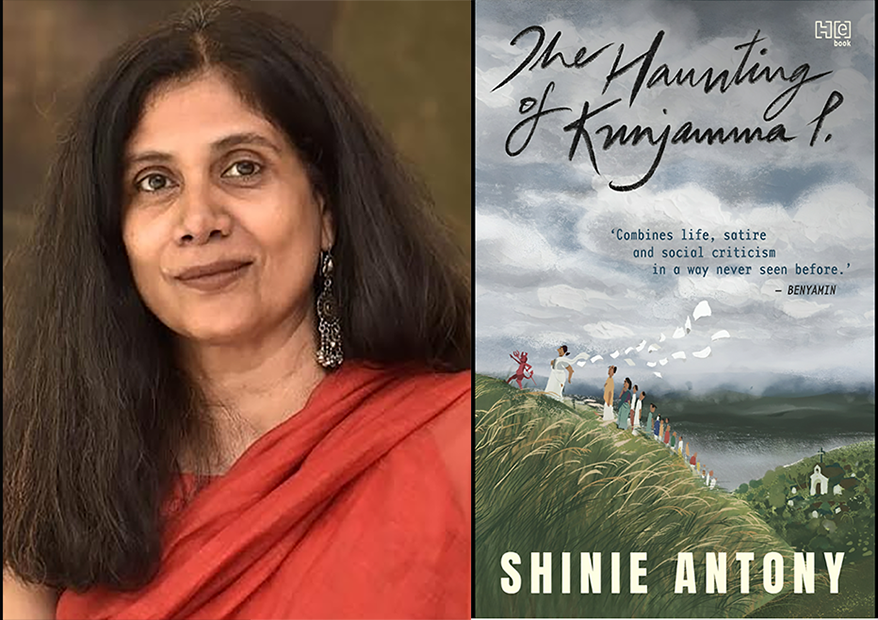
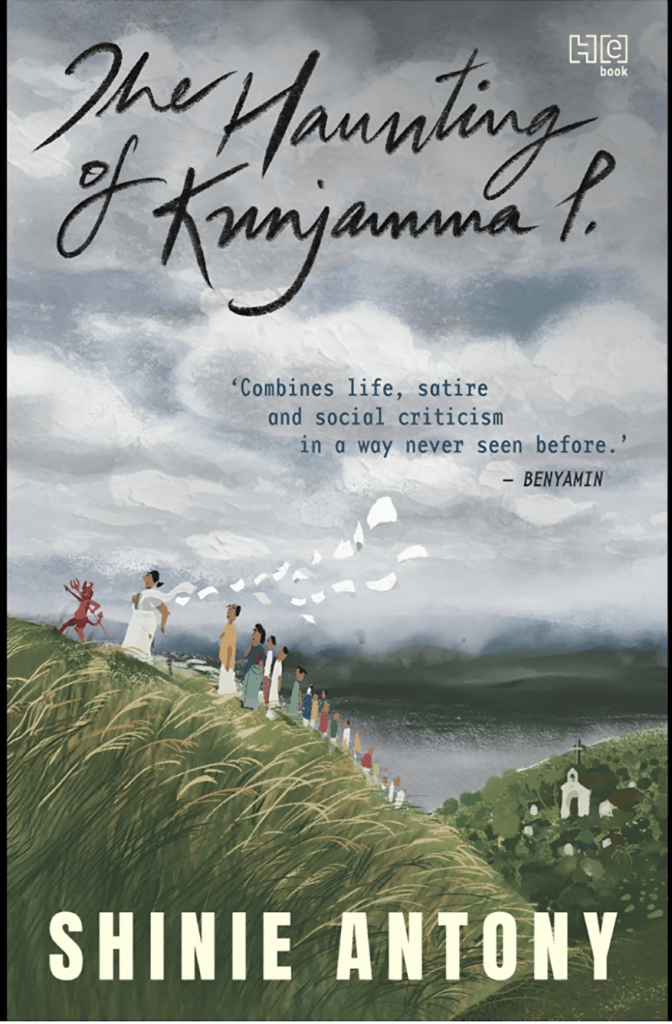
The Haunting of Kunjamma P. by Shinie Antony. Hachette India, 224 pages, Rs 699.
Page 66 is where the book got me.
I am not a reviewer, or a literary critic, or anything remotely to do with judging writing. I read.
And as always happens when you pick up an author new to you, more so one from Kerala, you start judging. So it is that I began The Haunting of Kunjamma P. telling myself this cannot be good. For a while it wasn’t.
Some of the wisecracks fell flat. The narrator’s omnipresence grated. Some predictability set in: one chapter from Double D, the devil telling his own story, the next from Shinie with Kunjamma’s, and so on.
Then came what Double D calls an “enforced cosmic meditation”. Having imagined “the horriblest” and run out of anything “horribler”, he shuts his eyes, breathes (inhala, exhala, the Malayali way) and writes himself a job description. Create mayhem in the small space allotted to human beings. Make them doubt their beliefs and themselves.
The paragraphs after that came at me like bombs. Somewhere in there I stopped reading the book and moved into it.
A woman, a devil and the Fifth Gospel
Kunjamma Paulose is the parish’s model of piety, the kind who sweeps the church courtyard at dawn and prays as if the whole town is watching. Double D chooses her.
In her interview with The Wise Owl, Shinie describes him as half-rakshas and half-pishach, a nobody in Hell, “almost an apprentice”. He wants to be the god of ungods. Kunjamma becomes convinced God has asked her to write the Fifth Gospel.
She fills notebooks in great blue loops, in what the priests decide is Aramaic with a sprinkling of Latin, and a pickle recipe in Malayalam somewhere in the middle. Blasphemy, if you like.
From there the men take over. The Vikari Achchan and Father John pore over the symbols, send a paragraph to an Aramaic expert in Iceland, and hold their meetings in the dead-toys room so no one suspects a conspiracy.
Jagathy in a mundu
The comedy is where a Malayali reader gets a bonus. Paulose, the husband who “showed all symptoms of having fallen in love with his own wife”, is Jagathy Sreekumar in print. Shinie says he was the character she most enjoyed writing: the covert lechery, the mundu flicked up and down so he looks busy and jobless at the same time.
Shinie does not let him off lightly. Summoned to the church, Paulose goes “without a thought in his head”, watching women from behind and locating their panty lines. He mourns the sari’s flyaway ends, finds the choodidhaar “believed in ‘show, don’t tell'”, and his mind, rejecting kundi and chandhi, settles lovingly on purram.
On buses his hands wander, and the Vikari Achchan keeps his own theory about what women mean when they stare at Christ’s feet. Shinie says that Kerala is a hotbed of misogyny; she shows it through the men’s eyes, and the joke is always on them.
Paulose asks Father John when the church is organising its next trip to the Holy Land; Kunjamma wants Rome. The priest explains that the Holy Land is in the Middle East. “O, Dubai!” says Paulose, knowingly.
And in what could be a situation from a Kalabhavan Mani skit, Father John turns up at the Vikari Achchan’s door and repeats every line the senior priest says, word for word, then sobs that he doesn’t feel like himself. Another knock, and a second Father John stands outside, also crying; Double D quietly deletes one.
Kochu Thresia’s hasty funeral, remembered as the two-minute Maggi samskaram, sends her off in Paulose’s banian and Y-fronts because Kunjamma’s underwear proved too large.
Shinie says she wanted to carry Malayalam wit into English, and that she adores the casual Malayalam rudeness that signals intimacy. It shows on every page.
Comparisons with Arundhati Roy and Abraham Verghese are inevitable for any Kerala novel in English. Roy writes with a poet’s ear; Verghese shoots in 70 mm.
Shinie mixes something else, a bit of Sreenivasan, a bit of Zacharia and a bit of MP Narayana Pillai, and the amalgam keeps taking on new layers.

Asura and Sura are brothers
Under the comedy sits an argument. Double D is shown running through a list. Satan testing Job with God’s permission. Iblis cast out for refusing to bow to Adam.
The yetzer hara, the evil inclination the rabbis say God himself put in man. Ahura Mazda and Angra Mainyu. Ravan, Shiva’s devotee and by tradition the author of the Shiva Tandava Stotram. Kacha, son of the devas’ guru Brihaspati, learning the Mrita Sanjeevani mantra from Shukracharya, guru of the asuras.
Every name here is a place where god and demon turn out to be family. Kacha matters most. The asuras killed him again and again, and each time Shukracharya’s mantra brought him back.
In Catholic teaching a fallen angel’s choice is final; the devil cannot repent. Indian tradition is kinder to its demons. Jaya and Vijaya, Vishnu’s own gatekeepers, chose to be born as his enemies because hatred would bring them home faster than devotion.
Shinie told The Wise Owl that one question drove her: what it means to be an Indian Christian, in what she called an imported religion. As I read it, her answer is to let a rakshasa-pishacha loose in a Syrian Christian parish and let the older Indian logic settle the ending.
Filius
A baby arrives in the house, and the demon who wanted to rule Hell finds himself undone by a child. I won’t say how. In the last thirty pages the devil’s monologue turns into an orphan’s confession, and Shinie keeps the comedy running through it.
“Perhaps evil is just the fear of love,” Double D says near the end. Shinie said it was the most threadbare thought she had when she started: that we turn away affection and court the very people guaranteed to break our hearts.
Watch what Double D does once he stops being afraid, and what it costs him.
I still can’t put a finger on this book. Maybe that is what books should be, no?
“Perhaps evil is just the fear of love,” he says. Shinie told The Wise Owl it was the most threadbare thought she had when she started: that we turn away affection and court the very people guaranteed to break our hearts. Double D stops being afraid, and it costs him everything. In the last pages he blows out the candles on his own cake and wishes himself out of existence, with Kunjamma and Syro among the faces flashing past. Then heavy oak doors open, and a voice booms Lupus in fabula. Speak of the devil.
I still can’t put a finger on this book. Maybe that is what books should be, no?



