
High Court pushback in its verdict against Lulu Group earlier this year echoes public concern
A majority of respondents based in Kerala in our first Global Food Systems Survey say the state’s flagship wetlands protection law is too weak to withstand the pressure of commercial development. This underscores a widening gap between policy intent and land-use reality in one of India’s most environmentally sensitive states.
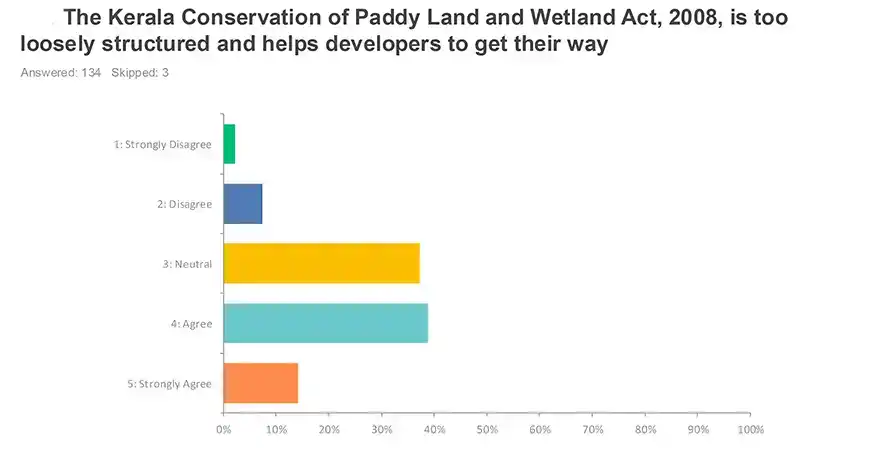
In the Fourth Plate Global Food Systems Survey, over half (53%)of those who answered a Kerala-specific question agreed or strongly agreed that the Kerala Conservation of Paddy Land and Wetland Act, 2008, is “too loosely structured and helps developers to get their way.”
Only about 10% disagreed, with an unusually large neutral bloc (37%) hinting at confusion or a lack of trust in enforcement rather than in principle.
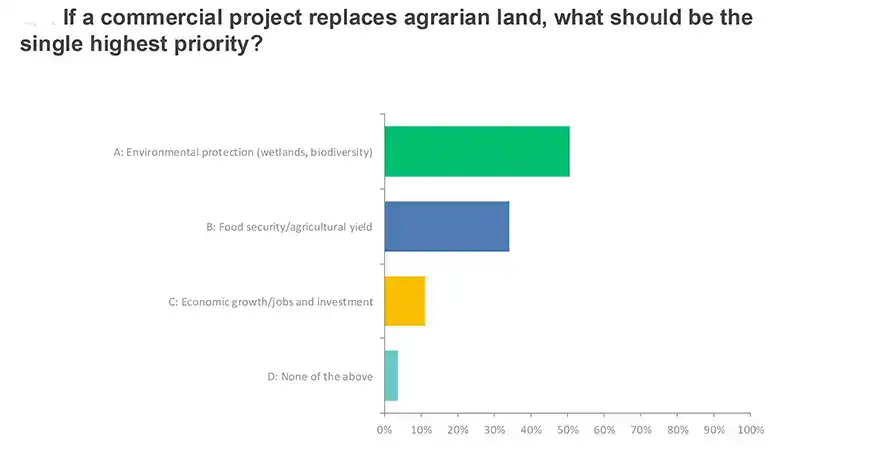
The finding is flanked by broader sentiments that sharpen the state’s dilemma: respondents nationwide rank environmental protection as the single highest priority when commercial projects replace agrarian land (51%), far ahead of food security (34%) and economic growth (11%).
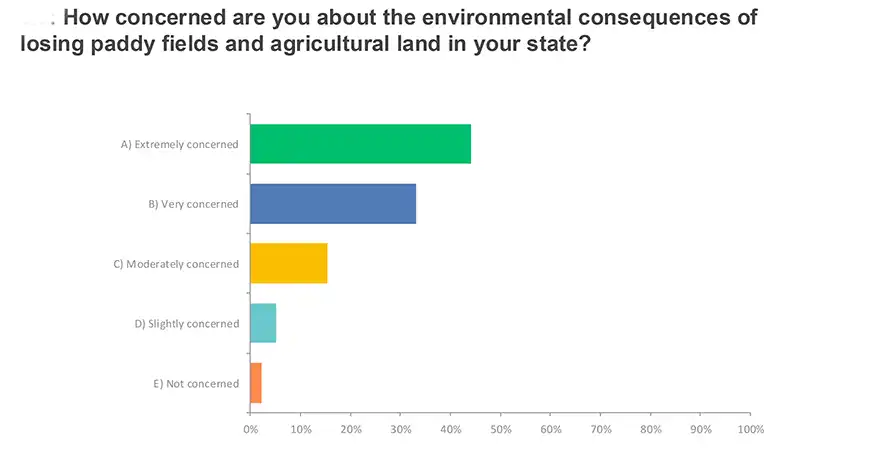
Three in four say large malls have a net negative impact on small local businesses. And 77% report being “extremely” or “very” concerned about the environmental consequences of losing paddy fields and agricultural land—an anxiety that maps directly onto Kerala’s flood-prone geography and its reliance on wetlands as natural buffers.
The findings resonate with the perspectives that we brought in our investigative series about malls and farmlands in Kerala. The story outlined Kerala High Court quashing Lulu Group’s arguments about the status of the land it had earmarked for a mall.
Taken together, the signal is clear: even as growth projects promise jobs and modern retail, the public mood—among digitally engaged citizens—is more protective than permissive. Where Kerala’s law is meant to hold the line, many believe it is not holding it well enough.
Policy design versus practice
Kerala’s 2008 Act is widely cited as a progressive bulwark against indiscriminate conversion of paddy lands and wetlands. Yet the critique in the survey points to the mechanics of exemptions, reclassification, and implementation.
For the respondents, the law’s strength is measured not by its text but by outcomes on the ground: fewer conversions, clearer maps, stricter approvals, and visible sanctions. The neutral bloc may reflect opacity—citizens uncertain whether a given mall or road was legally sited, or whether cumulative impacts were truly assessed.
Kerala’s urban fringe—where low-lying paddy fields meet rising real estate values—creates the conditions for “creeping conversion”: parcel-by-parcel shifts that elude comprehensive review but add up to hydrological risk. In such settings, even well-drafted statutes can be undermined by administrative discretion, political pressure, and data gaps.
Notably, 52% of respondents either agree or strongly agree that commercial projects creating thousands of jobs are an “economic necessity” for state development. That ambivalence—pro-growth but pro-protection—suggests the public would accept development if guardrails are credible and trade-offs are transparently evaluated.
The numbers imply a policy opportunity: move from permissive case-by-case conversion to integrated land-use planning with binding environmental thresholds and social impact accounting, and couple that with local enterprise strategies so that new malls do not hollow out the small business ecosystem they purportedly modernise.
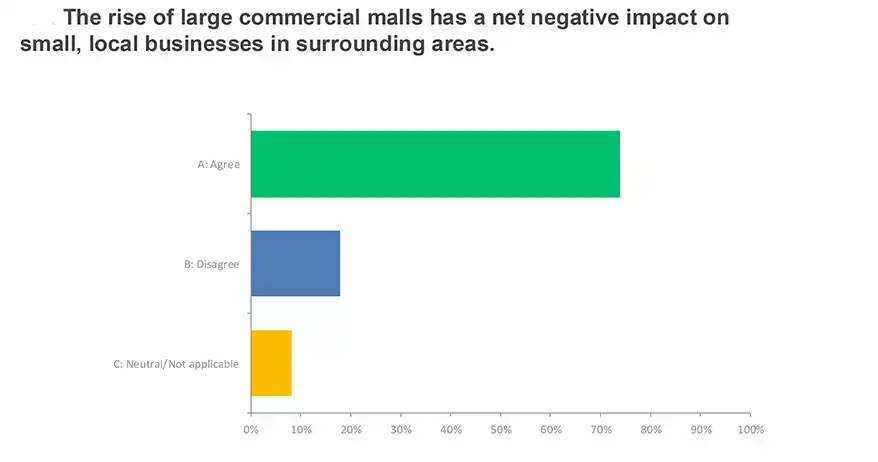
In a state where retail is a dense lattice of neighbourhood shops, the mall’s footprint is not only physical but systemic—altering supplier dynamics, credit cycles, and consumer habit formation.
Food systems and the youth questionKerala’s longer arc runs through food security and agricultural futures. While the Kerala-specific question is about legal robustness, adjacent signals matter: respondents overwhelmingly prioritise higher profits and market guarantees as the lever to draw young people into agriculture (49%), ahead of technology integration (24%).
If paddy land protection is to be politically sustainable, it must be paired with farm incomes that justify keeping land in agriculture rather than reclassifying it for urban use.
Climate risk sharpens the case with 85% reporting high concern about climate change impacts on Indian agriculture. In Kerala, where extreme rainfall events are more frequent, wetlands and paddy fields function as safety infrastructure as much as as agricultural assets. The public appears to grasp that dual role, even if policy tools have lagged.
What would reassure the public? The survey points towards three credibility gaps and corresponding fixes:
- Clear enforcement: public registers of protected parcels, conversion decisions, and compliance audits—so neutrality shifts to informed support.
- Studying cumulative impact: basin-level hydrological assessments that treat conversions as system changes, not isolated permits.
- Local economic integration: policies to prevent retail displacement—supplier diversity mandates, fair tenancy rules, and targeted support for small businesses alongside any large mall approval.
For Kerala’s planners and lawmakers, the path forward is less about rewriting intent and more about making intent legible and enforceable.
Read the research methodology here