
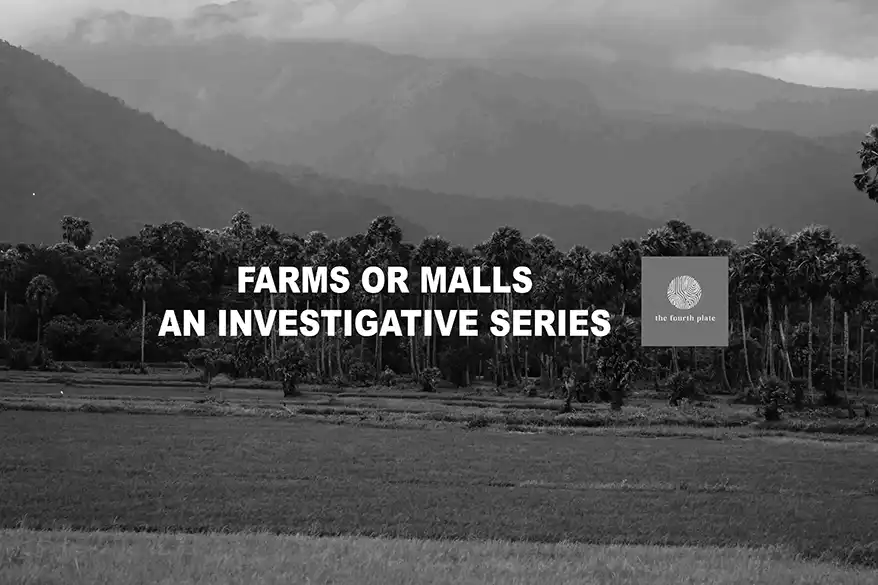
Agricultural Officers: Kerala’s Last Environmental Guardians Against Corporate Land Grabs
Part 1: How an Agricultural Officer’s Report Paused Lulu, the Retail Giant, in Thrissur
In a David versus Goliath battle playing out across Kerala’s paddy fields, Agricultural Officers have emerged as the final bulwark against what environmental activists describe as “systematic corporate land grabbing” by the state’s business oligarchs.
The scale of Kerala’s agricultural land loss is staggering. From 8.82 lakh hectares in 1974-75, paddy cultivation area has plummeted to 2.03 lakh hectares by 2018-19 – a loss of 7 lakh hectares in just 39 years.
The pressure for land conversion continues unabated, with 94,511 new applications filed since April 2021 alone.
The battle lines were drawn when Lulu Group, a multinational retail conglomerate, sought to proceed with the construction of a new mall complex in Thrissur. The project promised modern retail spaces, a multiplex and food courts – but at what environmental cost?
An investigation by The Fourth Plate, involving interviews with over 50 Agricultural Officers, farmers, and environmental activists across Kerala, reveals how these civil servants are using scientific evidence and regulatory powers to challenge such corporate interests – often at great personal and professional risk. Many officers reported facing transfers, professional isolation, and in some cases, indirect threats to their safety.

The Battle to Save Kerala’s Wetlands
The recent Kerala High Court verdict quashing Lulu Group’s arguments about the status of the land as buildable and seeking ‘fresh evaluation’ exemplifies this. The land in question is more than just a paddy field.
Despite claims about the land being barren, a bold Agricultural Officer provided meticulous documentation proving otherwise. The evidence included reports showing recent paddy stubble, and physical verification of cultivation.
The court found this evidence compelling, with the judgment observing that “wherein the District Collector has vouched to Ext.P14 report and stated that the Sub Collector has reported that a site inspection was conducted and the satellite pictures of the land were examined in detail and in the site inspection it has found that property in Survey No.405 was a paddy land before and the same is being converted by filling the same and further that the trees in the land appears to be recently planted and that it is surrounded by paddy land which are low lying….”
The true scale of Kerala’s land conversion crisis emerges from official records. Agricultural Officers have identified 7,294 cases of illegal filling, while revenue officials independently documented 7,134 cases. Kerala Vigilance’s “Operation Conversion” exposed how deeply systematic the land grab has become, finding the same phone number on 700 conversion applications across multiple districts.

The Environmental Cost
Critics argue that since Kerala has moved away from paddy cultivation, these lands should be released for development. This simplistic view ignores the ecological consequences, which become devastatingly clear with each new natural disaster.
Scientific evidence demonstrates that each hectare of converted paddy land eliminates approximately 2 crore liters of annual water recharge. The consequences became devastatingly clear during the 2018 floods – Kerala’s worst in nearly a century – which claimed 483 lives and forced over one million evacuations. The subsequent 2024 Wayanad landslides further emphasized the deadly link between unregulated development and natural disasters.
Ernakulam district alone has seen an 86 million cubic meter depletion in groundwater recharge between 2013-2023. These represent the systematic destruction of water management systems that evolved over centuries. But since any disaster happens to ‘somebody else’ and our immediate concerns are mall hopping, such integral realities are better left undiscussed.
Corporate Tactics and Legal Precedent
The High Court’s verdict exposed how many corporations attempt to game the system. The pattern is clear:
- Claims of historical conversion before 2008
- Attempts to bypass Agricultural Officers’ mandatory reports
- Pressure on local officials
- Use of multiple corporate entities
- Strategic legal maneuvers to avoid public precedents
A typical tactic involves creating multiple shell companies, each applying for small land parcels to stay under regulatory thresholds. In one case, investigators found 12 different companies, most of them sharing the same directors, applying for adjacent plots.

Putting the Onus on Politicians
The picture that many miss in this story is how the onus of ‘project delays’ are conveniently put on politicians while the real issue is brushed under the carpet.
It is in this vein that the issue came to the fore, when Lulu’s head MA Yusuffali spoke at a public function about one political party ‘needlessly’ interfering to impact the project that would have created ‘3,000 jobs.’
The media circus began shortly after. Without going into the detail of the claim, the hunt started for ‘which is that political party’ until it zeroed in on Mukundan, a worker of CPI, who said his fight is individual and not on party lines. The party also was quick to distance from Mukundan.
The slant of the stories that the media reported were understandably pro-Lulu. A report in a Gulf-based daily is an example, where it simply states – “The land had remained uncultivated for decades, with no paddy farming during this period. The Chiriyankandath family had filled the land with soil in anticipation of future development activities. However, the plans did not progress.”

This is partial truth or a denial of the absolute truth, with journalistic misrepresentation to side with those in power. In fact, the entire piece is written from the perspective of Lulu group. That is fine, but distortion of facts? The categorical assertion that the land was uncultivated? The subtle hint that ‘filling the land with soil’ by the previous owner is okay?
This strategy of blaming political interference resonates in Kerala, where “politics blocking development” has become an entrenched narrative.
That the current administration should act as guardians of agricultural land is conveniently forgotten. Only one perspective seems to matter: that of corporate interests.
Beyond Job Creation Claims
When Lulu Group promises 3,000 new jobs with their Trisshur project, it presents a seductive narrative in a state grappling with unemployment. Yet both the quality and impact of these positions demand closer scrutiny.
According to the Group’s own IPO prospectus filed in the UAE, 95% of their 55,300 employees work in entry-level store positions, with only 5% in administrative roles.
For Kerala, with one of India’s highest literacy rates and a growing pool of IT-skilled professionals, this represents a fundamental misalignment with the state’s developmental needs.
The question is: is this 95% store jobs that our youth need? Meaning, are our mall developers creating high quality jobs? The answer is an obvious no.
The economic impact is even more concerning. For every organized retail job created by malls, 3-4 traditional establishments close. In Ernakulam alone, over 7,000 retail shops closed between 2014 and 2022, affecting 21,000 families.
The post-COVID era has only accelerated this decline, with nearly 100,000 establishments shuttering and 300,000 small-scale merchants facing existential threats. While Lulu Mall Kochi celebrates 80,000 daily visitors, historic retail streets like Broadway have seen sales plummet by 50%, with many permanent closures.
This stark reality is often obscured when corporate leaders state that ‘political interference’ is blocking job creation.
Public opinion may temporarily swing in their favor, but the data tells a different story: Kerala is trading away opportunities for knowledge-economy jobs that could better serve its educated workforce. And we see this with industrial investors moving away from the state.
This is not a story that media outlets want to tell, but netizens are bolder. This Reddit thread is an example of how more voices are questioning whether malls are truly the ultimate in development.

The Agricultural Officers’ Fight
Agricultural Officers face immense pressure when their scientific assessments conflict with corporate interests. Yet they’ve built an undeniable paper trail of violations, methodically documenting each case through field visits, satellite imagery analysis, and physical verification.
The High Court’s intervention sets a crucial precedent. The judgment mandates that “the Director of the Kerala State Remote Sensing and Environment Centre shall personally supervise the preparation of the report and submit a clear and authentic report… regarding the nature of the land, strictly in accordance with the satellite images obtained for the relevant period.”
Verdicts are one thing, but what plays out in the next four months – the time granted by the court – will be crucial. Politics and power are likely to win, while the woes of land – and the scientific evidence – are likely to be ignored.
The Agricultural Officers’ successful intervention in Thrissur may have temporarily halted what appeared inevitable – the systematic conversion of the state’s remaining ecological heritage into corporate real estate.
But this success is fragile. With corporates having expanded resources and the systematic corruption exposed through Operation Conversion, the pressure on Agricultural Officers will only intensify.
Kerala must choose: strengthen these environmental guardians or watch its ecological future disappear under concrete and steel.
The battle for Kerala’s soul continues in every remaining paddy field, every Agricultural Officer’s report, and every court challenge against corporate land grabs.
These civil servants may well be Kerala’s last environmental guardians – and the state’s survival depends on protecting them.

Lest we forget…
The greatest victory for corporate interests would be our collective amnesia – when we stop questioning, stop going beyond corporate narratives and simply accept the corporate view that concrete development is the only path forward.
Once wetlands are filled and paddy fields are paved over, they are lost forever. No amount of future regret can bring back these complex ecological systems that evolved over centuries.
By maintaining this debate, by questioning each conversion and by supporting those who stand guard over our environmental heritage, we keep alive not just an argument, but the possibility of an alternative future for Kerala.
This is precisely why such resistance faces such organised opposition – because an informed, questioning public is the greatest threat to uncontrolled development.
“We’re not just protecting paddy fields,” adds an Agricultural Officer. “We’re protecting Kerala’s future water security, flood resilience, and food sovereignty. That’s worth fighting for.”
To be followed by Part 2, examining how mall culture has systematically eroded Kerala’s traditional retail ecosystem and farming supply chains, while exploring how new integrated developments in converted lands, especially in Thrissur, are impacting its fragile ecosystem.
This report is the result of investigations by over 10 contributors to The Fourth Plate.