
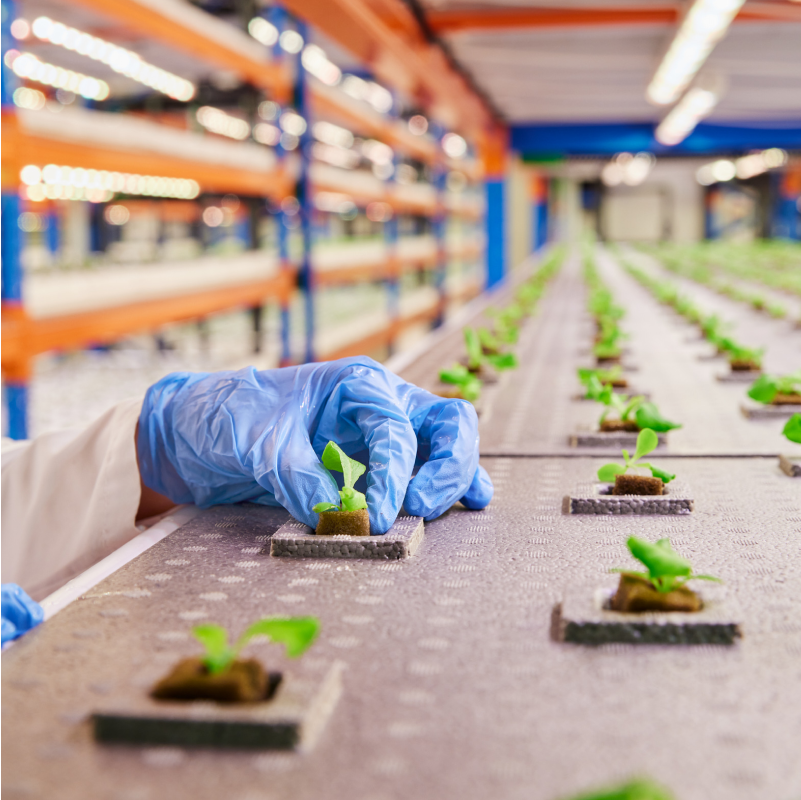
In the heat of the United Arab Emirates, where temperatures regularly soar past 40°C and rain is scanty, an agricultural revolution is taking root. The nation, which imports over 90% of its food, is turning to cutting-edge technology and innovative farming methods to grow everything from strawberries to saffron in one of the world’s difficult environments for agriculture.
At the heart of this transformation is Bustanica, the world’s largest vertical hydroponic farm, producing over one million kilograms of leafy greens annually in the desert outskirts of Dubai. The facility represents a new shift in farming, whereby traditional soil and sunshine are replaced by carefully controlled environments and advanced technology.
Last year, Emirates Flight Catering, one of the world’s largest catering operations, fully acquired Emirates Bustanica, formerly called Emirates Crop One, and its consumer brand Bustanica, the world’s largest indoor vertical farm.
“This move establishes Emirates Bustanica as a fully UAE-owned company, helping sustain the country’s vision of enhancing food and water security and its agricultural capabilities. The acquisition empowers Emirates Bustanica to leverage its local expertise and the latest tech know-how to meet the growing demands of the market,” a press release by Emirates stated.
Such state-of-the-art facilities use up to 90% less water than traditional farming methods, and are protected from extreme outdoor temperatures and sandstorms. The controlled environment allows for year-round production, independent of external weather conditions.

But the UAE’s agricultural ambitions extend far beyond vertical farming. In Dubai, the International Center for Biosaline Agriculture (ICBA) is pioneering another approach: teaching plants to thrive in harsh conditions rather than sheltering them from it.
Their scientists have successfully grown salt-tolerant varieties of quinoa, salicornia, and other crops using water that would normally kill most plants. The center’s genebank houses over 17,000 seeds of plants adapted to marginal environments, fostering research into crops that can flourish in desert conditions.
As a nation with high food imports, the UAE is vulnerable to global supply chain disruptions and price volatility. The COVID-19 pandemic and recent geopolitical tensions have highlighted these vulnerabilities, accelerating the nation’s push for greater food self-sufficiency.
This drive for food security, however, comes with its own challenges. The UAE’s agricultural sector is currently the largest consumer of water in a country where water is desperately scarce, accounting for approximately 67% of total water resources. Traditional farming methods have led to severe groundwater depletion and increasing soil salinity, making many areas unsuitable for cultivation.
The solution, according to the UAE’s National Food Security Strategy 2051, lies in technology. The nation is betting big on AgTech, with ambitious projects sprouting across the emirates. In Abu Dhabi, a $680 million joint venture between US-based Plenty Unlimited Inc. and Mawarid Holding Investment is developing a network of indoor farms, with their first $130 million facility aiming to produce over 2 million kilograms of strawberries annually.
The UAE’s agricultural transformation is also closely tied to its climate commitments. The country aims to achieve net-zero emissions by 2050, and the agricultural sector is expected to reduce its emissions from 6 million tonnes of CO2 equivalent in 2019 to just 1 million tonnes by 2050. This means new farming facilities must increasingly rely on renewable energy to power their operations.
The results of these efforts are already visible in local supermarkets, where UAE-grown produce is increasingly available. Local production now meets over 20% of the country’s vegetable demand, with some crops like cucumbers achieving 80% self-sufficiency. These numbers, while still modest compared to the country’s overall food needs, represent significant progress in a nation where conventional agriculture was once considered nearly impossible.
The high costs of advanced farming technologies, the energy demands of climate-controlled facilities, and the need to train a skilled workforce remain hurdles. However, the country’s commitment to innovation, substantial financial investments, and clear strategic vision suggest that the future of desert agriculture may be greener than ever imagined.