
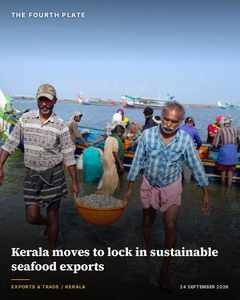
Kerala’s seafood sector has finalised a draft fisheries management plan intended to protect the state’s export markets by tightening how much and how young fish can legally be caught. The Indian Council of Agricultural Research’s Central Marine Fisheries Research Institute, headquartered in Kochi, drew up the framework, which sets science-based harvest control rules and gear restrictions for the state’s trawl fleet.
The plan’s central aim is keeping Kerala seafood exports competitive as international buyers grow more selective about sourcing. K N Raghavan, chief executive of the Seafood Exporters Association of India, said “international retailers are increasingly demanding certified sustainable seafood,” adding that the framework would help ensure Kerala’s catch remains “highly competitive, fully compliant, and recognised globally for responsible practices.”
Central to the plan is a requirement for square-mesh codends, netting that lets juvenile fish escape trawl nets before they are caught, protecting future breeding stock rather than depleting it season after season. The framework also mandates wider use of turtle excluder devices, which allow sea turtles caught in trawl nets to escape, and calls for modified trawl gear designed to cut fuel consumption alongside its emissions.

Tracking the catch digitally
Enforcement has historically been the weak point in fisheries management plans, and the CMFRI framework tries to close that gap with technology. It proposes digital tracking of trawler movements to monitor fishing effort against permitted zones, paired with a mobile application for on-water enforcement. Local fish dealers and aggregators will also be required to register online from next month, creating a paper trail from boat to buyer that regulators have previously lacked.
The plan also sets out a roadmap toward Marine Stewardship Council certification for Kerala’s shrimp and cephalopod fisheries, an internationally recognised sustainability label that increasingly determines which suppliers European and North American retailers will buy from. Exporters without such certification risk being squeezed out of premium markets regardless of how sustainable their actual fishing practices are, a competitive reality that has pushed the plan up the industry’s priority list well ahead of any regulatory deadline.
Certification schemes of this kind typically take years to complete, involving independent audits of catch data, gear practices and chain-of-custody records from boat to processing plant. Kerala’s exporters will need to build that data trail well before certification bodies can verify anything, which is part of why the plan pairs its sustainability rules with the digital tracking systems described below rather than leaving compliance to self-reporting.
Fuel costs feature almost as prominently as sustainability in the plan’s design. Kerala’s trawl fleet has long complained about diesel prices eating into already thin margins, and the modified gear the framework recommends is pitched partly as a cost-saving measure, not only an environmental one. Regulators appear to be betting that pairing sustainability rules with fuel savings will make compliance more palatable to an industry that has resisted gear restrictions in the past.
The stakes extend beyond any single fishing season. Kerala’s coastal communities depend on marine fisheries for both direct employment and the processing and export businesses built around the catch, an economic base that has shown signs of strain as younger workers move toward other trades. That pressure echoes a separate crisis facing Kerala’s traditional toddy-tapping industry, another coastal and rural livelihood confronting a shrinking workforce and thinning margins.
Whether the draft plan survives contact with the state’s trawl operators, who have resisted gear restrictions in the past on cost grounds, will determine how quickly its rules take effect. CMFRI has not published a timeline for formal adoption or enforcement rollout. For now, the framework represents Kerala’s clearest statement yet that certification, more than catch volume alone, now anchors its seafood trade going forward.