
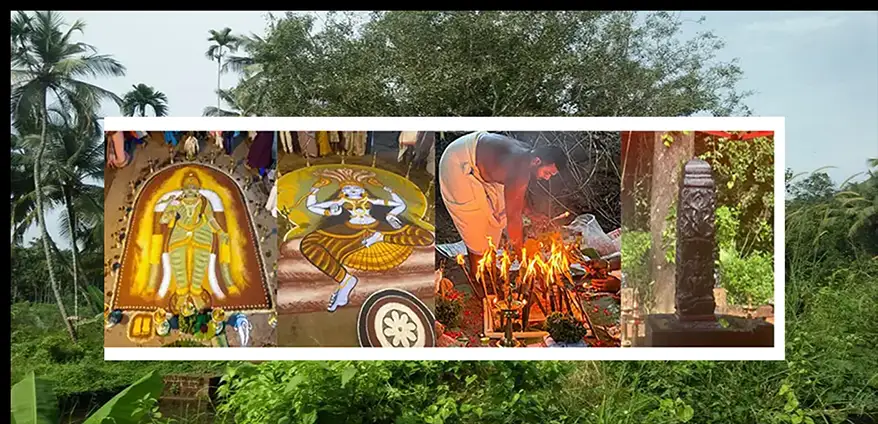
Buried under the earth for nearly a millennium, this Kaavu in Kattayilkonam, Edackode, near Thiruvananthapuram, has one of the oldest sacred serpent idols in Kerala
In the summer of 1974, children playing in a parched field watched something impossible: a stone serpent rising from the earth, month by month. Scientific evidence showed that it was not the idol rising but it being pushed upward by ancient tree roots.
When scholars finally examined the idol, covered in moss, carved with intricate serpent forms, they confirmed it was among the oldest serpent idols in Kerala, buried for nearly a millennium.
Forty years later, my family would unearth that same idol and build around it what our ancestors always knew: that faith and forest are one, that to worship the serpent is to protect the very soil beneath our feet.
This is the story of how we brought back to life a sacred grove, a Kaavu, and discovered that humanity’s oldest faith might also be its most urgent calling to conserve nature for our future generations.

Let us give some additional context:
Long before civilizations built temples or idols, humans worshipped serpents. Archaeological finds from Mesopotamia and the United Arab Emirates suggest that snake worship dates back more than 5,500 years, to the Bronze Age.
Across cultures, from ancient Egypt’s Uraeus to Greece’s Asclepius, serpents have symbolized immortality, healing, and regeneration, shedding their skin in a perpetual metaphor of renewal.
In Kerala, serpent worship evolved into something deeper: an act of gratitude. Here, the serpent became not a creature of fear, but a guardian of fertility, water, and balance.
The forest that prayed
I remember from my childhood: every time my father visited the temple for ritual circumambulation, he used to take me along. I would watch people fold their hands not only toward the main sanctum, but downward, toward a wild patch of forest just beyond the temple wall. There was no idol, no lamp, not even a pathway, just an overgrown thicket where sunlight hesitated to enter.
“What is there?” I asked my father, curious.
“That,” he said quietly, “is the serpent’s temple.”
That was the first time I heard the word Kaavu – a sacred serpent grove. Years later, I would learn that my own family had abandoned such a grove, in Kattayilkonam, Edackode, near Thiruvananthapuram, centuries ago.
In 2015, we decided to bring it back to life.

The idol that rose from Earth
“Sahasra seersham dwi sahasra vakthram
Pishanga nethram kapilaam sukaadyam
Vishayudham prajwala drumshta bahum
Tham Nagarajam pranathosmi nithyam.”
(A mantra offering obeisance to the king of divine serpents-Naga Raja, Takshaka.)
It all begins from a story the elders told us about the summer of 1974. A group of children were playing in a parched field that once used to grow tapioca and vegetables.
At one end stood a dense thicket where sunlight barely entered. No one dared cut the trees. The elders said it was once a serpent-worshipping grove, abandoned for centuries. They claimed it had flourished nearly 300 years earlier, during the reign of King Marthanda Varma of Travancore, and that palace records mentioned a sacred serpent temple there.
One day, the children spotted the curved tip of a stone emerging from the cracked soil. Afraid yet fascinated, they watched it rise higher each month. A rational schoolmaster finally explained: the stone was not growing, it was a serpent idol being pushed upward by the roots of a nearby tree, after having been buried by flood or earth movement long ago.
Years passed. The forest thinned, and the idol’s detailed serpent carvings slowly re-emerged. Yet the grove remained silent, forgotten, and untouched.
Until we found it.

The significance of what we had lost
In Kerala, a Kaavu is not merely a shrine; it is a living ecosystem, dense, wild, and sacred. Each grove is dedicated to divine serpents, guardians of fertility, rain, and prosperity.
Every Kaavu shelters rare plants, birds, reptiles, and small mammals, protected by spiritual reverence. In ancient times, every household maintained a Kaavu, believing that prosperity flowed from safeguarding these sacred fragments of wilderness. The rituals were simple, the faith deep; the land and the serpent coexisted.
Our grandfather told us the story of how Kerala was formed. After destroying arrogant kings 24 times, the warrior-sage Parashurama cast his axe into the sea. The ocean receded, and Kerala emerged. But the new land was barren and salty. To purify it, Parashurama prayed, and the serpent king Takshaka arrived with thousands of snakes. They absorbed the salt, making the soil fertile.
“These snakes are invisible,” our grandfather would say. “Golden beings called Yogarshis. They feed on air and meditate in silence.”
Through Sarpabali, the ritual offering to serpents, we seek forgiveness for the harm humans cause to earth, water, and life.

How the serpent groves disappeared
After Independence, rationalist movements surged. The first Communist government of Kerala viewed serpent worship as superstition. Many Kaavus were cleared, their ponds filled, their trees felled. It also aligned with the developmental priorities.
But time proved that the ancients were right. Ecologists underlined that Kaavus were biodiversity hotspots, vital for groundwater recharge and home to rare flora and fauna.
Ironically, in 2015, the same Communist government – which once uprooted Kaavus – launched the Devaranyam Project, a statewide initiative to conserve sacred groves once dismissed as relics of blind faith.

Our restoration efforts
Inspired by ancient wisdom and modern environmental resurgence, we began restoring our ancestral Kaavu in 2015. A committee was formed; guidance was sought from Ameda Illam, one of Kerala’s most respected serpent-priest families. Along with Mannarasala, Vettikkode, and Pampummekkavu, they oversee thousands of Kaavus across Kerala.
The serpent idol, buried for nearly a millennium, was reinstated in its sanctum. When unearthed, covered in moss and roots, scholars confirmed it was among the oldest serpent idols in Kerala. That moment was indeed about the reclamation of memory, of identity, of faith waiting underground for centuries.
Kaavu: An ecosystem of faith
A Kaavu is not built like a temple. No cement, no concrete, only vettukallu, porous stone that shelters insects and micro-organisms. These nurture plants, which attract birds and reptiles, which in turn sustain small mammals. A living food chain forms.
A pond is essential – for snakes to drink, birds to bathe, and aquatic plants to thrive. Over time, endangered species such as the Asian palm civet, jungle cat, and white-breasted waterhen find refuge there. Human access is restricted to ritual days. The Kaavu must remain what it was always meant to be, nature’s own temple.
In modern cities, the Miyawaki method creates miniature forests, dense, layered, and self-sustaining. Yet centuries before Akira Miyawaki, Kerala was already practising this model.
Every Kaavu functioned like a Miyawaki forest, and with a spiritual dimension. It filtered air, conserved soil, stored water, and nurtured life. Faith was not separate from ecology; it was ecology.

Songs that awaken the serpents… and the forest
Every Kaavu breathes to the rhythm of its own music, the Pulluvan Paattu. The Pulluvar, with their one-stringed Pulluvan Veena and clay pot, sing hymns that are not merely songs, they are dialogues with serpents.
Women draw intricate Nagakalam patterns on the earth using rice flour and turmeric, transient mandalas that vanish with the wind but endure in memory. Once dismissed as superstition, anthropologists now recognize these rituals as ecological memory systems, transmitting knowledge through music, myth, and art.
According to folklore, the first serpent was Adi Sesha, also called Anantha, eternity itself, the cosmic coil on which Vishnu rests. Vasuki, draped around Shiva’s neck, symbolizes disease and healing, dual forces that sustain life. Takshaka, Karkotaka, Kaliya, Shankhapalan, Padman, Mahapadman, and Gulikan appear across Hindu lore, each embodying a distinct cosmic energy. Even modern medicine carries this memory: the serpent coiled around a staff remains the universal emblem of healing.
The return of the Serpent King
Today, as the revived Kaavu near my home hums with life, I often think back to that summer when I first learned to pray to the Nagas. The Return of the Serpent King is not merely myth, it is memory, science, and coexistence.
Our ancestors knew that to worship the serpent was to protect soil, water, and air. In a Kaavu, ecology is worship; faith is conservation. And so, beneath whispering trees where the idol once slept in silence, the serpent returns, not to demand devotion, but to remind us of the oldest truth on earth:
When we protect nature, we protect ourselves and preserve for our future.

Mitravinda Giri Nair completed her MBA in Marketing and is working at Walnut Fox on
co-influencer marketing