
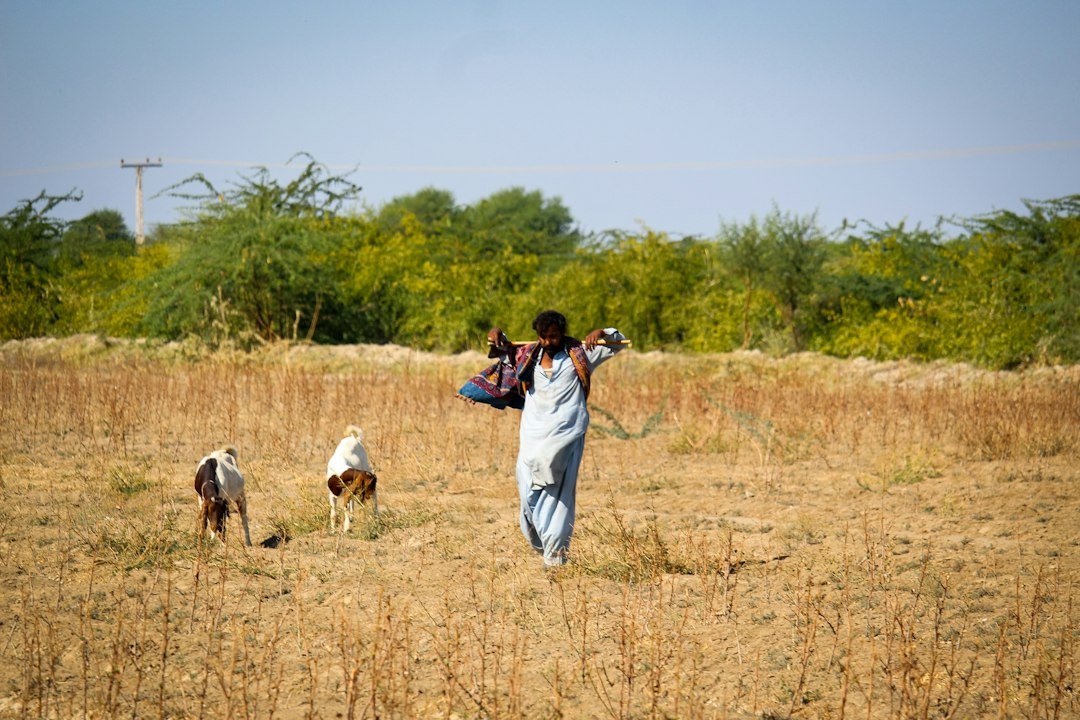
Nearly 60% of children under five in Tharparkar, a drought-prone desert district in Pakistan’s Sindh province, are stunted from chronic malnutrition, according to Pakistan’s 2018 National Nutrition Survey, the most recent government data available for the region. The Tharparkar drought crisis has worsened in 2026 as another weak monsoon reduced grazing land and drinking water for the roughly 1.6 million people spread across nearly 2,880 villages in the district.
Tharparkar covers about 19,389 square kilometres, some 97% of it arid land, and most households depend on livestock herding and rain-fed farming for income. When rainfall fails, as it has in repeated recent years, grazing areas shrink and herders are forced to sell animals early or walk them further for water, according to reporting by The Friday Times in late September. Livestock losses translate quickly into lost income and reduced access to milk and meat, compounding existing nutrition gaps.
A cycle of malnutrition and lost schooling
The 2018 National Nutrition Survey recorded underweight prevalence of roughly 60.1% among Tharparkar’s under-five children, with combined stunting and wasting affecting close to 19.8%. Public health workers in the district have long linked these figures to limited dietary diversity, reliance on livestock products that disappear during drought, and inconsistent access to clean water. Some groundwater sources in Tharparkar also carry fluoride levels above the World Health Organization’s guideline of 1.5 milligrams per litre, a further strain on families already short of safe drinking water.

Education outcomes track a similar pattern. Census data cited by The Friday Times puts overall literacy in the district at 36.39%, with a sharp gender gap: 48.50% among men against 23.49% among women. Herding families that migrate seasonally in search of water and grazing frequently pull children, especially girls, out of school for extended periods, educators in the district say.
Aid programmes struggle to keep pace
Provincial and federal relief efforts, including periodic water tankering and supplementary feeding programmes, have reached parts of Tharparkar during past droughts, but residents and local officials describe coverage as inconsistent from one dry spell to the next. The district’s remoteness and dispersed village structure make sustained service delivery difficult, a challenge shared with other arid pastoral regions across South Asia.
Researchers who study the district note that Tharparkar’s vulnerability is structural rather than a product of any single bad season. Its economy is built around livestock and rain-fed cropping with little buffer against consecutive dry years, and public infrastructure, including health posts and schools, remains thin relative to the district’s size and population. Without sustained investment in water storage, veterinary support and mobile schooling that can follow herding families, aid workers and local officials say the nutrition and literacy gaps are likely to persist through future droughts.
Some figures occasionally cited for Tharparkar, including specific counts of non-functioning water infrastructure and annual suicide tallies, could not be independently corroborated beyond a single source and are not included here. The nutrition and literacy figures above come from Pakistan’s official 2018 survey and census records, the most recent verifiable baselines for the district.
Tharparkar is not unique in facing this combination of pressures. Pastoral and dryland farming communities across South Asia, from Rajasthan’s Thar extension on the Indian side of the border to parts of Balochistan, share a similar dependence on livestock and rain-fed cultivation with limited buffer against repeated dry seasons. Development researchers who study these regions argue that drought response needs to move beyond emergency water deliveries toward longer-term investment in fodder storage, veterinary services and diversified income sources that do not collapse entirely when rain fails.
For Tharparkar’s herding families, the practical choices in a drought year are narrow: sell livestock early at depressed prices, migrate with animals in search of water and grazing, or stay and absorb steep losses in income and nutrition. Each option carries a cost that compounds over successive dry years, which is why aid organisations working in the district describe its vulnerability as cumulative rather than tied to any single season’s rainfall.



