
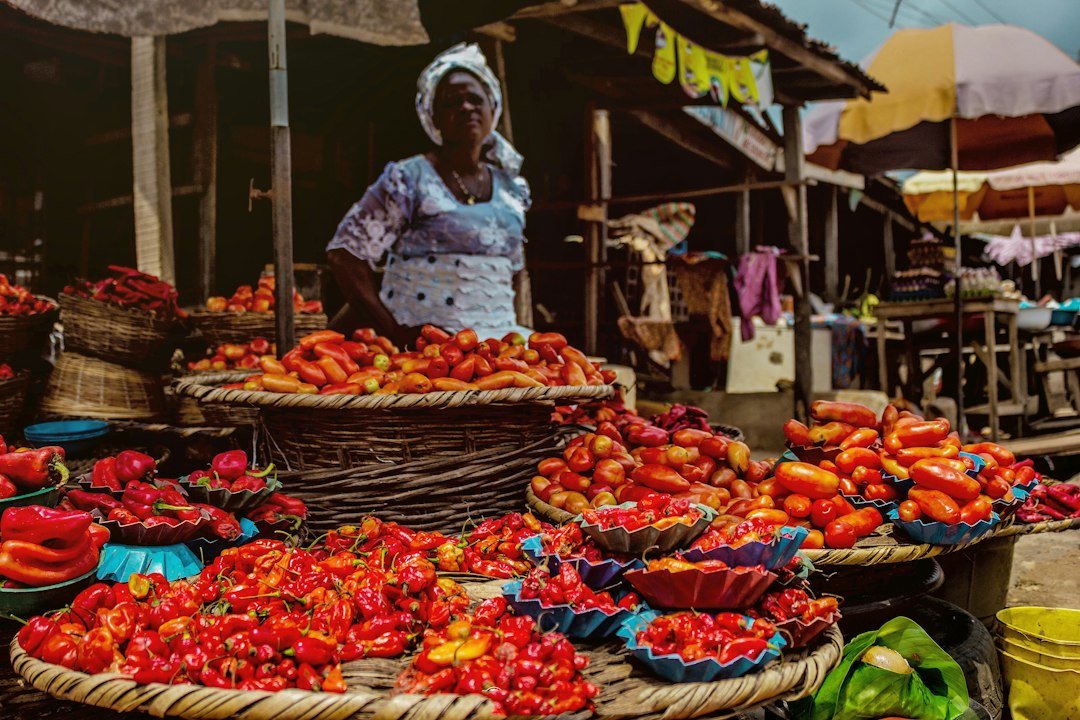
Lagos State has unveiled a five-point food security strategy. The aim is to raise food self-sufficiency from around 20% to 40%. Officials announced the plan at the finale of the state’s World Food Day events, delivered on behalf of Governor Babajide Sanwo-Olu by his deputy. The plan does not rely on expanding farmland. Lagos is Nigeria’s smallest state by landmass, home to more than 22 million residents, and has little spare land left to bring under cultivation.
The five points cover faster adoption of agricultural technology and partnerships with food-producing states elsewhere in Nigeria. They also include direct investment in farmers, measures to cut post-harvest losses, and a stated commitment to balance affordability, nutrition and environmental sustainability. Vanguard and P.M. News both reported the announcement.
Why a city-state needs other states’ farmland
Lagos’s strategy depends heavily on its third point: formal partnerships with Nigeria’s food-producing states. A state with so little agricultural land of its own cannot double self-sufficiency through local production alone, not in any realistic timeframe. Officials have not yet named which states those partnerships will involve. Nor have they said what form they will take, whether preferential trade arrangements, joint investment in processing facilities, or direct state-to-state produce contracts.

Cutting post-harvest losses is the strategy’s more immediately actionable element. Nigeria loses a substantial share of its harvested food before it reaches consumers. Inadequate storage, processing and transport between farm and market are the main causes. That problem affects food availability in Lagos regardless of where the food was grown. Investment in cold storage and faster logistics between Lagos’s ports, markets and food-producing hinterlands would address losses closer to the point of consumption than the point of harvest.
A policy-led approach, not crisis response
The announcement stands out for its framing. It presents a forward-looking policy target, not a response to an acute shortage or price spike. That distinguishes it from most recent food-security news out of West Africa. It also fits a broader pattern across the continent this year, where governments increasingly treat food self-sufficiency as an economic development goal in its own right, not purely as a hunger-prevention measure.
Agricultural economists note a problem with targets like this one. Self-sufficiency figures stated as simple percentages are easier to announce than to verify. Reliable data on exactly how much of a city’s food consumption is sourced locally, versus imported from elsewhere in Nigeria, is often incomplete. Lagos has not published the baseline methodology behind its 20% figure, nor a target date for reaching 40%.
Still, the scale of the ambition reflects a real vulnerability. Lagos is a dense urban economy with minimal agricultural land of its own. Any disruption to food supply chains from other states or countries hits its 22 million residents directly and quickly, with little local production buffer to absorb a shock. That vulnerability has sharpened in recent years, as transport costs and insecurity along some of Nigeria’s farm-to-market routes have periodically disrupted food flows into the city.
Whether the strategy produces measurable change depends on details the government has yet to release. These include funding commitments, named state partnerships and an implementation timeline. For now, the five points amount to an agenda rather than a fully costed plan. The governor’s office is expected to provide further detail in the coming months.
Without named milestones or an interim target date, the 40% goal risks becoming a recurring talking point rather than a measurable commitment. Nigerian state governments have announced ambitious percentage-based development targets before, with mixed records on follow-through once initial publicity fades. Whether Lagos’s plan proves different will depend on budget allocations the state has not yet published alongside the strategy’s five headline points.



