
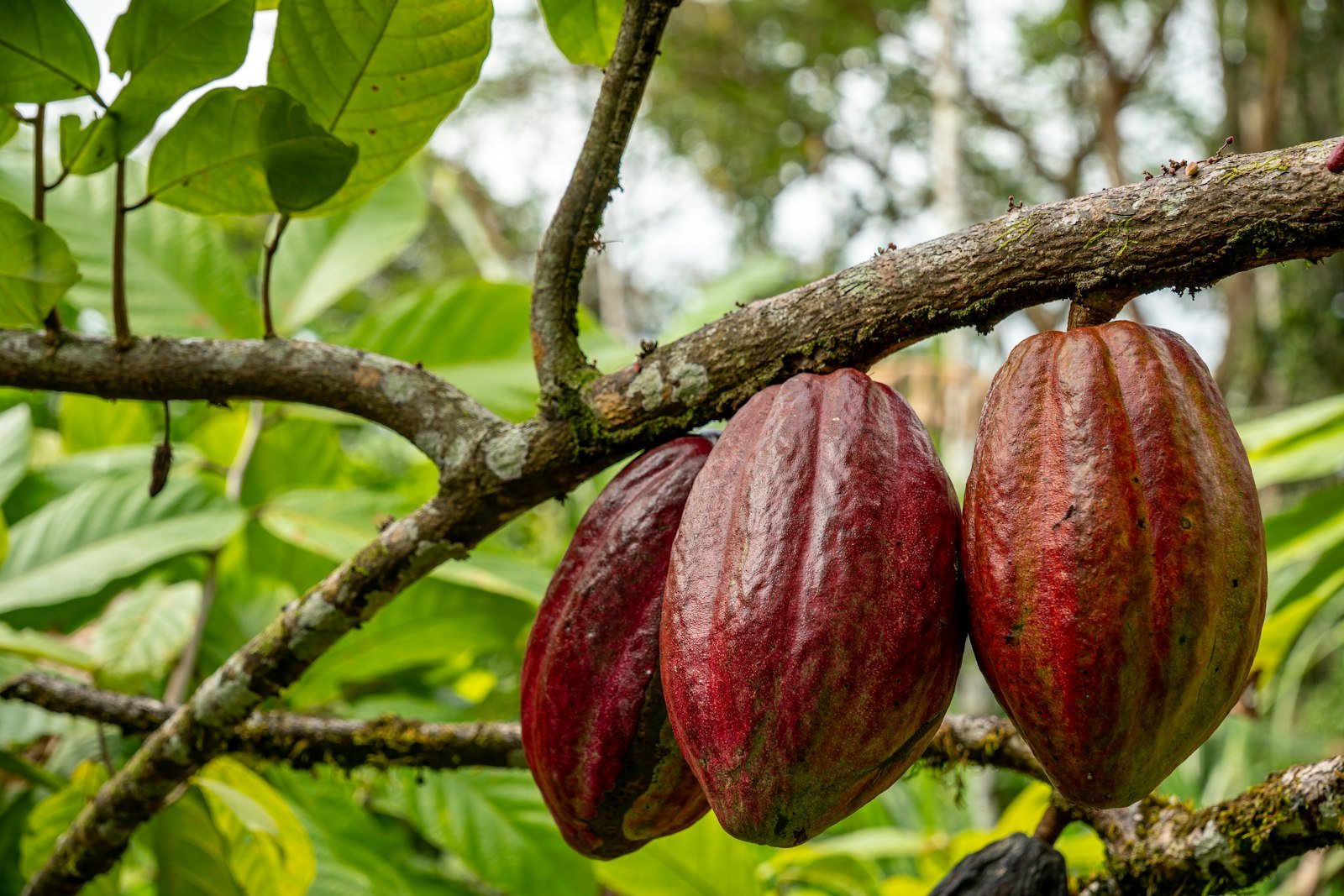
Cocoa prices in Ghana and Ivory Coast now sit far apart. Ghana pays its farmers GH¢42,400 a tonne for the 2026/27 season, about US$3,640, while Côte d’Ivoire pays 1,200 CFA francs a kilogram, about US$2,050 a tonne. Both are well below the New York futures price of about US$5,420 a tonne on 3 November 2026.
This guide explains how world cocoa prices are set and how the two state boards turn them into a fixed farmgate price. It shows why the gap between cocoa prices in Ghana and Ivory Coast moves beans across borders. It also covers forward sales, EU deforestation rules, disease and cocoa in Kerala and Karnataka.
Key facts
- Ghana farmgate price 2026/27: GH¢42,400 a tonne from 25 September 2026, 71.18% of realised FOB value (Ghana Cocoa Board, 2026)
- Côte d’Ivoire farmgate price 2026/27 main crop: 1,200 CFA francs a kg from 1 September 2026 (Ministry of Agriculture, 2026)
- New York cocoa futures: about US$5,420 a tonne on 3 November 2026, against a record US$12,906 in December 2024 (Trading Economics; CocoaIntel)
- Price gap: Ghana pays about US$1,590 a tonne more than Côte d’Ivoire at November 2026 exchange rates (Fourth Plate calculation)
- World output 2024/25: 4.733 million tonnes, a surplus of 37,000 tonnes (ICCO, August 2026)
- EU deforestation rules apply to large and medium cocoa importers from 30 December 2026 (Regulation (EU) 2025/2650)
- India grew 34,320 tonnes of cocoa in 2025/26, with Kerala at 12,170 tonnes (Ministry of Agriculture second advance estimates, 2026)

How world cocoa prices are set
World cocoa prices are set on two futures exchanges run by ICE: London cocoa, traded in pounds sterling a tonne, and New York cocoa, traded in US dollars a tonne. A futures contract is a promise to deliver or take a fixed quantity of beans of a set quality in a future month at an agreed price.
Chocolate makers, grinders and trading houses use the contracts to lock in costs. Hedge funds and other speculators trade them for profit, which adds money and volatility. Physical beans then sell at the futures price plus or minus a premium for origin and quality, known as the differential.
The International Cocoa Organization (ICCO), the intergovernmental body for producing and consuming countries, publishes a daily indicator price drawn from both exchanges. Its 2024/25 indicator averaged US$6,612 a tonne, about 39% above the previous season, the ICCO said in its annual report.
The path from the 2024 spike to November 2026
The spike began with poor West African harvests in 2023 and 2024. New York futures reached a record US$12,906 a tonne in December 2024, according to Trading Economics and Ecofin Agency. From the 1980s until 2023, prices traded around US$2,500 a tonne for long stretches, Bloomberg reported in 2024.
Prices fell steadily through 2025 as demand weakened and supply recovered. ICCO data show world grindings, the volume of beans processed, fell 3.3% in 2024/25 while output rose 8.5%. New York futures dropped to US$2,952 a tonne on 24 February 2026, their lowest in more than two years, Ecofin Agency reported.
A rebound followed. London futures rose from about £2,100 a tonne in early March 2026 to above £4,800 by 1 September, Reuters reported. New York futures stood at about US$5,420 a tonne on 3 November 2026, down 7.6% over the month and 17.9% over the year, according to Trading Economics.
How Ghana’s Cocobod sets the farmgate price of cocoa
The Ghana Cocoa Board (Cocobod) fixes one producer price for the whole season, and every licensed buyer must pay it. The Ghana Cocoa Board Act, 2026 (Act 1182) guarantees farmers at least 70% of the realised gross free-on-board (FOB) price. FOB is the value of beans loaded at a Ghanaian port.
A Producer Price Review Committee, which includes the Ministry of Finance, farmer groups, licensed buying companies, hauliers and processors, recommends the figure. The realised FOB price blends forward sales and spot sales averaged over a period. The farmer price therefore follows the price Cocobod actually achieved, and lags the daily market.
Cocobod set the 2026/27 price at GH¢42,400 a tonne on 25 September 2026, up 2.4% from GH¢41,392, chief executive Randy Abbey said in Accra. The board puts the bag price at GH¢2,650. The new price equals 71.18% of realised gross FOB, Cocobod said, which implies an FOB value of about GH¢59,570 a tonne.
A volatile 2025/26 season in Ghana
Ghana set three different prices in the 2025/26 season. The season opened at GH¢51,660 a tonne in August 2025. Cocobod raised it to GH¢58,000 on 3 October 2025, set at 70% of an average FOB price of US$7,200 a tonne, Graphic Online reported.
Finance minister Cassiel Ato Forson cut the price to GH¢41,392 a tonne on 12 February 2026, citing a sustained fall in world prices. Cocobod had sold until world prices fell below US$6,400 a tonne, which the government gave as the cost of moving cocoa from farm to port, GhanaWeb reported.
Ghana’s output is also under pressure. Cocobod forecasts 2026/27 production of about 650,000 tonnes, down from 750,000 to 771,000 tonnes in 2025/26, as The Fourth Plate reported in October. Its output warning blames weather, disease and illegal gold mining, known as galamsey, on cocoa land, as our November report sets out.
How Côte d’Ivoire’s Conseil Café-Cacao fixes the cocoa price
Côte d’Ivoire’s Conseil du Café-Cacao (CCC), the state cocoa regulator, sets a guaranteed minimum farmgate price for each crop. The main crop usually starts in October and the smaller mid-crop in April, and the agriculture minister announces each price.
The CCC sells most of the expected harvest in advance, pre-selling about 70% to 80% through electronic auctions. The farmgate price is set at about 60% of the value of those sales, the US Department of Agriculture’s Foreign Agricultural Service (USDA FAS) said in March 2025.
Agriculture minister Bruno Koné held the 2026/27 main-crop price at 1,200 CFA francs a kg on 1 September 2026. The CCC had forward-sold nearly 1 million tonnes for the season by June 2026, Ecofin Agency reported. The main crop runs to 28 February 2027.
From a record price to a 57% cut
Côte d’Ivoire raised its price to a record 2,800 CFA francs a kg on 1 October 2025. World prices then fell below the price the CCC had promised, foreign buyers slowed purchases, and unsold beans piled up. The CCC counted about 100,000 tonnes of unsold main-crop beans in January 2026, Ecofin Agency reported.
On 4 March 2026 the minister cut the mid-crop price by 57% to 1,200 CFA francs a kg. The government set aside 280 billion CFA francs to buy back unsold stock at the main-crop price. Farmers’ union Synapci later estimated unsold, unpaid stock at about 700,000 tonnes, as our October report details. The union’s figure is far above official counts.
How cocoa prices in Ghana and Ivory Coast compared, 2024 to 2026
Our table sets each country’s farmgate price for the last three seasons side by side, in local currency. Dollar values are those the source gave at the time. The two boards moved in opposite directions after the peak.
| Season and crop | Ghana (GH¢ a tonne) | Côte d’Ivoire (CFA francs a kg) |
|---|---|---|
| 2024/25 opening | 48,000 (September 2024) | 1,800 main crop (October 2024), about US$2.89 a kg |
| 2024/25 revised | 49,600 (October 2024), about US$3,062 a tonne | 2,200 mid-crop (April 2025) |
| 2025/26 opening | 51,660 (August 2025) | 2,800 main crop (1 October 2025) |
| 2025/26 revised | 58,000 (3 October 2025), then 41,392 (12 February 2026), about US$3,847 a tonne | 1,200 mid-crop (4 March 2026), about US$2.13 a kg |
| 2026/27 | 42,400 (25 September 2026) | 1,200 main crop (1 September 2026) |
Why the Ghana and Ivory Coast cocoa price gap drives smuggling
Cocoa moves illegally across a border when one country pays clearly more than its neighbour. Both boards fix a single national price, so a farmer or middleman near the frontier can earn the difference by selling beans on the other side.
We converted both 2026/27 prices at rates on 3 and 4 November 2026. Ghana’s GH¢42,400 a tonne, at the Bank of Ghana mid-rate of GH¢11.66 to the dollar, equals US$3,636 a tonne. Côte d’Ivoire’s 1,200 CFA francs a kg equals US$2,048 a tonne, using the fixed rate of 655.957 CFA francs to the euro and a euro worth US$1.1195. The gap is about US$1,590 a tonne, so Ghana pays 78% more.
The gap has reversed. In 2023/24, when Ghana paid less, the country lost about 160,000 tonnes to smuggling, a Cocobod official told Reuters and Ghanaian media in September 2024. In 2026 the flow runs the other way, with Ivorian beans entering Ghana’s supply chain through some licensed buying companies, CocoaIntel reported in April 2026. Arrests and seizures followed.
Togo adds a third price. It set its 2026/27 cocoa price at 2,240 CFA francs a kg, or about US$3,820 a tonne at the same rates, above both neighbours. Togo’s official cocoa exports fell from 24,000 tonnes to 8,900 tonnes in 2025/26, as our Togo report records. The earlier gap and its smuggling risk are covered in our September analysis.
What share of the world price farmers receive
Our second calculation compares each farmgate price with the New York futures price of about US$5,420 a tonne on 3 November 2026. Ghana’s farmers receive about 67% of that price (US$3,636 divided by US$5,420). Ivorian farmers receive about 38% (US$2,048 divided by US$5,420). The futures price is a delivered price, so the comparison overstates what any board could pay, but the difference between the two countries is large and real.
The cause is timing. The CCC sold much of the 2026/27 crop in advance in the first half of 2026, when futures sat far below their 2024 and 2025 levels. Ghana’s price follows realised FOB value under a legal floor. A board that sells forward into a falling market locks in a low farm price for the season.
Forward sales and the Living Income Differential
Forward sales are contracts the two boards sign with exporters months before the harvest, fixing the price for future delivery. They give farmers a known price and give the boards collateral to borrow against. They also tie the farm price to market levels at the time of sale.
Cocobod is moving its crop finance to local markets. It plans to raise GH¢16.3 billion through cocoa bills and bonds listed on the Ghana Stock Exchange, the Ghana Netherlands Business and Culture Council reported in October 2026. The aim is to cut its reliance on dollar loans.
The Living Income Differential (LID) is a fixed premium of US$400 a tonne that Ghana and Côte d’Ivoire charge on top of the market price for their beans. The two countries announced it in 2019 and introduced it in 2020. Buyers have reportedly offset it by cutting the origin premium when prices fall. USDA FAS said in 2025 that the LID had fallen short of its aims.
When the EU deforestation regulation applies to cocoa
The EU Deforestation Regulation (EUDR) applies to cocoa from 30 December 2026 for large and medium companies. Micro and small companies follow on 30 June 2027. Regulation (EU) 2025/2650, published on 23 December 2025, set these dates after a second delay.
The rule covers cocoa, coffee, palm oil, soya, rubber, cattle and wood. Importers must show the crop grew on land free of deforestation since 31 December 2020. Each consignment needs a due diligence statement with the geolocation of the farm plots. The European Commission confirmed the December 2026 date in a review published on 4 May 2026.
Cocobod said in September 2026 that it has deployed the Ghana Cocoa Traceability System across all cocoa-growing areas, covering beans and semi-processed products. Exporters of other crops are already shifting sales to markets outside the EU, as our report on Ethiopian coffee shows.
How swollen shoot disease and ageing trees cut cocoa supply
Cocoa swollen shoot virus disease (CSSVD) is a virus spread by mealybugs that cuts yields and kills the tree. Infected trees produce at a reduced rate for five to ten years and then die, Reuters reported in 2024. Growers must uproot and burn them before replanting.
A 2023 Cocobod survey found 31% of Ghana’s cocoa land infected, up from 17% in 2017, Reuters reported in August 2024. Infection reached 81% in the Western North region in 2024. Cocobod said in February 2024 that 590,000 hectares, out of 1.9 million, still awaited treatment.
In Côte d’Ivoire the virus affects 11 of the 13 main cocoa regions, and growers have uprooted over 100,000 hectares, USDA FAS reported in 2025. Ageing trees add to the decline in both countries. StoneX forecast an 11% fall in Ivorian output in 2026/27, to about 1.77 million tonnes, Ecofin Agency reported.
Which other countries grow cocoa
Côte d’Ivoire and Ghana grew 49% of the world’s cocoa in 2024/25, by our calculation from ICCO figures. Ecuador is third and close behind Ghana. The ICCO’s 2024/25 annual report ranks the main producers as follows.
| Country | Output 2024/25 (thousand tonnes) | Notes |
|---|---|---|
| Côte d’Ivoire | 1,681 | Up 0.4% on 2023/24 |
| Ghana | 600 | Up 34% after a disease-hit 2023/24 |
| Ecuador | 570 | Up 36%; exporters’ body Anecacao expects exports above 623,000 tonnes in 2026 |
| Nigeria | 330 | Farmers replanted and expanded after the spike |
| Cameroon | 310 | Fifth-largest producer |
| Indonesia | 200 | Largest Asian producer |
| Brazil | 190 | Seventh-largest producer |
| India | 34 (2025/26) | Ministry of Agriculture estimate |
Cocoa in Kerala and Karnataka
India grew 34,320 tonnes of cocoa on 116,780 hectares in 2025/26, according to the Ministry of Agriculture’s second advance estimates for horticulture. Andhra Pradesh grew 14,400 tonnes and Kerala 12,170 tonnes, followed by Karnataka at 4,440 tonnes and Tamil Nadu at 3,310 tonnes.
Our yield calculation from the same estimates puts Kerala at 626 kg a hectare, against 292 kg in Andhra Pradesh, 308 kg in Karnataka and 98 kg in Tamil Nadu. Kerala grows cocoa mostly as an intercrop under coconut and arecanut. The national average is 294 kg a hectare.
India produces far less than it uses. Domestic output meets under 20% of demand of more than 180,000 tonnes in bean terms, Grant Thornton Bharat said in 2026. Imports of beans and products exceed US$866 million a year. India exported cocoa products worth Rs 2,512.39 crore in 2024/25, while Kerala’s own exports fell to 128 tonnes, India Seatrade News reported.
Campco and the Kerala Agricultural University
The Central Arecanut and Cocoa Marketing and Processing Co-operative (Campco), founded in Mangaluru in 1973, buys cocoa from farmers in Karnataka and Kerala. Its chocolate factory at Puttur in Dakshina Kannada opened on 1 September 1986.
The Kerala Agricultural University (KAU) Cocoa Research Centre at Vellanikkara, Thrissur, commissioned in 1979, keeps Asia’s largest cocoa germplasm collection: 700 genotypes from 23 countries. It has released 15 clones, with six more ready, that yield 1.5 to 2 kg of dry beans a tree each year. It supplies about 90% of Kerala’s planting material, according to a published report on the centre.
What the West African prices mean in rupees and dirhams
The rupee closed at Rs 94.75 to the dollar on 3 November 2026. At that rate Ghana’s farmgate price equals about Rs 345 a kg and Côte d’Ivoire’s about Rs 194 a kg. At the UAE’s fixed rate of AED 3.6725 to the dollar, they equal about AED 13,350 and AED 7,520 a tonne.
Indian growers have no state price board and sell to Campco, private grinders and traders. Dry beans fetched about Rs 900 a kg at Manimala in Kottayam during the 2024 spike, a report on the KAU collection said. That is more than twice Ghana’s farmgate price today.
Frequently asked questions
Why is the Ivory Coast cocoa price lower than Ghana’s?
Côte d’Ivoire sold most of its 2026/27 crop forward in the first half of 2026, when New York futures fell as low as US$2,952 a tonne. Its farmgate price of 1,200 CFA francs a kg reflects those sales. Ghana’s GH¢42,400 a tonne follows realised FOB value under a 70% legal floor, so it paid about US$1,590 a tonne more in November 2026.
What is the cocoa price in Ghana per bag?
Cocobod set the 2026/27 producer price at GH¢2,650 a bag and GH¢42,400 a tonne, effective 25 September 2026. Cocobod describes the bag as 64 kg, but the bag figure equals the tonne price divided by 16, which implies a 62.5 kg bag. At GH¢11.66 to the dollar, a tonne is worth about US$3,636.
What is the current world cocoa price per tonne?
New York cocoa futures traded at about US$5,420 a tonne on 3 November 2026, according to Trading Economics and CocoaIntel. That is down 17.9% on a year earlier and about 58% below the December 2024 record of US$12,906. London futures traded near £4,190 a tonne in late October 2026, Investing.com data show.
Who is the largest cocoa producer in the world?
Côte d’Ivoire is the largest producer, with 1.681 million tonnes in 2024/25, the ICCO estimates. Ghana was second at 600,000 tonnes and Ecuador third at 570,000 tonnes. World production reached 4.733 million tonnes in 2024/25, according to the ICCO’s August 2026 bulletin, which left a surplus of 37,000 tonnes.
What is the cocoa Living Income Differential?
The Living Income Differential is a US$400 a tonne premium that Ghana and Côte d’Ivoire charge buyers on top of the market price. The two countries announced it in 2019 to lift farm incomes and introduced it in 2020. USDA FAS said in March 2025 that it had fallen short of its aims, as buyers cut other premiums.
When does the EUDR apply to cocoa?
The EU Deforestation Regulation applies to cocoa from 30 December 2026 for large and medium operators and traders, and from 30 June 2027 for micro and small operators. Regulation (EU) 2025/2650 set the dates in December 2025, and the European Commission’s May 2026 review confirmed them.
Does India grow cocoa?
India grew 34,320 tonnes of cocoa on 116,780 hectares in 2025/26, the Ministry of Agriculture estimates. Andhra Pradesh and Kerala grow over three-quarters of it, and Kerala farmers grow it mostly as an intercrop under coconut and arecanut. Kerala’s yield of 626 kg a hectare is the highest among the main states. India still imports most of the cocoa it uses.
Fourth Plate coverage
These Fourth Plate stories report the 2026 cocoa season as it happened.
- Ghana Ivory Coast cocoa price gap revives smuggling risk, on the gap that opened ahead of the 2026/27 season
- Ivory Coast keeps cocoa farmgate price at $2.14 a kilogram, on the decision to hold 1,200 CFA francs a kg
- Ghana cocoa farmgate price rises as 2026/27 harvest forecast falls, on Cocobod’s GH¢42,400 price and 650,000-tonne forecast
- Ivory Coast cocoa prices leave farmers unpaid for months, on unsold stock and the state buy-back
- Ghana forecasts 16 percent cocoa output drop for 2026/27 season, on disease, weather and galamsey
- Togo fixes 2026-27 cocoa and coffee prices after export slump, on Togo’s 2,240 CFA franc price
- Cocoa prices climb again as climate risk hits West Africa, on futures swings and rainfall extremes
- Ethiopian coffee exporters pivot to China as EU deadline nears, on how the EUDR is redirecting trade
- Ivory Coast cuts cashew price 6% on US market jitters, on Côte d’Ivoire’s other big farmgate price
Sources
Ghana Cocoa Board, Review of the producer price of cocoa for the 2026/27 season (September 2026); Ghana News Agency, 26 September 2026; Pulse Ghana, 26 September 2026; Graphic Online, 2 October 2025; GhanaWeb, 12 February 2026; Ghana News Agency, September 2024; Class FM, October 2024; Ghana Netherlands Business and Culture Council, 1 October 2026; Reuters via CNBC Africa, 1 September 2026; Ecofin Agency, 2 September 2026; Ecofin Agency, 5 March 2026; Economie Ivoirienne, April 2025; USDA FAS GAIN, Côte d’Ivoire Cocoa Sector Overview 2025 (March 2025); Eco3min, Cocoa price war (2026); CocoaIntel, 30 April 2026; Graphic Online, September 2024; MyJoyOnline, September 2024; Food Business MEA, Togo sets 2026/27 prices; Benin Web TV, Togo 2026/27 prices; Trading Economics, cocoa, accessed 4 November 2026; Investing.com, London cocoa futures, accessed 4 November 2026; ICCO, August 2026 Quarterly Bulletin of Cocoa Statistics; ICCO, Annual Report 2024/25; Wikipedia, Cocoa crisis (2024 to present), for the pre-2023 price history; Coolset, EUDR timeline tracker (September 2026); EY Tax News, EUDR application postponed to 30 December 2026; Reuters via ThePrint, 8 August 2024; Ecuador Brief citing Anecacao and Reuters, February 2026; Ministry of Agriculture and Farmers Welfare, state-wise area and production of cocoa, second advance estimates 2025/26, via Dataful; Grant Thornton Bharat, India cocoa sector growth and development (2026); India Seatrade News, June 2025; KAU cocoa germplasm repository report, via inkl; Wikipedia, Campco; Bank of Ghana interbank rates via Pulse Ghana, 4 November 2026; Trading Economics, EUR/USD, 3 November 2026; Business Standard, rupee close, 3 November 2026. Exchange-rate conversions use the fixed CFA franc peg of 655.957 to the euro (BCEAO) and the UAE dirham peg of AED 3.6725 to the dollar (Central Bank of the UAE).
The Fourth Plate reviews this guide and updates it as Cocobod, the Conseil du Café-Cacao, the ICCO and India’s Ministry of Agriculture publish new figures.
Last updated: 4 November 2026.


