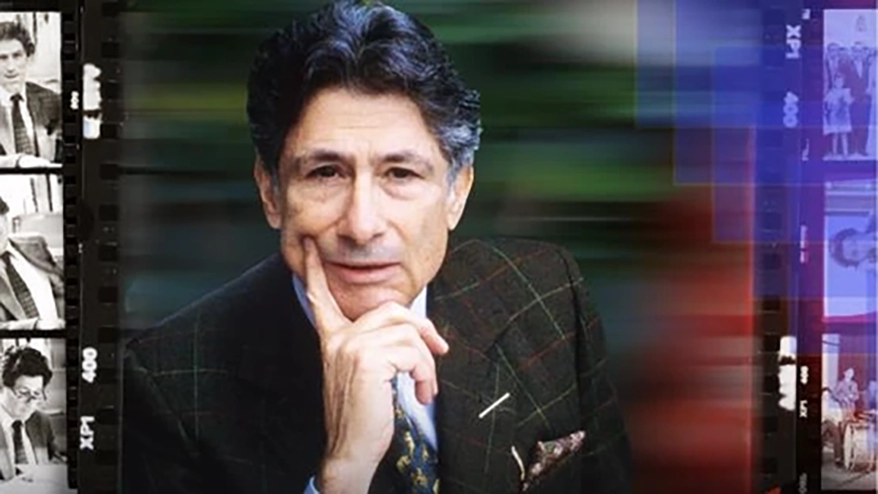
A solitary horse runs against the wind in Edward Said: Between Worlds, a perfect analogy to open a biopic on a man who defied every norm with his intellect and placed before the world the real Palestinian narrative.
This is a biopic with a difference. It doesn’t have the customary praises of people who talk about the protagonist. It firmly sets the entire body of work on the words of Said: his lectures, television interviews, voice recordings, photographs and the 8 mm home movies his father, Wadie Said, shot of the family. Directed by Maiken Baird, the 107-minute film is the first documentary made with full access to the Said family and estate.
That is no mean feat: to sift through decades of video clips and interviews and piece together what is arguably the most compelling take on the man’s life, and through that reflect the voice of Palestine. That voice has been increasingly sidelined by a distorted media narrative, repeated by voices far removed from the theatre of war, who cast their arguments on flimsy ground. The most heard of them: that Palestine, as a name, never existed.

A film for after October 7
The film is gripping. It takes you through the story of Palestine through the life of one man, from the grainy home movies of a Jerusalem childhood to the American television studios where Said argued, often alone, for a people the West preferred not to see. His daughter Najla Said, a consulting producer on the film, said it makes “a story of Palestine, concurrent to the story of my father’s life”.
The makers are clear about why the film exists now. Baird met Said in the 1980s and read The Question of Palestine in 1981. “As a European, we had never learned this history,” she said. After October 7, she found herself thinking of him. “There were a lot of things that people were saying that were untrue,” she said. “It would be great if he was back, if we could bring him back.” To her, he was the most articulate voice on anything to do with Palestine and the region.
The producer Sarah Mowaswes, a Palestinian American, said the team set out to make Palestine itself a character: a real, living place, as opposed to the death and destruction people see on their phones. “It’s so often reduced to rubble,” she said.
Permission to narrate
That the man waged a war as relevant today as then is evident when Melanie Phillips tells the world: “There is no such thing as the Palestinian people.” A clip of the British columnist saying exactly that went round X this month.
William Dalrymple counters her, and those who listen to reason. On 23 November he called her an “ignorant bigot”, and in a detailed post on X he set out the history. Modern nation states are late 19th-century creations, he wrote, and so are modern Zionism and Palestinian nationalism. The Merneptah Stele, carved at Thebes around 1208 BCE, is the oldest known inscription to carry the word “Israel”, naming a people of the Canaanite highlands, not a kingdom. Less than thirty years later, the walls of Ramesses III’s mortuary temple at Medinet Habu recorded the defeat of the Peleset, the people who gave their name to Palestine. “Two peoples, two names, both first written in Egyptian stone within a generation of each other, in the same moment of civilisational catastrophe,” Dalrymple wrote.
Not surprisingly then, the film starts with exactly that reality. “Whenever there is a Palestinian effort to tell a story, to put in a dramatic and realisable way the story of Palestine, it’s been assaulted and stopped,” Said says. “So we appear as if we are orphans, as if we have no origins, we have no narrative as a people. We are being told in a certain sense that we don’t really exist.”
Said gave that complaint a name in 1984. His essay “Permission to Narrate”, written for the London Review of Books after Israel’s invasion of Lebanon, argued that Palestinians had been denied the right to tell their own history. Four decades on, the film grants him that permission once more.

A professor of literature
Coming early in the film, Said’s opening lines set the stage for what follows: how his life intertwines with the fate of Palestine, and how he straddles two worlds. In one interview he says he would like to be identified as “a professor of literature at Columbia University”. The interviewer repeats “professor of literature” with a sort of doubt. Said repeats it. “I mean, that’s what I do for a living.”
Across the length of the film, this existential question of identity is seen plaguing Said. Mowaswes calls 1967 his fork in the road: stay a professor, or be drawn into the Palestine Liberation Organization and the Palestinian diaspora. “He didn’t know everything,” she said. “He didn’t even have a full understanding of what it was to be Palestinian.”
So he went back to learning. He spent a sabbatical year in Beirut in 1972-73, studying literary Arabic properly and reading everyone from Naguib Mahfouz. He wrote most of Orientalism a few years later, as a fellow at Stanford’s Center for Advanced Study in the Behavioral Sciences in 1975-76. In the film he says he could never have written it had he thought about the response and welcome it would receive. It has since been translated into at least 41 languages.
For readers in Kerala, a familiar name turns up. In the introduction, Said writes: “The relationship between Occident and Orient is a relationship of power, of domination, of varying degrees of a complex hegemony, and is quite accurately indicated in the title of K. M. Panikkar’s classic Asia and Western Dominance.” He goes on to argue that Europe made the Orient “Oriental” because it had the power to; the Orient was in no position to refuse the label. (Sardar K M Panikkar, the Kerala-born historian and diplomat, published Asia and Western Dominance in 1953. It traces European power in Asia from Vasco da Gama’s landing near Calicut in 1498 to the end of empire after the Second World War.)

The humanist and the olive branch
Orientalism, and the film, put Said in one word at the core of its narrative: a humanist. That is why his anger and frustration at how the world’s twisted narrative dehumanises Palestinians, and the Palestinian cause, is what you take home. And that is what you see every day, so brazenly: how Israel systematically took down Gaza, first its people, then its supplies, and then cut it off from the rest of the world, as it does even today. (A similar vein runs through the film Life Support.)
This cutting off has always been the pain of Palestine. On 13 November 1974, Yasser Arafat reminded the world in his famed UN address: “Today I have come bearing an olive branch and a freedom fighter’s gun. Do not let the olive branch fall from my hand.” He repeated the warning three times. The English the world heard was Said’s. He helped prepare the speech and translated it for the UN, while the poet Mahmoud Darwish worked on the Arabic.
Midway through, the film plays a song. “The Urgent Call of Palestine” was written in 1970 by Zeinab Shaath, a Palestinian-Egyptian singer, when she was 16, in her parents’ home in Beirut. She set to music a poem by the Indian poet Lalita Panjabi; another Indian name at the heart of a Palestinian story. The PLO released it in the early 1970s as the title track of a four-song EP, every song in English, meant for the world to hear. Israeli forces seized the master copy during the invasion of Lebanon. For more than 40 years, the song was lost. It was reissued only in 2024.
When Said lost his cool
The film skips one episode the Western press will never let go: the photograph of Said, in July 2000, throwing a stone towards an Israeli guard post from south Lebanon. Baird said she researched the incident in depth and found “there was no there there”. Including it in the film, she said, would have meant doing what the mainstream media always does with Said. Mowaswes said the family spoke of how much the episode upset him. “When you die, you have no control over your legacy,” she said.
The film does not hide his anger, though. In one exchange, a man asks, naively, about the Arabs and their lands stretching from Cairo to Spain, as if the Palestinians were just another piece of that sweep. Said is seen losing his cool, and later admits he was angry. He tries to set the man right: that he is talking about the Palestinians, a people driven from their land, not the Arab world as a whole. It is another human moment in the film. The scholar who could hold a room for an hour running out of patience with having to explain, yet again, that his people exist.

Jerusalem, faith and a father’s warning
There is so much to write about Said from this film. He sets himself apart as a man frustrated with religion, Christianity included, for the way it divides people. He describes Jerusalem, his birthplace, as the place that “makes religion”. His father, whom he describes as the man who brought “bureaucracy to the Middle East”, left him with these last words: “I am very worried about what the Zionists will do to you.”
His children saw the other Edward. “He was a very funny person,” Najla Said said. “He carried that mischievous little boy into his adulthood.” She did not grasp how far his reach went until she was about 14, when the first intifada broke out and her father was on television almost every night, “the only person that anyone seemed to want to speak to”.
His son, Wadie Said, came to it through a book: After the Last Sky (1986), Said’s essay on Palestinian lives with photographs by Jean Mohr, who often visited their home. “This is a thinker,” he recalled realising. “This is someone who is not just my father.” Of Orientalism, he offered a fair warning: “If you ever sat down with Orientalism, you might want to sit for a while.”
But most of all – and this is nothing new for anyone familiar with Said – the film returns to his observation on the parallels between the making of America and the making of Israel. In both, the people who already lived on the land were sidelined and airbrushed out, much as Palestinians are today. That commonality remains one of the forces binding the US and Israel to this day: both share a history of snatching land where there was room for coexistence.
Music was the other world Said lived in. The film shows him at the piano, and he speaks of himself as one who could listen to music endlessly. In fact, in 1999 he founded the West-Eastern Divan Orchestra with the conductor Daniel Barenboim, bringing young Arab and Israeli musicians to play side by side. For a man who argued all his life for coexistence, the orchestra speaks of a conviction made real.
Where we at The Fourth Plate stand
This is less a film review than the thoughts Said spawned in our minds about Palestine. Today every conversation about Palestine is distorted. It is always seen as with me or against me, and always as Muslim against non-Muslim: Muslim read as Islamic fundamentalism, non-Muslim as the morally high-grounded Hindus and Christians who, we are told, live fiercely secular lives. That makes discourse difficult. And there is always the rigour with which people go back into history to connect the dots and prove the land belonged to the Israelites alone, when they would never have lived in isolation. There were always Palestinians, or Peleset, as Dalrymple would have it, beside them.
How long will this bloodlust last, this tit-for-tat, this vague posturing about “they did that” so “we are doing this”? And how long will we continue with the notions the West has wanted us to believe? Said had an answer, and he wrote it into his preface to the 2003 edition of Orientalism, months before he died. The struggle for equality in Palestine and Israel, he wrote, “should be directed toward a humane goal, that is, coexistence, and not further suppression and denial.” He also knew how stories get lost. “History is made by men and women,” he wrote, “just as it can also be unmade and rewritten.” It is rewritten with omissions and distortions, until the East becomes something the West owns and steers.
So when people continue to say Palestine never existed, we need to tell them this is exactly the narrative Said set out to counter. He did. Yet the bias of the Western media, the very thing Orientalism is about, continues to win. We live in a world where those who shout harder and louder are heard, and, with time, acknowledged.
For us at The Fourth Plate, the aim is to reconstruct every narrative from our own point of view, one that does not reflect the assumptions and presumptions of the West. That is why we stand with Said, who first gave voice to Palestine and challenged the entire concept of Orientalism. We will also need to build a new vocabulary for how the rest of the world sees the West.
Said died of leukaemia in 2003, after a 12-year fight. Even after his death, his words are still needed to prove that there is, and there was, a place in the world called Palestine, although it might not have been defined by any cartographer. After all, when did all these theories of borders come to life?
Said says he was always envious of people who had a place to anchor them. Palestinians may not have a land to call their own, geographic boundaries or passports. Perhaps they are God’s children, for the entire world of God has no boundaries. God cannot have many lands, divided by religions, all calling out to him. If only the Palestinians didn’t suffer this much.
Arafat ended that 1974 speech, the one Said had put together, with a line the world is still waiting on: “War flares up in Palestine, and yet it is in Palestine that peace will be born.”
May it come true.
Edward Said: Between Worlds (USA/Qatar, 2026). Director: Maiken Baird. Producers: Sarah Mowaswes, Razan Ghalayini. Consulting producer: Najla Said. Music: Kareem Roustom. Distributed by Kino Lorber; wide release in 2027.