
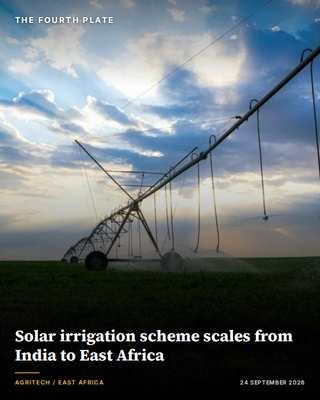
A solar irrigation programme spanning India, Bangladesh, Kenya and Ethiopia has entered a second phase, moving from technical pilots to the policy and financing questions that determine whether solar pumps reach smallholder farms at scale. The International Water Management Institute and Switzerland’s development agency are leading the effort, known as SoLAR.
The programme’s first phase, running from 2019 to 2024, tested how grid-connected and off-grid solar pumps performed technically, economically and environmentally across the four countries. Phase two shifts the focus to policy design, financing models and what the programme calls “living labs,” sites where solutions are tested against local conditions before wider rollout to national governments.
The scale of India’s existing rollout gives some sense of what is at stake. The government’s PM-KUSUM solar pump scheme had reached more than 1.4 million farmers by July 2025, according to official figures cited by the programme. Phase one data suggested grid-connected systems could offset roughly 12.3 tonnes of carbon dioxide per farmer each year, while participating farmers earned an average of Rs 14,000 (around $146, or £110) in additional income from selling surplus power.

From pumps to power markets
Solar irrigation’s appeal is straightforward: diesel pumps cost money to run and emit carbon, while solar pumps, once installed, draw on free sunlight for years afterwards. The complication comes when farmers with grid-connected systems generate more power than they use and sell the surplus back to local utilities, a shift that changes how rural electricity grids are planned, priced and balanced across a growing season.
Phase one recorded a 23% rise in net energy evacuation, the electricity flowing from farms back into the grid, at trial sites. Handling that reliably, at national scale, requires the financing structures and regulation that SoLAR’s second phase is designed to test, rather than the pump technology itself, which is already commercially available and reasonably well understood by engineers in all four countries.
Maya Tissafi, the Swiss ambassador to India and Bhutan, said the goal was for solar energy to “become a source of assurance, opportunity and resilience for rural communities.” Ramesh Chand, a member of India’s NITI Aayog policy body, said solar power in agriculture supported “both adaptation for the present and mitigation for the future,” language that reflects the programme’s dual billing as a climate intervention and a livelihoods one.
Extending the model to Kenya and Ethiopia tests whether lessons from India’s subsidy-driven rollout translate to East African farming systems, where land holdings, grid infrastructure and financing access differ substantially from South Asia. Kenya’s smallholder plots and Ethiopia’s more fragmented rural grid present different engineering and financing problems than India’s more centralised electricity system, and the programme’s designers have been explicit that a direct copy-paste approach is unlikely to work without local adaptation.
Training and technical capacity present a further hurdle. India’s rollout has relied on a decade of accumulated experience among installers, financiers and grid engineers, a base of expertise that Kenya and Ethiopia are still building. Living labs, in the programme’s own framing, exist partly to compress that learning curve, letting local technicians and policymakers observe what works before committing national budgets to a particular financing model.
The programme’s next milestones will be the policy frameworks and financing pilots it produces in each of the four countries, rather than pump installation numbers alone. If East African utilities and governments adapt India’s approach to their own grid realities, solar irrigation could shift from a pilot programme into standard infrastructure for climate-vulnerable farming regions across both continents. The push mirrors a parallel effort this week to reframe India-Africa seed trade around shared research infrastructure, another sign that agricultural cooperation between the two regions increasingly runs through shared systems rather than one-off transactions.