
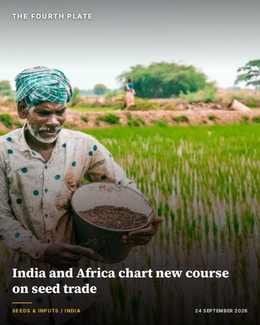
India and African nations should build joint seed research and local production capacity rather than rely on trade alone, Telangana governor Shiv Pratap Shukla told delegates as the second India-Africa seed summit closed in Hyderabad on 17 September. The India-Africa seed trade relationship, he said, needed to “extend beyond seed commerce.”
Governor Shukla’s valedictory address capped four days of talks among plant breeders, seed companies and government officials from both regions. He told delegates that “quality seeds were the foundation for food security, higher farm incomes, rural development and self-reliance,” framing the summit’s outcomes as a starting point rather than a conclusion to the two regions’ cooperation.
The event, held at a Hyderabad hotel from 15 to 18 September, brought together researchers and agribusinesses to discuss seed breeding, hybrid technology and cross-border trade rules. It followed a first edition the previous year, signalling an intent to make the gathering an annual fixture on the India-Africa agricultural calendar rather than a one-off trade showcase.

Moving beyond exports
Shukla’s recommendations went further than trade volumes. He proposed that Indian and African institutions share expertise in seed research, breeding and hybrid technology, rather than treating the relationship as a one-way export channel from India to African buyers. He also called for joint work on seed production, processing and quality control standards that would let African buyers verify what they were importing before it reached their fields.
Most notably, the governor urged India to help African nations build their own seed production and testing infrastructure, so that countries currently dependent on imports could eventually breed and certify varieties suited to local soils and climates. That shift, from exporter to technical partner, mirrors a broader pattern in South-South cooperation, where Indian institutions have increasingly positioned themselves as capacity-builders rather than suppliers of finished agricultural products.
For African farmers, locally adapted seed varieties matter more than the origin of the seed itself. Imported hybrids bred for Indian growing conditions do not always perform well against African pests, soils or rainfall patterns, a mismatch that has slowed adoption in past cooperation efforts between the two regions. Local testing infrastructure, of the kind Shukla described, would let breeders screen varieties against those specific conditions before they reach smallholder farmers who cannot afford a failed planting season.
Seed sovereignty has become a contested subject elsewhere on the continent, where some farming groups have accused large seed companies of consolidating control over varieties that farmers previously bred and saved themselves. Shukla’s framing, centred on shared research infrastructure rather than corporate supply chains, sidesteps that tension without directly addressing it, leaving open whether the summit’s African partners will experience this cooperation as capacity-building or as a new form of dependency.
The summit’s organisers used the gathering to push seed innovation as a food security tool rather than a purely commercial one. That framing lines up with a separate push, reported this week, to scale climate-resilient solar irrigation across South Asia and East Africa, another sign that agricultural cooperation between the two regions is shifting from single-transaction trade deals toward shared infrastructure and research partnerships.
Whether the governor’s recommendations translate into funded programmes remains to be seen. Summit valedictory addresses routinely set ambitious agendas that later require ministries, development banks and private seed companies to commit money and staff, and no timeline or funding commitment accompanied Shukla’s remarks. What the Hyderabad gathering did confirm is that India-Africa seed trade, once measured mainly in tonnes shipped, is being reframed around research partnerships and local capacity.