
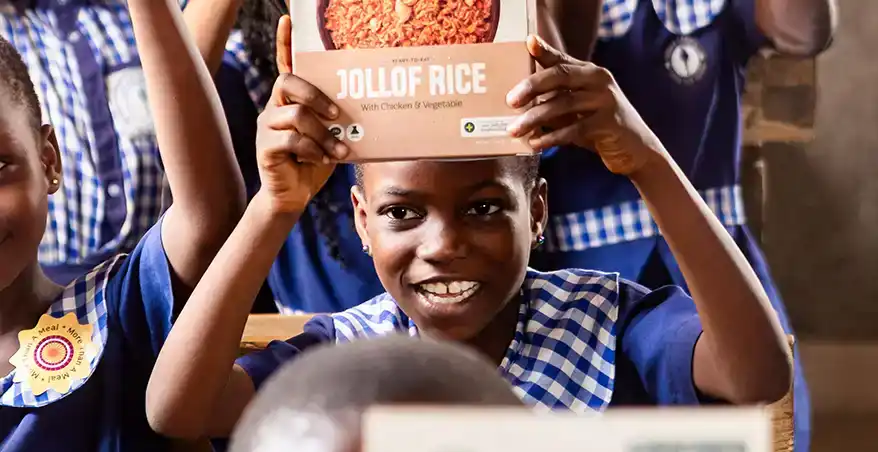
I have always loved food and people, and for as long as I can remember, food has been my way of bringing people together. I believe everyone deserves at least one good meal a day because I know the power of it myself.
When I am at my lowest, a good meal can lift my spirit, even if just for a moment. Food is joy, comfort, and one of the most universal languages of humanity.
In Nigeria, food is culture. We share meals in mosques and churches, in schools and workplaces, at family gatherings and community events. Feeding one another is part of who we are; it reflects a deep sense of care and solidarity.
Yet, even with this generosity, the reality is that hunger and poor nutrition remain widespread, and the systems that should guarantee food security are often fragile.
Over time, I began to notice the cracks. Whether in community feeding programs, school canteens, or disaster response efforts, the same problems surfaced: meals that spoiled quickly without proper storage, long queues that left the vulnerable at risk, raw ingredients that were difficult to cook without fuel, and food that filled stomachs but did not nourish.
Children showed signs of stunting, mothers quietly battled anaemia, and families cycled through preventable illnesses. Hunger also brings with it the weight of futures cut short.
As we say in Yoruba, “Bi ebi ba kuro ninu ì?é, ì?é bu se”—once hunger is removed from poverty, the burden of poverty is halved. That truth became the foundation of the solution I wanted to build.

The Birth of Forti Foods
Starting Forti Foods was never straightforward. In the early days, I was just a young woman with a big dream, emailing food processing facilities across the world, trying to convince them to help me create something new with little to no budget. Most of them did not even reply. Some would only speak to me if I agreed to pay for the minimum order quantities before they would even begin R&D. I remember thinking, Why would I order products before I even had customers? It was humbling and honestly discouraging.
Still, I could not shake the idea. So, I became scrappy. I used whatever money I had to work with different factories, testing whatever opportunities I could access. Each step was hard, but it was the only way to learn, improve, and keep the vision alive.
Whilst I had always loved food and had even taken a module on food microbiology during university, I had no real knowledge of food processing. I had to start from scratch, figuring out how to create a product that could be stored safely without preservatives, travel long distances, and still nourish people without causing more harm than good.
I spent hours walking supermarket aisles, speaking to nutritionists, watching tutorials, studying labels, testing methods, and experimenting in small ways, trying to connect what I saw on the shelves to what might be possible for communities back home.
What struck me was this: while ready-to-eat meals already existed, the ones targeted at Africans often felt like “fusion” or “inspired by” versions, products that missed the mark when it came to authenticity. They did not quite taste like home; they tasted factory-made. My vision was different.

I wanted to merge food science, convenience, nutrition, and authentic taste. Meals that could be trusted by soldiers in the field, by aid workers on long assignments, by companies seeking a reliable way to support communities, and by families simply looking for something quick, wholesome, and familiar. What we were creating was a solution for institutional feeding, workforce nutrition, and even a way to bring authentic African meals to the diaspora who still longed for the taste of home.
Then came COVID. Strangely enough, the pandemic became a turning point. For the first time, doors that had been firmly shut began to open. A lot of factories and experts who might have been too busy before suddenly had the time, and the response felt warmer, more human. I finally started receiving the support I needed to bring the idea to life: help with product development, recipe design, and nutritional analysis.
Throughout 2020, I worked closely with one factory, developing recipes remotely in an endless back-and-forth. Almost every other day, DHL delivered new samples to my door. I spent the better part of that year eating my own products, tasting, tweaking, and improving.
A major breakthrough came when DSM (Dutch State Mines), one of the world’s leading nutritional specialists, offered me their team and resources. They believed in my vision, and their backing gave me both confidence and credibility. Having DSM copied into emails made factories open up to me. It carried weight and signalled that I was not just wasting their time. That partnership pushed the vision forward in ways I could not have achieved alone.

Commercialisation Before Impact
One of the most important lessons I have learned is that before you can have true impact, you must first build a model that is commercially viable. Charity alone cannot sustain scale.
We are still in the early stages of this journey, conducting pilots, testing our products in different contexts, and beginning to drive small streams of revenue. Each step is teaching us how best to localise production, because the truth is that food security cannot be outsourced. The infrastructure for resilience must be built here, by us, using our own crops, our own talent, and our own systems.
In September 2025, just about a year after launching fully in Nigeria, we received our first venture backing through a pre-seed investment from Antler Africa. That catalytic support marked a turning point. It signalled that we were no longer just an idea, but a business with a future, backed by partners who believed in our vision. With this foundation, we can now begin to build out the infrastructure and systems needed to truly scale.
Our entry point into large-scale feeding initiatives is not only through humanitarian programs but also through commercial sectors that rely on safe, reliable meals. Militaries, schools, institutional feeding programs, peacekeeping missions, offshore rigs, and companies operating in remote sites without infrastructure all face the same challenge: how to provide adequate nutrition at scale. By addressing their needs, we are slowly building the supply chains and credibility that will also allow us to serve the most vulnerable.
This dual pathway of humanitarian and commercial markets is what will make Forti Foods sustainable. It means we are not only an impact business but also a food innovation company with relevance across multiple sectors. Commercialisation is not separate from impact; it is the foundation that makes impact possible.

Our North Star
Africa is home to some of the world’s most delicious, nutritious dishes and an abundance of super crops that should stand confidently on the global stage. Yet for decades, much of this bounty has been underutilised—lost to post-harvest waste or exported raw, only to return as expensive imports. Too often, the real value is captured outside the continent, while local communities remain underserved.
Forti Foods exists to change that story. Starting with ready-to-eat meals, we are building a farm-to-fork ecosystem that doesn’t just preserve Africa’s harvests but transforms them into high-quality products that meet global standards.
We invest in local processing and packaging, create decentralised production hubs, and ensure that the value of what we grow is retained and reinvested. We simply want to make meals that are culturally authentic and nutritionally fortified.
By producing locally for local communities, while also building processing and packaging capacity across the continent, we strengthen food systems, reduce waste, and unlock economic value that stays in Africa.
Our vision is clear: an Africa that not only feeds itself but also fuels its defenders and first responders, supports humanitarian missions, empowers businesses to give back, and shares its bounty with the world.
Looking Forward
In the next five to ten years, I see Forti Foods becoming more than a company. We want to be a movement. A movement that reimagines how Africa tackles food insecurity, that decentralises production across the continent, and that shifts us from being heavy importers of food to becoming global players in food exports and innovation.
The pre-seed investment we received in 2025 was a pivotal step on this journey. It gave us the capital and confidence to move from pilots to building lasting systems. The future is bright, and with the right partners, we can scale Forti Foods into a business that not only feeds Africa but also positions Africa as a global food leader.
But we cannot do it alone. To investors and policymakers, my message is simple: believe in African solutions. Too often, funding and policies are shaped elsewhere and imported here. What Africa needs are investments that empower local production, local talent, and local ideas. That is how we create resilience that lasts.
Closing Note
For me, food has always been about love and community. With Forti Foods, it has become something more: a pathway to dignity and resilience for millions. If we can ensure that every person has access to at least one good meal a day, then we are not just feeding bodies, we are nourishing futures.

Adenike Adekunle is the Founder & CEO of Forti Foods, a social enterprise on a mission to tackle food insecurity and malnutrition through fortified, ready-to-eat meals that bring both nutrition and dignity to large-scale feeding. She balances two worlds: Driving Forti Foods’ growth into a global leader in nutrition, food security, and social impact, and continuing to provide specialist consulting in financial crime compliance, maintaining my position as a trusted subject matter expert in the field.