
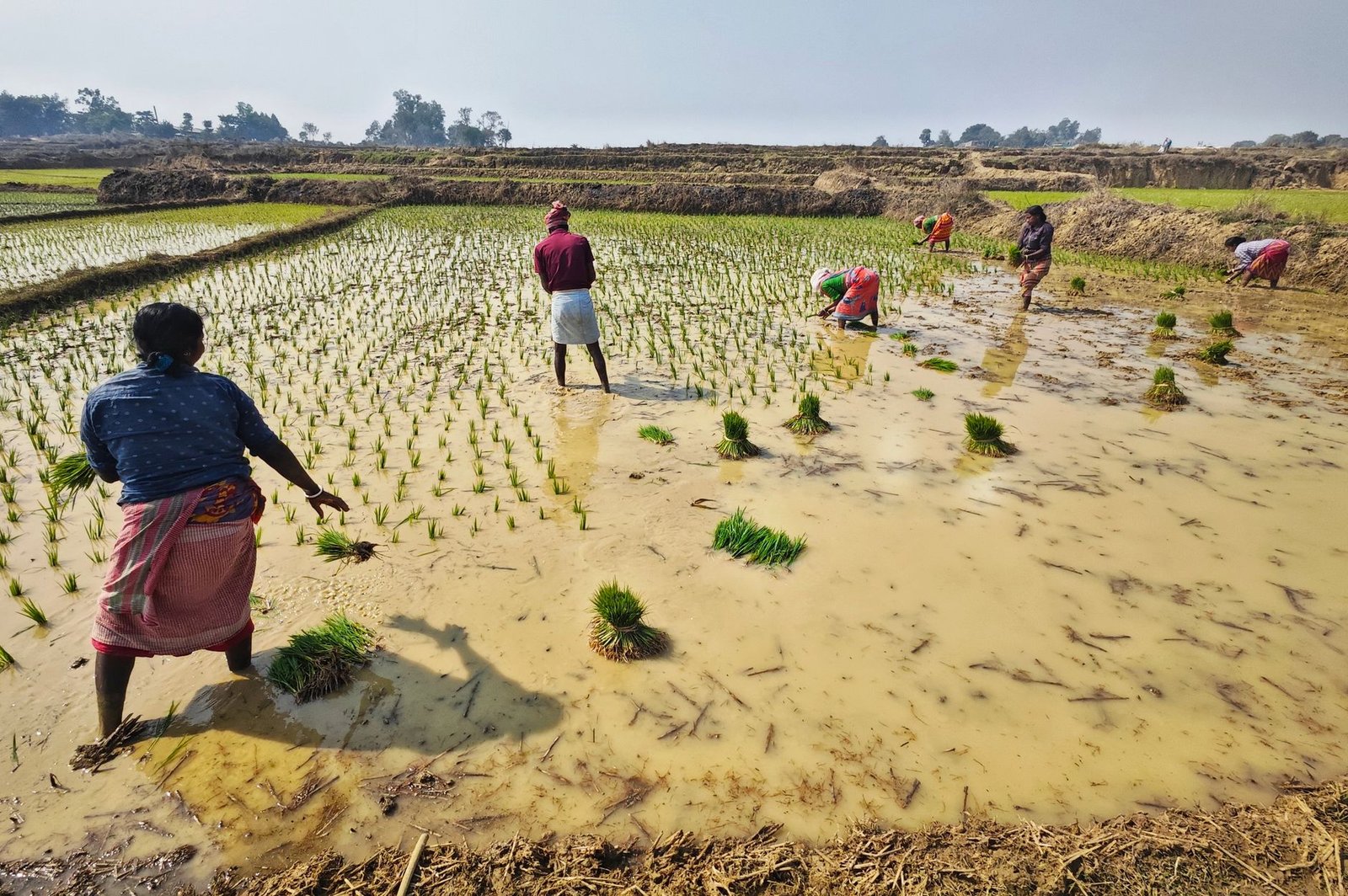
Direct-seeded rice uses far less water and labour than the flooded paddies most Indian farmers still rely on. The technique, known as DSR, skips the step of raising seedlings in a nursery and transplanting them by hand into flooded fields. Seeds go straight into the soil instead, cutting both the water needed to keep paddies flooded and the labour needed to transplant seedlings. India has now approved two new direct-seeded rice varieties built specifically for that method, DRR Dhan 92 and CR Dhan 217.
Both were developed jointly by the Indian Council of Agricultural Research, known as ICAR, and the International Rice Research Institute, known as IRRI. Scientists used genomic-assisted breeding to combine more than 19 genes linked to crop establishment, stress tolerance, disease resistance and grain quality. That genetic groundwork allows each variety to perform reliably under direct-seeded conditions. Traditional breeding had mostly targeted flooded systems instead.
The two varieties are suited to different parts of the country. DRR Dhan 92 fits north-eastern India and received support from India’s Department of Biotechnology. Under direct-seeded conditions it yielded an average of 5.8 tonnes per hectare, about 18% higher than the widely used MTU 1010 variety. In traditional transplanted systems, by comparison, it yielded 5.74 tonnes per hectare, showing it holds its own even without flooding.

Two varieties, two regions
CR Dhan 217 is aimed at eastern and central India instead. Backed by the Asian Development Bank and the government of Finland, it yielded an average of about 5.9 tonnes per hectare in trials. Under favourable conditions, yields reached as high as 8.7 tonnes per hectare. The variety matures in around 118 days, a window that matters for farmers timing their harvest around the monsoon.
Dr Michael Quinn of IRRI said the new rice varieties “enable farmers to adopt a more productive, sustainable and efficient rice production system.” The water savings from direct-seeded rice matter most in regions where monsoon rainfall has grown less reliable and groundwater is under strain. Less time spent flooding and transplanting fields also frees up labour that smallholder households can direct elsewhere.
The breeding effort reflects years of coordinated work between ICAR and IRRI rather than a single breakthrough. Dr R.M. Sundaram, Director of the Indian Institute of Rice Research, known as IIRR, said consistent performance “across environments… is where long-term collaboration between ICAR and IRRI becomes critical.” Developing a variety that performs well in one trial plot is one challenge. Making it perform consistently across India’s varied growing regions is a different and harder one.
A response to a bigger risk
The approval of these water-smart rice varieties lands alongside growing evidence of the economic stakes tied to erratic monsoons. A recent Allianz Climate Economics Report projected a $50 billion hit to India’s economy in 2027 from El Niño-driven weather effects alone. Breeding rice that needs less water and survives less predictable rainfall is a direct, practical response to that exposure. Crop science alone cannot offset a macroeconomic loss of that scale, though.
For now, the two varieties offer Indian farmers a tested alternative that does not require abandoning rice altogether as rainfall patterns shift. Whether DRR Dhan 92 and CR Dhan 217 see wide uptake depends on how well extension services introduce them. It also depends on whether their yield advantages hold up outside controlled trials. ICAR and IRRI’s sustained collaboration offers some confidence that further varieties fitted to India’s regional diversity are already in the pipeline.