
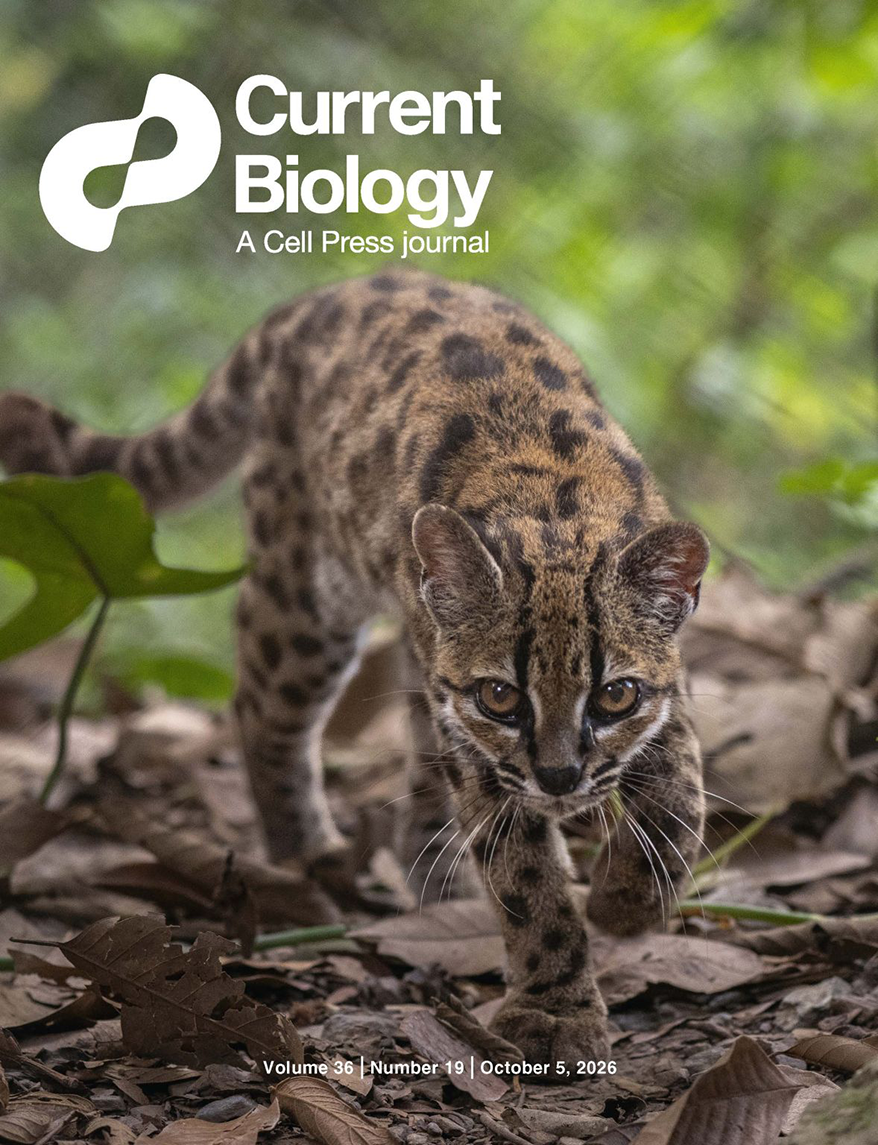
A spotted cat at a Bolivian sanctuary has turned out to be a species unknown to science. The genome study behind it splits South America’s tiger cats into five
A small spotted cat living at a wildlife refuge in Bolivia’s Yungas cloud forest is the first new wild cat species to be formally named and described in more than a century. The study, published in Current Biology, names it Leopardus tilcayo. Tilcayo is the name communities in the Yungas already used for the animal.
The paper also changes how scientists classify the group the cat belongs to. South America’s tiger cats were long treated as one species, Leopardus tigrinus. Genome data from 38 cats, eight of them museum specimens, show the group contains five distinct species. A second new taxon, from the Peruvian Yungas, is described as a subspecies, Leopardus tigrinus antisuyo.
The study was co-led by Jonas Lescroart, an evolutionary biologist at the University of Antwerp, and Paola Nogales-Ascarrunz, founder of the Programa de Investigación de Félidos Bolivia and a National Geographic Explorer. Eduardo Eizirik of the Pontifical Catholic University of Rio Grande do Sul (PUCRS) in Porto Alegre, Brazil, is the senior author.
A kitten on a forest road
The species came to light through one animal. About ten years ago a local man found a kitten on a road near the Yungas forest and took it home, believing it was a stray domestic cat, National Geographic reported. The family struggled to keep it as a pet and left it at Senda Verde, a wildlife refuge near Coroico. The refuge is a couple of hours’ drive from La Paz.
In 2016 Senda Verde contacted Nogales-Ascarrunz about an animal its staff described as a strange cat. She told National Geographic she photographed it extensively on that first visit as its size stood out. The male, now about ten years old, measures 46 cm from head to the base of the tail and weighs 1.4 kg. That makes it smaller than an average house cat.
The photographs stayed on file for three years. In 2019, while preparing a booklet on Bolivia’s wild cats, Nogales-Ascarrunz compared them with reference images from Brazil and found they did not match. Published descriptions of tiger cats were based mostly on Brazilian animals. “What tiger cat do we actually have in Bolivia?” she said in an interview with Reuters.

Five species under one name
Tiger cats are cryptic species. Lescroart says that they cannot reliably be told apart by appearance, so DNA is the decisive test. The original species, L. tigrinus, was described in 1775 from an illustration of an animal from Cayenne in French Guiana. European naturalists later gave tiger cats several names across South America. In the 20th century, taxonomists merged them into a single species.
Genetic work began to reverse that in 2013. Researchers, several of whom co-authored the new paper, split the northern tiger cat (L. tigrinus) from the southern tiger cat (L. guttulus). A 2024 study proposed the clouded tiger cat (L. pardinoides) of the Andes as a further species. Lescroart described tiger cats to Al Jazeera as “a contentious group with an uncertain taxonomy”.
Bolivia sat largely outside that research. Lescroart and colleagues in Belgium, Brazil, Bolivia, the United States, Colombia, the United Kingdom and Peru were collecting tiger cat DNA across the continent. Nogales-Ascarrunz’s Bolivian question joined that project. Lescroart said nobody had previously proposed the Bolivian cat as a separate species or subspecies.
What the genomes showed
The team analysed whole genomes from 38 cats of the genus Leopardus, 26 of them tiger cats, sampled across South and Central America. Fresh samples came from countries including Colombia, Peru and Brazil. Bones and skins held in museums in the United States and Europe supplied DNA where live samples were unavailable. The technique is known as museomics.
The museum material settled a question fresh sampling could not. The dataset includes DNA from tiger cats in the Guianas, where L. tigrinus was first described. Lescroart told Gizmodo this was the element missing from earlier studies. In his own summary of the paper, he wrote that museomics of the Guiana tiger cat allowed the team to validate the eastern and clouded tiger cats genomically.
The result is five species: L. tigrinus, L. guttulus, L. emiliae, L. pardinoides and L. tilcayo. Four had been proposed before. The study confirms them with genome data and adds tilcayo as new to science. Its lineage separated from other tiger cats about 1.4 million years ago. Lescroart said a gap of that length is generally treated as a species-level divide in cats.
The Peruvian Yungas population was handled more cautiously. The journal’s issue note says the authors described the Antisuyo tiger cat conservatively, as a subspecies of L. tigrinus. Lescroart told the AP the findings show that diversity remains hidden even in well-studied groups such as the cat family.

An animal science barely knows
Tilcayo has light brown fur marked with irregular rosettes. Rodent remains in scat samples suggest small rodents form part of its diet, Nogales-Ascarrunz said. Camera-trap evidence indicates it is active mainly at night. Lescroart told Reuters the team’s knowledge rests on the two live animals examined and a small number of camera-trap records. According to Current Biology, the Senda Verde male is the only known individual living in protective captivity.
The species’ confirmed range is the Bolivian Yungas, a humid, often cloud-covered forest on the eastern slopes of the Andes. The ecoregion extends into Peru and northern Argentina. The tilcayo has been genetically confirmed only in Bolivia so far. Its population size, full range and behaviour are unknown.
The cat was familiar locally long before it was described. Wai-Ming Wong of the wild cat conservation group Panthera, who was not involved in the research, said the AP: “This isn’t an animal that nobody had ever seen before.” Wong added that local communities knew of it but science had not recognised it as separate.
The conservation case
The International Union for Conservation of Nature (IUCN) Red List currently recognises two tiger cat species, northern and southern. Both are listed as vulnerable with declining populations. A species counted within a wider group can appear more secure than it is. The tilcayo could be classed as endangered once assessed on its own.
The researchers have shared their findings with the IUCN. Lescroart told Gizmodo the coming reassessment will treat each lineage as a separate unit. He named reassessment of each tiger cat by the IUCN SSC Cat Specialist Group as the next priority.
Pressure on the Yungas is growing. Nogales-Ascarrunz said deforestation, agricultural expansion, human-caused fires and mining are all increasing in the region. The AP reported gold mining as a specific threat. She identified restoring fire-damaged forest, protecting the remaining native forest and keeping habitats connected as urgent work. Eizirik warned that many species remain undescribed and could disappear before scientists record them.
The paper’s authors argue the case for speed. Lescroart says that biodiversity is under pressure and being lost now, so this kind of discovery work should move faster.
Who did the work
Lescroart completed the research as part of a joint PhD at the University of Antwerp and PUCRS, co-supervised by Hannes Svardal and Eduardo Eizirik. Research Foundation Flanders (FWO) funded the doctorate. He finished it in March 2026 and is now a science officer at the Flanders Marine Institute (VLIZ).
Naturalis Biodiversity Center in the Netherlands and the Smithsonian National Museum of Natural History provided access to collections. The Vlaams Supercomputer Centrum supported the genome analysis. Senda Verde cared for the animal at the centre of the study. Other contributors include Beth Shapiro, Molly Cassatt and Fernando Angulo Pratolongo.
Lescroart, J., Nogales-Ascarrunz, P. et al. (2026). Phylogenomics and museomics reveal five distinct species of tiger cats in South America. Current Biology. DOI: 10.1016/j.cub.2026.08.059



