
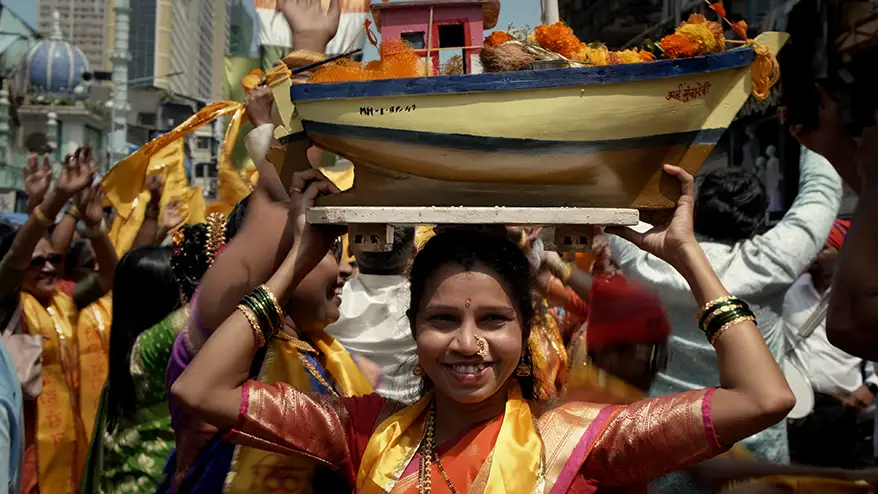
The ferryboat Sundari exists now only in whispers and half-remembered melodies. But perhaps that’s exactly why we need to listen.
There’s a moment in Sudarshan Sawant’s Lost Songs of Sundari that stays with you long after the credits roll: a young child talking about sports cars that thunder across a bridge above, while below, fishing boats drift empty-handed through waters that once teemed with life.
“The machines scare the fish,” the child observes with the matter-of-fact wisdom that only children possess. “The bridges have killed the waves.”
These simple statements cut through decades of development rhetoric with precision.
Mumbai, we’re reminded, was once seven islands connected not by concrete and steel, but by water and the boats that carried people across it. The Koli community—Mumbai’s original inhabitants—lived in harmony with the sea’s rhythms, their lives ebbing and flowing with tides that modern reclamation has all but erased.

But this isn’t just Mumbai’s story. It’s the story of every global south city that mistakes mimicry for progress.
We build bridges to connect, the film suggests, but bridges can also divide. They connect the privileged to new opportunities while severing indigenous communities from ancestral waters. They bring strangers in while pushing the original inhabitants further back—first from coastlines, then from consciousness itself.
The film’s central metaphor—Sundari, the mythical ferryboat and her ferrywoman—becomes a conduit for collective memory that’s rapidly dissolving. Through three perspectives (a woman keeper of myths, an aging ferry operator, and a child witnessing change), Sawant creates what feels like a generational conversation around a dying fire.
The visual poetry is deliberate: slow fishing boats beneath speeding cars, crowded ferries carrying resigned faces, mangroves that may soon exist only in songs. Each frame asks uncomfortable questions about what we lose when we gain “progress.”

There’s a particularly haunting sequence where the camera follows a boat through mangroves—spaces that exist in the margins, literally and figuratively. These are the last refuges of a world that once was, soon to be reclaimed for development that serves everyone except those who belong there.
The film’s power lies in its refusal to romanticize the past or demonize the present. Instead, it holds space for complexity—the understanding that bridges do connect people, that development does bring opportunities, but also that something irreplaceable dies in the process.
As the director notes in his statement: “This is not just a story about Mumbai; it is a story of urbanization and the quiet losses it brings, seen through the lens of a community once united by the sea.”

The global south faces a particular version of this tragedy. Unlike countries with smaller populations and more land, we’re often massive nations with even more massive populations, all trying to squeeze into development models designed for different geographies, different histories.
When we build like New York, we forget we’re not New York. We create claustrophobic closeness instead of connection, pushing indigenous communities not just to the margins of cities, but to the margins of memory itself.
The child’s voice in the film carries the weight of this amnesia. This generation might be the last to remember the songs, the stories, the ways of being that connected people to place. After them—silence.
Lost Songs of Sundari does what the best stories do: it makes the invisible visible, gives voice to the voiceless, and reminds us that progress without memory is just destruction with better PR.

The film will likely resonate most powerfully with global south audiences who recognize this story in their own cities—the constant battle between development and displacement, between bridges that connect strangers and traditions that connected neighbors.
As Sundari disappears into myth, and the Koli community faces a similar fate, the film becomes an act of preservation itself. It holds songs that might otherwise be lost, stories that might otherwise be forgotten.
In the end, the question isn’t whether we should build bridges or preserve traditions. The question is whether we can learn to build bridges that don’t silence songs: After all, development doesn’t require amnesia.
Lost Songs of Sundari suggests we still have time to remember, if we choose to listen.