
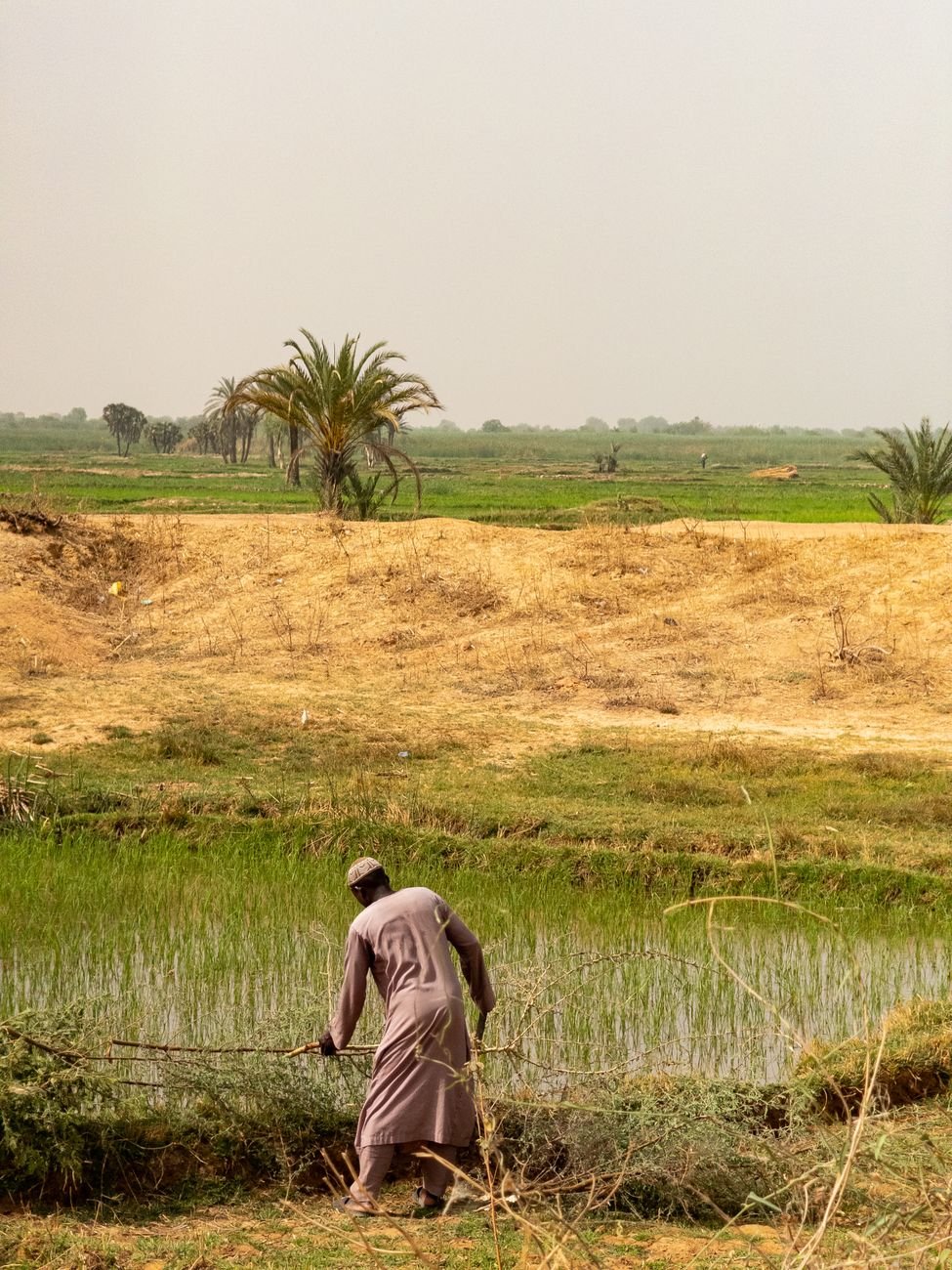
Farming communities across Kano State are weighing how far new irrigation and road infrastructure can turn reliable water access into dependable income, according to reporting by This Day. The intervention, overseen by Nigeria’s Ecological Project Office under President Bola Tinubu’s Renewed Hope Agenda, has rehabilitated and expanded irrigation at three dams, Tiga, Challawa Gorge and Kafin Chiri, alongside road and drainage improvements across 16 local government areas.
Faruku Musa Haruna, a farmer in Kumfada, Garko local government area, described how he once pooled money with neighbours to buy plastic sheeting to trap rainwater for his fields. With more reliable irrigation now reaching his area, he has expanded into carrots, onions, tomatoes and peppers, and hopes to add rice and wheat. Elsewhere, residents describe how road and drainage upgrades have changed daily life beyond farming itself: in Kwanar-Dangora, businesswoman Hafsat Yakubu says drainage improvements have eased customer access to her street after years of flooding; in Sumaila, resident Ado Ibrahim recalls carrying household goods by hand when vehicles could not get through before road repairs.
Not every improvement has landed evenly. Abdullahi Hamza, a farmer in Gana, says poor roads still damage onions in transit to the Bakin-Fa market, a reminder that dam and canal upgrades alone do not guarantee produce reaches buyers in sellable condition. At Kafin Chiri, the main irrigation canal is complete, though distribution and field channels, the smaller networks that carry water to individual plots, remain under construction.

Training, not just water, determines the payoff
The International Institute of Tropical Agriculture, which provides technical support alongside the infrastructure work, has trained 501 smallholder farmers through eight farmer field schools and 86 demonstration plots across the programme’s 16 local government areas, with women making up 97 of those trained and a fifth of the roughly 1,890 overall beneficiaries. Prof. Lucky Osabuohien Omoigui, a plant breeding and genetics specialist at IITA’s Kano station, said training on effective water use, cereal-legume rotation and fertiliser management is what ultimately determines whether new irrigation access translates into higher, sustained yields, adding that the effects of such training typically take two or three years to show clearly.
Dr Aishetu Gogo Ndayako, permanent secretary at the Ecological Project Office, said the intervention is designed around that longer timeframe rather than a single season’s results, pairing infrastructure handover with ongoing engagement between farmers, the Hadejia Jama’are River Basin Development Authority and dam managers on operations and maintenance.
Infrastructure handover is only the start
Site engineers overseeing the works, including Jibril Muhammad Ibrahim of ECL Construction and Adamu Salisu of Firm and Resolute Engineering, say the embankment section at Kafin Chiri is around 80% complete, with field-level distribution works still to follow. For farmers like Haruna, the infrastructure itself is only half the equation; the other half, as Kano’s enforcement action against pesticide-preserved beans at Dawanau Market this month underlined, is what happens to produce once it leaves the farm gate, from storage and transport through to the market stalls where Kano’s harvests are ultimately sold.
Two years to know if it worked
Ecological Project Office officials say they do not expect a clear verdict on the intervention’s success until farmers who adopted irrigation and training together have completed at least two full growing cycles, consistent with Omoigui’s estimate of how long soil and rotation benefits take to show. In the meantime, the programme’s early adopters, Haruna among them, are treating the current season as a test case: expanding into new crops cautiously rather than committing fully, while watching whether the roads, canals and training on offer actually hold up once the rehabilitation works are complete and routine maintenance, rather than construction, becomes the main demand on the system.



