
By Dikshit Handique, Soumak Sardar, Chinmoy Rabha
and Dr. Gautam Saikia
The morning mist still clings to the tea leaves when Girish Chutia steps into his garden in Barekuri village in Tinsukia district, Assam . His hardened hands brush against the tender shoots – the same hands that have transformed a modest plot of land into a beacon of organic tea innovation in Assam.
This is the inspiring story of how he became a pioneer in producing different types of tea that delight people far and wide.
“Every leaf tells a story,” he says, carefully plucking what will become one of his award-winning brews. In a region where tea runs through people’s veins, Chutia has done the impossible: transformed a centuries-old tradition while preserving its sacred roots.

Three decades ago, he started with nothing but a dream and an unwavering belief in organic farming. Today, as the founder of Barekuri Organics and Borgaon Natural Green Tea Producers Society, and President of the All Assam Small Tea Growers Association’s Barekuri Region, he’s producing organic tea, while also preserving heritage.
His crowning achievement? Being the sole commercial producer of the ancient Khilang Tea, a sacred brew of the Moran tribe that was nearly lost to time.
A tea farmer since 1990s, Chutia has dedicated his life to cultivating organic teas that honor both tradition and innovation, from rare brews like Khilang Tea and several blends, which are now savored far beyond Assam.
He turned obstacles into stepping stones, building a journey that inspires not just the community, but anyone who believes hard work still writes the best success stories.
Hailing from Jogyukhowa village, Chutia is an inspiration to his community, vouching for the promotion of organic tea cultivation and the rich regional product of the Moran Community, thereby singlehandedly putting Barekuri on the map for specialized tea.
One may wonder, how a single person can achieve such a feat. Was he from a family who dealt in specialized tea processing? Was he involved in business previously? Did he have advantage in terms of wealth? Or were his achievements just a stroke of pure luck?

The answer to all is No. He started out his journey from the ground up through, in his own words “Courage in my heart, Patience in my mind, Will in my body and action with my hands.”
Driven by his belief in sustainability, he has made organic cultivation the heart of his work. His dream is to create his own model for organic farming that can be replicated across Assam, ensuring both environmental preservation and farmer empowerment. Keeping his visions in mind he established a small scaled organic green tea factory in 2012 at his own home.
From a small patch of land to a flourishing garden of flavors, he has transformed his dream into reality by producing not just tea, but a diverse range of teas that reflect innovation and tradition.
His journey is not only about cultivating leaves, but about crafting experiences— green tea, orthodox, specialty blends, and more— each carrying a story of hard work, vision, and passion.

He produces an array of specialty tea including green tea, blue tea, white tea, rose tea, hibiscus tea, Dheki tea, jasmine green tea, tulsi green tera, masala tea, and of course, the rare Khilang tea.
His dedication to quality and innovation has brought him several accolades. In 2022, he secured the second prize under the Tea category for Machine-Made Orthodox Black Tea at the Trinitea Excellence Awards during the Indian International Small Tea Growers Convention in Kolkata.
He has also completed a 6-day Entrepreneurship Development program at the Entrepreneurship Development Institute of India, Ahmedabad
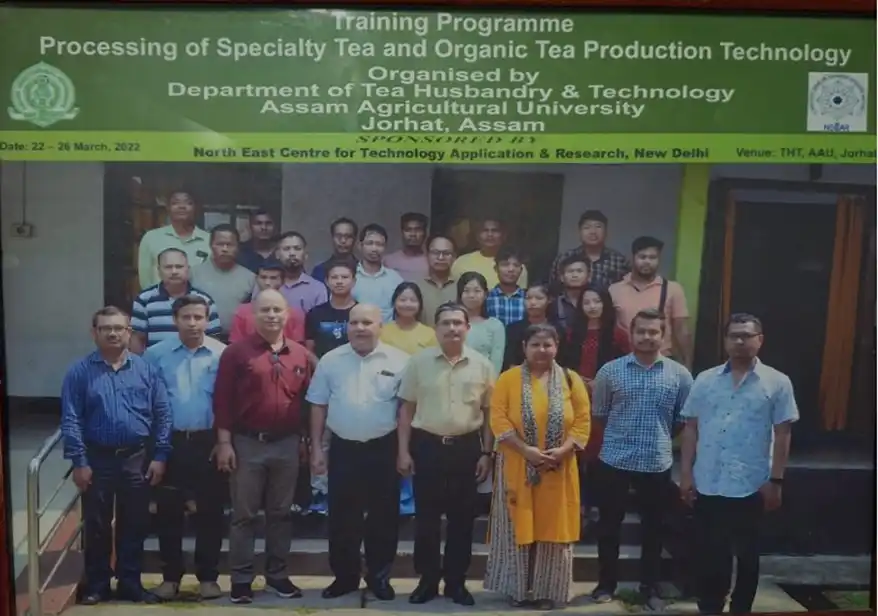
Chutia’s learning journey is as rich as his plantations. He has participated in training programs on Good Agricultural Practices on Black Pepper under the OIL Jeevika project, courses at the Indian Institute of Entrepreneurship, Guwahati, and specialized training on Processing of Specialty Tea and Organic Tea Production Technology.
He received training on Augmenting the Income of Small Tea Growers through Production and Marketing of Specialty Tea. In addition, he attended the Small Tea Grower Advisory Program of the Department of Tea Husbandry and Technology at Assam
Girish Chutia credits Assam Agricultural University’s Department of Tea Husbandry and Technology for laying the foundation of his success. It was here that he received not only technical training in tea cultivation but also the confidence to experiment with new methods.

at Assam Agricultural University
The exposure to modern agricultural practices, coupled with the mentorship of professors, enabled him to diversify into producing different types of tea. For Mr.Chutia, the university is more than just an institution – it is one of the guiding forces that transformed his vision into reality. He proudly acknowledges that without the education and support he received at AAU, his journey as a progressive tea grower may not have been same.
Despite his achievements, Chutia remains grounded, crediting his growth to his roots and his community. His contributions extend beyond business — he actively works for the development of his home village, Barekuri, by generating local employment and promoting eco-friendly farming. With plans to soon launch an organic spice industry, he continues to brew a future where tradition, innovation, and sustainability blend seamlessly.

Dr Gautam Kumar Saikia is a Professor, at the Department of Tea Husbandry & Technology , Assam Agricultural University, Jorhat, Assam. India. Email: gksaikia68@yahoo.com; gautam.saikia@aau.ac.in

Watch the story here