
By Sukumaran Narayanan
An average fishing trip in the Munambam trawl fishery in Kerala now costs Rs 4.99 lakh to run, more than three times the Rs 1.59 lakh of 2013. Net profit per trip has barely moved, according to a study in the Indian Journal of Fisheries.
The study is titled Technological innovations and fishing effort: Paradigm shifts in the trawl fishery of Munambam Fishing Harbour, Kerala, South India. Shyam S. Salim of the ICAR-Central Marine Fisheries Research Institute (CMFRI), Kochi, is the corresponding author. Co-authors Lowrane Stanley and N.R. Athira work at the same institute.
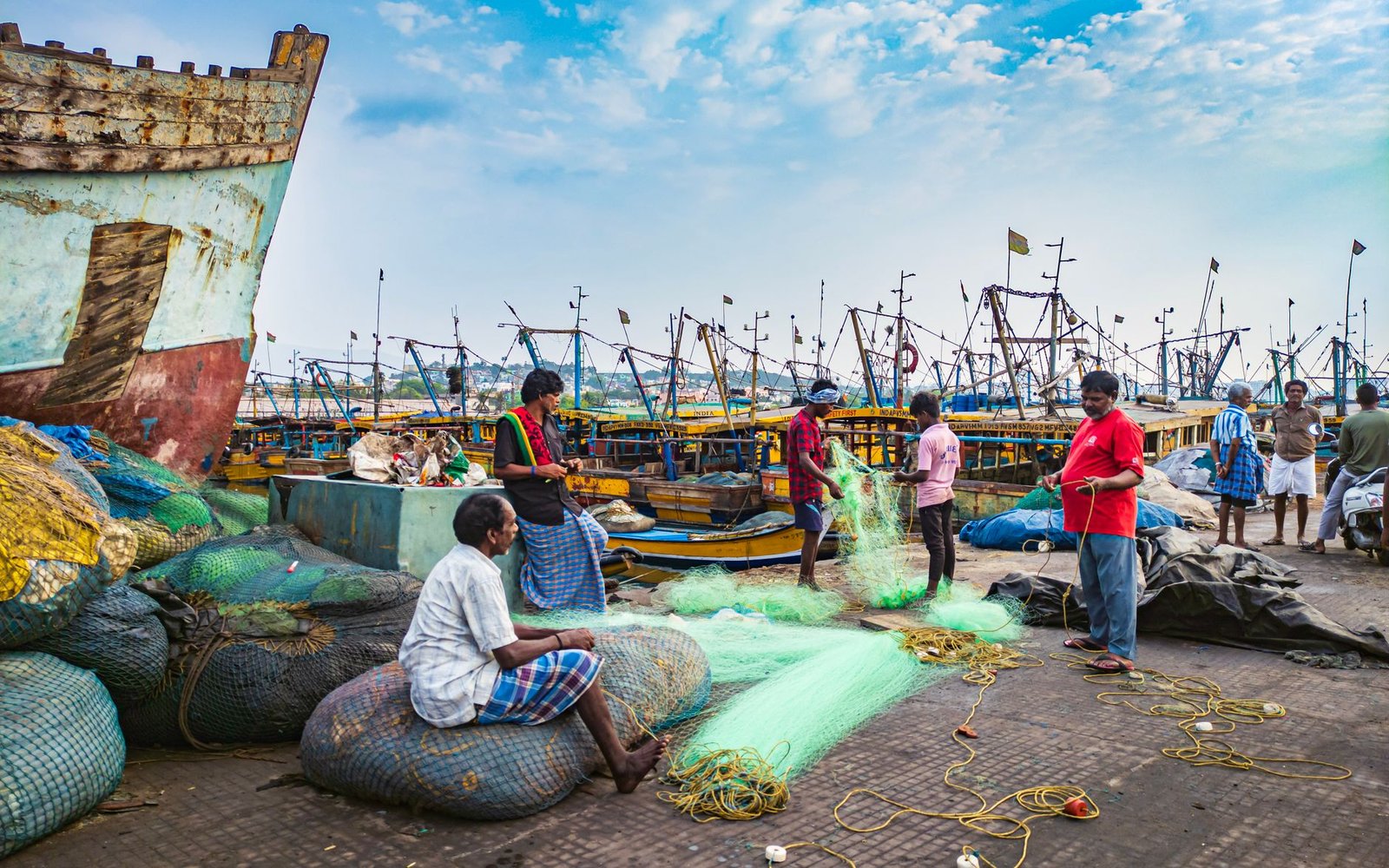
Munambam Fishing Harbour is located on Vypin Island in Ernakulam district. Mechanised trawlers, boats that drag a cone-shaped net through the water, land most of its fish. Trawlers supplied 60% of the harbour’s landings in 2013 and 77% in 2023, the authors report, using CMFRI landing data. Fishing sits alongside farming in the state’s food economy, described in The Fourth Plate’s guide to how Kerala agriculture works.
What did the Munambam study measure?
The Munambam study measured how trawl boats, crews, costs and catches changed between 2013 and 2023. The researchers used a recall survey, in which people describe past conditions from memory. They interviewed 60 randomly chosen fishers and boat owners, each with at least 10 years in the trade. Respondents described trawl operations in 2013, 2018 and 2023.
The CMFRI team then worked out costs and earnings for an average multiday trip in each year. One measure the team used is the operating ratio, which is running cost divided by revenue. A ratio of 0.46 means 46 paise of every rupee earned goes on running the trip.

Bigger boats, longer voyages, new crews
Maximum boat length at Munambam grew from 23 metres in 2013 to 40 metres in 2023, according to the study’s technical table. Maximum engine power rose from 150 to 591 horsepower, almost four times as much. Boats now travel about 125 km to reach fishing grounds, up from 20 km. Fish storage capacity rose from 2 tonnes to 15 tonnes.
Crews on Munambam trawlers grew from six to eight people in 2013 to 14 to 16 in 2023. Local workers made up 80% of crews in 2013 and about 10% in 2023, the study found. Migrant workers filled 80% to 90% of places by 2023. Trips in 2013 lasted four to five days, the authors write. The paper gives conflicting lengths for recent trips, ranging from 6 to 8 days in one section to 8 to 16 days in another.
Why do Munambam trawlers earn no more per trip?
Munambam trawlers earn about the same per trip because fuel and crew costs have risen almost as fast as revenue. Revenue per trip nearly doubled, from Rs 3.46 lakh in 2013 to Rs 6.81 lakh in 2023. Net profit per trip, equal to revenue minus operating cost in the study’s tables, went from Rs 1.86 lakh to Rs 1.82 lakh.
| Metric | 2013 | 2023 | Change |
|---|---|---|---|
| Operating cost per trip | Rs 1.59 lakh | Rs 4.99 lakh | +214% |
| Revenue per trip | Rs 3.46 lakh | Rs 6.81 lakh | +97% |
| Net profit per trip | Rs 1.86 lakh | Rs 1.82 lakh | –2% |
| Fuel share of operating cost | 19.41% | 47.52% | +28.1 pts |
| Catch per trip | 2,180 kg | 3,385 kg | +55% |
| Catch per crew member per trip | 273 kg | 242 kg | –11% |
| Operating ratio | 0.46 | 0.73 | +0.27 |
Fuel cost per trip rose from Rs 30,923 in 2013 to Rs 2,37,070 in 2023, about 7.7 times, by The Fourth Plate’s calculation. Fuel’s share of operating cost rose from 19.41% to 47.52%, according to the study. The paper’s abstract gives a 2023 fuel share of 33.06%. Running cost per kilogram of fish doubled at Munambam, from about Rs 73 in 2013 to about Rs 147 in 2023. Revenue per kilogram rose more slowly, from about Rs 159 to about Rs 201. Both figures are The Fourth Plate’s calculations from the paper’s cost table.
Catch per trip rose 55%, from 2,180 kg in 2013 to 3,385 kg in 2023. Catch per crew member fell from 273 kg to 242 kg per trip, about 11% lower. The operating ratio climbed from 0.46 to 0.73. Owners now keep about 27 paise of each rupee after running costs, down from about 54 paise.
The Munambam study rests on memory. Respondents recalled conditions up to ten years back, and recall can drift. All 60 respondents worked at one harbour, so the results describe Munambam alone. The authors say “the study emphasises the need for effective fisheries management strategies”. They call for fleet size and engine power to match the fish available. They also recommend more selective nets, stricter regulation and closer monitoring at sea.
Owners in the Munambam trawl fishery now spend three times as much per trip to earn the same profit. Fuel takes almost half of every trip’s running cost, so rise in diesel prices or fall in catches will cut straight into that profit.
Sources: Salim, S.S., Stanley, L. and Athira, N.R. (2026). Technological innovations and fishing effort: Paradigm shifts in the trawl fishery of Munambam Fishing Harbour, Kerala, South India. Indian Journal of Fisheries, 73(2): 164–174. https://doi.org/10.21077/ijf.2026.73.2.165672-18. Licence: CC BY-NC-ND 4.0. No press release was found; all findings are from the paper.


