
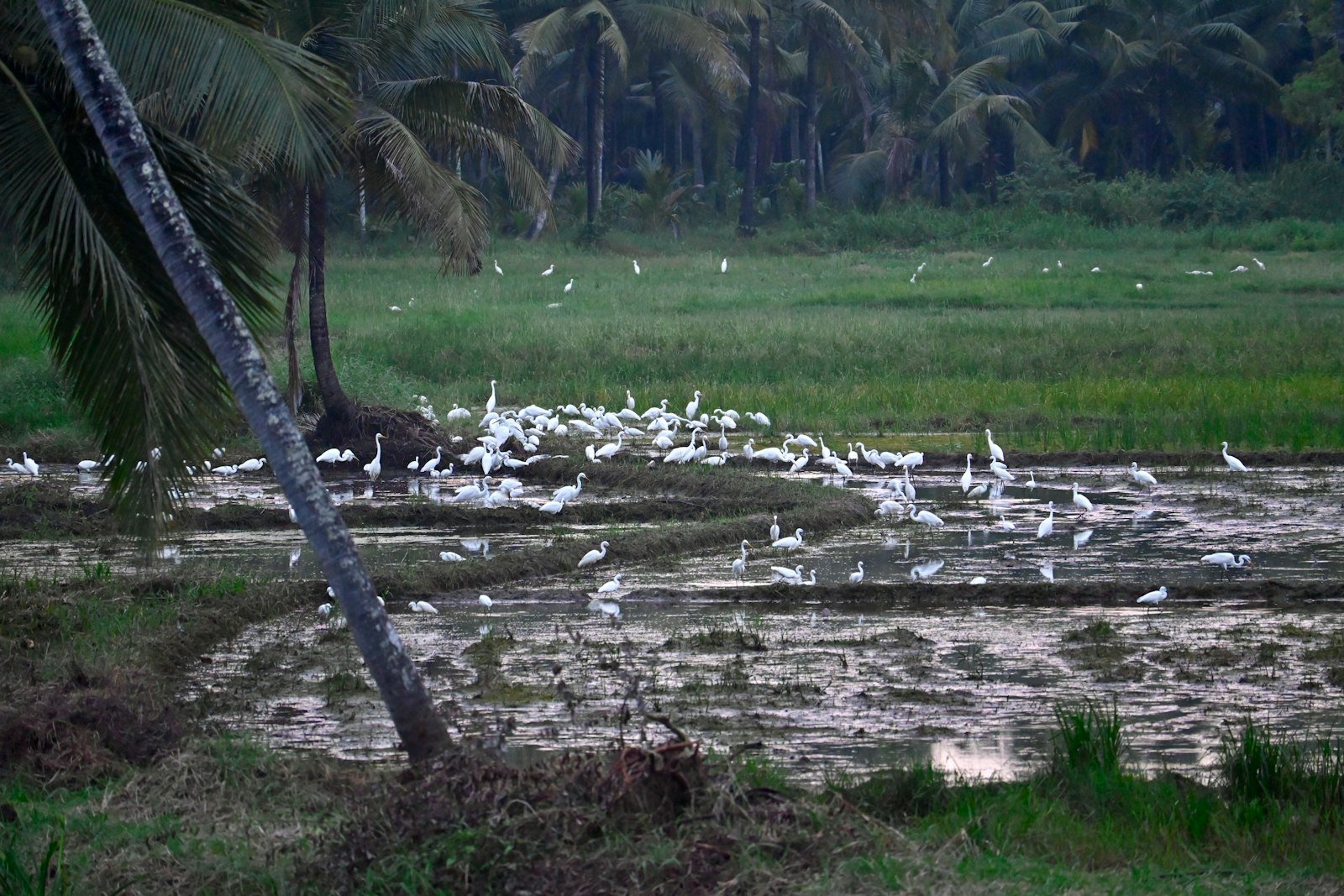
Kerala agriculture is a tree-crop economy. Coconut and rubber together cover more than half the state’s cropped area, and rice fills about 7%, the Kerala State Planning Board’s Economic Review 2025 says. Agriculture, forestry and fishing produced 7.64% of Kerala’s gross state value added in 2024-25, down from 10.74% in 2015-16.
Kerala produces about 71% of India’s natural rubber and about 88% of its small cardamom, and it has the country’s largest area under coconut. It buys most of its rice from other states. This guide explains how farming in Kerala works and gives the latest official figures, with the period each one covers.
Key facts
- Total cropped area: 25.15 lakh hectares, 64.71% of Kerala’s land (Economic Review 2025, for 2024-25)
- Coconut covers 30.44% of the cropped area, rubber 21.78% and rice 7.01% (Economic Review 2025, 2024-25)
- Rubber output: 6.25 lakh tonnes, about 71% of India’s 8.75 lakh tonnes (Economic Review 2025; Rubber Board, 2024-25)
- Rice output: 5.30 lakh tonnes against demand of about 40 lakh tonnes a year (Economic Review 2025; Kerala Agriculture Department)
- RSS-4 rubber crossed a record Rs 300 a kg on 2 November 2026 (Rubber Board, reported by Onmanorama and PTI)
- Average farm holding: 0.18 hectares, against 0.22 hectares in 2010-11 (Agriculture Census 2015-16, cited in Economic Review 2025)
- The 2018 floods caused Rs 7,155 crore of damage and loss to agriculture, fisheries and livestock (Post Disaster Needs Assessment, 2018)

What Kerala agriculture grows and where
Kerala grows perennial tree crops on its midlands and hills and rice on its wetlands. Plantation crops (tea, coffee, rubber and cardamom) made up 28.22% of the cropped area in 2024-25, and coconut alone made up 30.44%, the Economic Review 2025 says.
The state falls into three belts. The coastal lowlands carry coconut, paddy and fish ponds. The laterite midlands of Kottayam, Pathanamthitta, Ernakulam and Thrissur carry rubber, arecanut, banana and tapioca. The Western Ghats highlands carry the spices and beverages. Small cardamom grows in Idukki, tea around Munnar, Peerumade and Wayanad, and coffee and black pepper in Wayanad and Idukki.
Much of Kerala’s farming happens in homesteads, mixed plots around a house with coconut, pepper vines, banana, nutmeg and often a cow. Kerala had 75.83 lakh operational holdings in 2015-16, up 11% from 2010-11, and the average size fell from 0.22 to 0.18 hectares. That is about one-sixth of the all-India average of 1.08 hectares in the same Agriculture Census.
Kerala has lost its national lead in two old crops. Karnataka produced 595 crore coconuts in 2022-23 against Kerala’s 563 crore, Coconut Development Board figures reported by The Hans India show. Karnataka also grows more black pepper. Kerala still has India’s largest coconut area, 7.66 lakh hectares in 2024-25.
Area and production of Kerala’s main crops
The table sets the Economic Review 2025 figures for 2024-25 against 2023-24. The change column is The Fourth Plate’s calculation from those two years. Coffee and banana appear separately below because the Review gives no crop-level figures for them.
| Crop | Area 2023-24 (’000 ha) | Area 2024-25 (’000 ha) | Output 2023-24 | Output 2024-25 | Change in output |
|---|---|---|---|---|---|
| Rice | 178.95 | 176.36 | 530.28 kt | 530.22 kt | 0.0% |
| Coconut | 765.84 | 765.62 | 5,523 m nuts | 5,612 m nuts | +1.6% |
| Rubber | 548.30 | 547.74 | 609.60 kt | 625.12 kt | +2.5% |
| Black pepper | 72.67 | 69.89 | 30.80 kt | 29.50 kt | -4.2% |
| Small cardamom | 40.35 | 40.35 | 22.87 kt | 18.31 kt | -19.9% |
| Tea | 35.68 | 35.70 | 65.09 kt | 57.29 kt | -12.0% |
| Arecanut | 96.11 | 96.05 | 103.99 kt | 85.89 kt | -17.4% |
Rubber and coconut grew in 2024-25 while the spices, tea and arecanut shrank. Cardamom output fell by a fifth on an unchanged area of 40,345 hectares. Black pepper lost area and output for a second year.
Rice output held at 5.30 lakh tonnes even as area fell 1.45%, because yield rose by 43 kg to 3,006 kg a hectare. Palakkad, Alappuzha, Thrissur and Kottayam together hold 81.53% of the paddy area and 83.14% of output, the Review says.
The Department of Economics and Statistics’ Agricultural Statistics 2023-24 gives the other two crops. Coffee covered 85,957 hectares and yielded 70,354 tonnes. Banana covered 47,542 hectares and yielded 4.78 lakh tonnes.
Current prices of rubber, pepper, cardamom and coconut in Kerala
Kerala’s cash crops are trading near record levels in late 2026. RSS-4 sheet rubber crossed Rs 300 a kg (about $3.17) in Kottayam and Kochi on 2 November 2026. That is the highest Rubber Board price on record, Onmanorama and PTI reported. Dollar figures in this guide use the 3 November 2026 rate of Rs 94.75, reported by PTI.
The rubber price is up about 50% on the 2024-25 average of Rs 199.85 a kg in the Economic Review. International RSS-4 stood at Rs 266.69 a kg that day, so Indian buyers are paying a premium for domestic sheet. Growers gain less than the headline suggests. Tappers are scarce, and Elanji grower Tony P Emmanuel told PTI that yield per acre has fallen to a third of its level 15 years ago. The Fourth Plate reported the earlier record of Rs 284.50 on 13 October.
Black pepper traded at Rs 720 a kg ungarbled and Rs 740 garbled in Kochi on 21 October 2026, Kedia Advisory reported. Kerala’s smaller crop and thinner imports have pushed prices to a decade high. Sri Lankan pepper was offered at about $6,800 a tonne against Indian quotes near $7,825.
Small cardamom averaged Rs 3,036 a kg (about $32) across ten Spices Board e-auctions between 29 October and 3 November 2026. The Fourth Plate weighted each auction’s average price by the 703,698 kg sold to reach that figure. The best lots fetched Rs 4,001 a kg.
Coconut prices have eased from their 2025 peak. Raw coconut hit an all-time high of Rs 78 a kg in 2025 and fell to Rs 55 by early January 2026, ETV Bharat reported. Copra fell from Rs 27,000 to Rs 20,000 a quintal over the same months. Copra stayed well above the Centre’s 2026 minimum support price of Rs 12,027 a quintal for milling copra.
What a hectare earns at today’s prices
The table multiplies each crop’s 2024-25 Kerala yield by its late-2026 price. For cardamom The Fourth Plate divided output by area, 18,310 tonnes over 40,345 hectares, which gives 454 kg a hectare. It shows gross revenue before costs, and it pairs a 2024-25 yield with a 2026 price. It still explains the choices farmers make.
| Crop | Kerala yield 2024-25 | Price (late 2026) | Gross revenue per hectare |
|---|---|---|---|
| Small cardamom | 454 kg/ha (output divided by area) | Rs 3,036/kg (auction average, 29 Oct-3 Nov) | Rs 13.78 lakh (about $14,540) |
| Rubber (RSS-4) | 1,586 kg/ha | Rs 300/kg (2 Nov) | Rs 4.76 lakh (about $5,020) |
| Black pepper | 422 kg/ha | Rs 720/kg ungarbled (21 Oct) | Rs 3.04 lakh (about $3,210) |
| Paddy | 3,006 kg/ha | Rs 24.41/kg (Centre’s minimum support price, 2026-27) | Rs 73,376 (about $774) at the 2026-27 MSP, before the state incentive (3,006 kg × Rs 24.41) |
At current prices and the 2026-27 MSP, a hectare of cardamom grosses 18.8 times a hectare of paddy, and rubber grosses 6.5 times as much. Paddy survives where land floods each year and few other crops grow, in Kuttanad, the Kole lands and the Palakkad plains.
How paddy is farmed in Kuttanad, Palakkad and the Kole lands
Kerala grows rice in a few wetland systems with their own calendars. The state’s paddy area peaked at 8.76 lakh hectares in 1975-76, Department of Economics and Statistics figures reported by Onmanorama show. At 1.76 lakh hectares in 2024-25 it is about 80% smaller.
Kuttanad, spread across Alappuzha, Kottayam and Pathanamthitta, is farmed below sea level on land reclaimed from Vembanad lake. Farmers grow paddy in polders, called padasekharams, ringed by mud bunds, and pump out water before each crop. The Food and Agriculture Organization (FAO) lists the Kuttanad Below Sea Level Farming System as a Globally Important Agricultural Heritage System. FAO says it is the only system in India that grows rice below sea level. Alappuzha’s Puncha crop covered 23,330 hectares in 2024-25 and yielded 57,390 tonnes.
The Kole lands of Thrissur and Malappuram cover about 13,632 hectares, 0.5 to 1 metre below mean sea level. They flood from June to November and carry one rice crop from December to May. Kuttanad and the Kole lands sit within the Vembanad-Kol wetland, a Ramsar site of 151,250 hectares designated in 2002.
Palakkad’s rice yield was 3,281 kg a hectare in 2024-25, above the state average of 3,006 kg, and its output rose 18%. A model of the Bharathapuzha basin projects Palakkad yields falling 54% to 74% by 2100 if farming and water use stay as they are.
Kerala names its three rice seasons Virippu, Mundakan and Puncha. Yields in 2024-25 were 2,790 kg a hectare for Virippu, 3,046 kg for Mundakan and 3,100 kg for Puncha, the Economic Review says.
Why Kerala farmers are under pressure
Kerala’s farmers face high wages, tiny plots, volatile prices, floods and droughts, and wild animals. Each pushes land out of food crops and into tree crops, house plots or fallow.
Labour costs and migration
A male unskilled paddy-field worker earned Rs 858.79 a day in 2024-25, up 3.57% in a year, and a woman Rs 709.10, the Economic Review says. At Rs 858.79, a day of hired male labour costs the price of about 35 kg of paddy at the 2026-27 minimum support price of Rs 24.41 a kg. Young Malayalis left farm work for the Gulf. The Kerala Migration Survey 2023 counted 2.2 million emigrants who sent home Rs 2,16,893 crore (about $22.9bn) in 2023, against Rs 85,092 crore in 2018, Deccan Herald reported. Workers from eastern India now do much of the transplanting and harvesting, The Fourth Plate has reported.
Land conversion and fragmentation
Kerala cleared the conversion of 10,950 hectares of paddy land between 2018-19 and 2024-25 and collected Rs 1,606.9 crore in fees, Revenue Department figures given to the Assembly show, Onmanorama reported. Thrissur converted the most, 2,150.58 hectares. The Kerala Land Reforms Act of 1963 bars the leasing of farmland, so owners of idle plots cannot legally rent them to working farmers, The Fourth Plate has reported.
Price volatility and imports
Kerala’s cash crops trade on world markets, so imports cap local prices. India imported 5.51 lakh tonnes of natural rubber in 2024-25, 39% of its consumption of 14.10 lakh tonnes, a Rubber Board panel reported. The 2025 coconut rally reversed within months as Tamil Nadu and Karnataka harvested well and Indonesian imports arrived, ETV Bharat reported. Pepper fell to about Rs 340 a kg by 2019 after years of cheap imports, The Fourth Plate reported, before climbing back above Rs 700.
Floods and climate stress
The August 2018 floods caused Rs 26,720 crore of damage and loss across Kerala, the United Nations-led Post Disaster Needs Assessment found. Agriculture, fisheries and livestock bore Rs 7,155 crore, or 26.8% of the total by The Fourth Plate’s calculation. The assessment singled out Kuttanad’s below-sea-level paddy land. In 2026 farmers in Wayanad’s Pulpally could not transplant paddy as the Kannaram and Kabini rivers ran low.
Human-wildlife conflict
Kerala declared human-wildlife conflict a state-specific disaster in 2024, the Economic Review says. Elephants killed 19 people in 2024-25, the Economic Review and the Forest Department both report. The state paid Rs 20.81 crore on 8,533 compensation claims that year, 6,295 of them for crop and property loss. In October 2026 it doubled crop-loss compensation and removed the cap on claims. The state’s 2026-27 plan sets aside Rs 90 crore for measures to reduce conflict.
What the state and Centre do for Kerala farmers
Kerala supports farmers through state procurement, price floors, crop insurance and a panchayat-level network of farm offices. The Centre sets minimum support prices and funds most of the paddy price.
Paddy procurement through Supplyco
The Kerala State Civil Supplies Corporation (Supplyco) buys paddy from registered farmers at the Centre’s minimum support price (MSP) plus a state incentive. The Union Cabinet set the MSP for common paddy for the 2026-27 kharif marketing season at Rs 2,441 a quintal (Rs 24.41 a kg) in May 2026, up Rs 72, Devdiscourse and S&P Global reported. Kerala raised its procurement support for paddy by Rs 300 a quintal in August 2026, Congress Bharath reported. Supplyco bought 1.45 lakh tonnes from 57,529 farmers in the first 2024-25 crop and 4.34 lakh tonnes from 1,49,615 farmers in the second, the then Food Minister G R Anil said.
Open-market mandi rates for common paddy in Kerala ranged from Rs 2,500 a quintal in Kasaragod to Rs 3,130 a quintal (Rs 31.30 a kg) in Pulpally, Wayanad, in November 2026, the mandi price trackers Commodity Online and KisanDeals show. The UDF government elected in 2026 promised Rs 35 a kg in its manifesto, The Fourth Plate has reported.
Farmers also wait months for payment, The Fourth Plate has reported. Supplyco rejects paddy above 17% moisture, so Palakkad farmers paid Rs 2.50 to Rs 3.50 a kg for machine drying during the October 2026 rains, Onmanorama reported.
Price support for rubber, coconut and vegetables
The Rubber Production Incentive Scheme began in July 2015 with a floor of Rs 150 a kg. It pays small growers the gap between the floor and the Rubber Board’s daily price, on up to two tapped hectares, Deccan Chronicle reported. The floor rose to Rs 200 from 1 November 2025 and to Rs 250 from 3 July 2026. With the market at Rs 300 the scheme pays nothing today and protects growers against the next slump.
Kerala buys green coconut at Rs 34 a kg and procured 1,254 tonnes from 2,748 farmers in 2024-25, the Economic Review says. In November 2020 Kerala became the first state to fix base prices for 16 fruits and vegetables. The Vegetable and Fruit Promotion Council Keralam (VFPCK) and Horticorp buy the produce.
Krishi Bhavans and crop insurance
A Krishi Bhavan is the state agriculture department’s office at panchayat level. It handles subsidies, soil testing, seed and seedling supply, farmer pensions and coconut procurement, and Ernakulam district alone has 97 of them. The Restructured State Crop Insurance Scheme paid Rs 33.14 crore to 16,959 farmers in 2024-25. The weather-based crop insurance scheme covered 92,743 farmers in kharif 2024 and 1,26,906 in rabi 2024-25.
The Kerala Paddy and Wetland Act
The Kerala Conservation of Paddy Land and Wetland Act, 2008, bars filling paddy land or leaving it fallow without permission from a district or state committee. A 2015 change let owners regularise land reclaimed before 2008 by paying 25% of its fair value, Down To Earth reported. Over half of Kerala respondents in The Fourth Plate’s Global Food Systems Survey called the law too weak.
How much of its food Kerala buys from other states
Kerala grows about one-seventh of the rice it eats. Demand runs at about 40 lakh tonnes a year, the state Agriculture Department says, as reported by Onmanorama, against 5.30 lakh tonnes grown in 2024-25. That is 13% self-sufficiency by The Fourth Plate’s calculation.
Andhra Pradesh, Tamil Nadu and Karnataka supply most of the gap through ration shops and private trade. Jaya rice comes from Andhra Pradesh and onions, tomatoes and potatoes from Tamil Nadu and Karnataka, The Fourth Plate reported on Kerala’s 70th birthday. Kerala grew 19.11 lakh tonnes of vegetables, banana included, on 1.22 lakh hectares in 2024-25.
The dependence ties Kerala’s food bills to weather elsewhere. A cyclone on the Andhra coast or a drought in Karnataka reaches Kerala kitchens within weeks. Gulf remittances, Rs 2,16,893 crore in 2023, give Kerala households the income to buy food grown elsewhere.
Frequently asked questions
What is the main crop of Kerala?
Coconut is Kerala’s main crop by area. It covered 7.66 lakh hectares in 2024-25, or 30.44% of the cropped area, and yielded 5,612 million nuts, the Economic Review 2025 says. Rubber comes second at 5.48 lakh hectares, and Kerala grows about 71% of India’s natural rubber, on Rubber Board and Economic Review figures.
Why is Kuttanad called the rice bowl of Kerala?
Kuttanad has grown rice for generations below sea level, in polders reclaimed from Vembanad lake. The Ramsar information sheet for the Vembanad-Kol wetland calls the Kuttanad belt the rice bowl of Kerala. FAO lists it as a Globally Important Agricultural Heritage System, the only one in India growing rice below sea level. Alappuzha district’s Puncha crop covered 23,330 hectares in 2024-25, the Economic Review 2025 says.
What is the rubber price in Kerala today?
RSS-4 rubber crossed Rs 300 a kg in Kottayam and Kochi on 2 November 2026, its highest price on record. RSS-5 traded at Rs 294 and 60% latex at Rs 197.60 a kg, Rubber Board figures reported by PTI show. The 2024-25 average was Rs 199.85, so prices are up about 50%.
Does Kerala produce enough rice?
Kerala produces about 13% of the rice it eats. It grew 5.30 lakh tonnes in 2024-25, the Economic Review 2025 says, against annual demand of about 40 lakh tonnes estimated by the state Agriculture Department. Andhra Pradesh, Tamil Nadu and Karnataka supply most of the rest through ration shops and private traders.
What is the Kerala Paddy and Wetland Act?
The Kerala Conservation of Paddy Land and Wetland Act, 2008, protects paddy fields and wetlands from filling and conversion. Owners need a committee’s permission to change land use. Between 2018-19 and 2024-25 the state still cleared 10,950 hectares for conversion and collected Rs 1,606.9 crore in fees, Revenue Department figures show.
How much does agriculture contribute to Kerala’s economy?
Agriculture, forestry and fishing made up 7.64% of Kerala’s gross state value added in 2024-25, the Economic Review 2025 says, against 10.74% in 2015-16. The sector grew 2.14% in 2024-25, up from 1.25% the year before, and the crop sector grew 2.43%.
Fourth Plate coverage of Kerala farming
- Kerala turns 70 as farm pledges slip and other states fill its plate traces how Kerala lost three-quarters of its paddy land and now buys rice, leaves and vegetables from neighbours
- Kerala rubber prices hit record Rs 284.50 per kg reports the October 2026 rubber record and the shortage behind it
- Kerala black pepper prices hit decade high as supply tightens explains the pepper rally and why few growers have stock to sell
- Palakkad paddy yields could fall by more than half by 2100 reports a Bharathapuzha basin model of climate risk to Kerala rice
- Wayanad paddy farmers face monsoon failure as Pulpally runs dry reports on fields left untransplanted in the 2026 monsoon
- Kerala rubber belt turns to rambutan for better pay shows rubber growers switching land to fruit for higher returns
- Idukki clears cardamom fences to reopen elephant corridors reports on cardamom land and elephant deaths in Chinnakanal
- Kerala rolls out AI-based wildlife defence policy for farms covers the state policy on forest-edge monitoring and compensation
- Kerala flood-hit farmers report over Rs 127 crore in losses tallies 2026 crop losses from floods
- Engineer swaps factory floor for a Palakkad coconut farm profiles a farmer intercropping avocado, nutmeg and pepper under coconut
- Survey respondents call Kerala wetlands law too weak reports The Fourth Plate Global Food Systems Survey findings on the 2008 Act
- Farms or Malls is The Fourth Plate investigative series on paddy land conversion in Thrissur
Sources
Sources: Kerala State Planning Board, Economic Review 2025; Department of Economics and Statistics, Agricultural Statistics 2023-24; Agriculture Census 2015-16; Onmanorama, rubber at Rs 300, 3 November 2026; PTI in Deccan Chronicle, rubber growers, 3 November 2026; PTI in ThePrint, rupee rate, 3 November 2026; Kedia Advisory on Investing.com, pepper, 23 October 2026; Spices Board, small cardamom auctions; ETV Bharat, coconut prices, January 2026; The Tribune, copra MSP 2026; The Hans India, coconut output by state, January 2025; Onmanorama, paddy area since 1955-56, September 2023; FAO, Kuttanad GIAHS; Ramsar Information Sheet, Vembanad-Kol wetland; Deccan Herald, Kerala Migration Survey 2023; Onmanorama, paddy land conversion, February 2025; Kerala Post Disaster Needs Assessment, 2018 floods; Onmanorama, Forest Department conflict report, February 2026; Onmanorama, wildlife crop-loss compensation, October 2026; Kerala Kaumudi, paddy price shares, August 2025; The News Minute, paddy procurement and dues, August 2025; DD News, kharif MSP 2026-27; Devdiscourse, Centre raises paddy MSP by Rs 72 to Rs 2,441 a quintal for 2026-27, May 2026; S&P Global, India hikes minimum support price for kharif paddy for 2026-27, May 2026; Congress Bharath, Kerala raises paddy procurement support by Rs 300 a quintal, 18 August 2026; Commodity Online, Kerala mandi prices for common paddy, November 2026; KisanDeals, Kerala mandi prices for common paddy, November 2026; Onmanorama, Palakkad paddy drying costs, October 2026; Deccan Chronicle, Rubber Production Incentive Scheme, July 2015; NewsBytes, rubber support price Rs 200, October 2025; Onmanorama, rubber support price Rs 250, July 2026; Tyre Trends, Rubber Board panel on production and imports, May 2026; AgroSpectrum, vegetable base prices, October 2020; Ernakulam district administration, Krishi Bhavans; Down To Earth, paddy land regularisation, August 2015; Onmanorama, rice demand and paddy land loss, 2020; Government of Kerala, revised plan summary 2026-27.
The Fourth Plate reviews this Kerala agriculture guide and updates it as new official data is published, starting with each year’s Kerala Economic Review.
Last updated: 4 November 2026.


