Remember those clay piggy banks that once taught children the value of saving? In Kerala’s Thodupuzha in Idukki district, a retired schoolteacher has reimagined this age-old concept with an ingenious twist.
Instead of coins, students are filling their modern-day piggy banks – called “kudukka” in Malayalam – with something far more meaningful: the harvest from their family farms and fresh produce that often goes waste for lack of buyers.
Welcome to Pacha Kudukka – the “green piggy bank” – that is redefining how students view agriculture, and are learning the value of savings as well as self-reliance, while acknowledging the toil of their parents in the fields.

“Pacha Kudukka means green wealth,” explains KG Antony Kandirickal, who founded the initiative under the Kerala Agricultural Development Society (KADS). “When children see their family harvest turning into savings, something changes in their understanding of farming’s value.”
The concept took shape in 2018 in Peringasseri, a forest community, when a teacher at the local school there approached Mr Antony with a simple request – could their students bring produce from home to sell? That question sparked what would become a successful program now operating across twenty schools and benefiting 1,000 students.
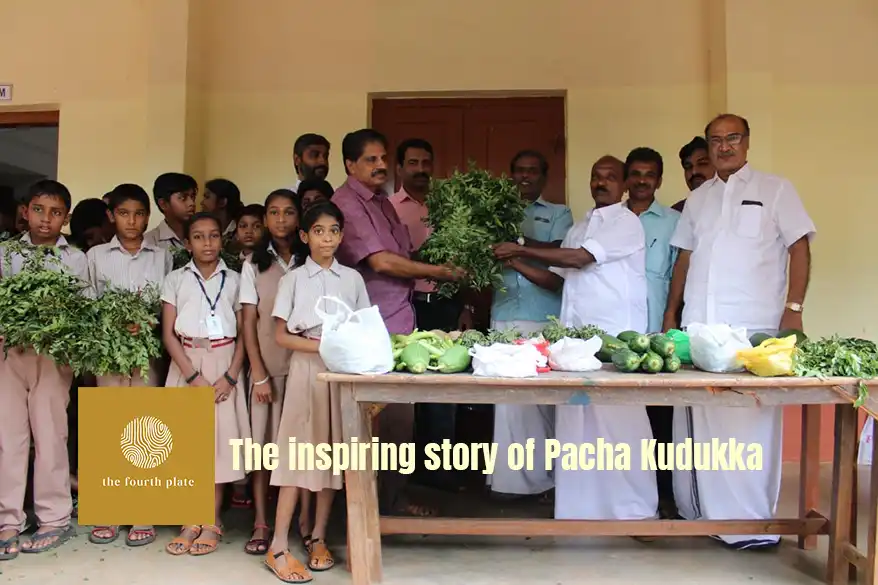
Over the past years, one day in a week, 50 students from classes 4 to 9 across 20 schools bring the family famr produce to their schools. They bring anything from freshly picked red asparagus, tender pumpkin leaves, aromatic curry leaves, and countless other produces from their family farms.
Today, as young Indians increasingly turn away from agriculture, Pacha Kudukka teaches schoolchildren that farming isn’t just their parents’ legacy, something that many young people have walked away from. Agriculture, indeed, can be their pathway to financial independence and self-reliance.
The program’s value lies in its simplicity. Fifty students from one school are enrolled for the programme, primarily those from agrarian families and who are interested in farming. They bring organic produce from their family fields and homestead gardens. KADS purchases these items and sells them through dedicated Pacha Kudukka stalls, where customers eagerly await these organic, locally-sourced products.

The earnings go directly into students’ bank accounts, untouched until an annual award ceremony. If a kilogram of curry leaves fetches 35 rupees, over a year, a student can save up to 4,200 rupees. One student even earned 23,500 rupees – enough to cover their school expenses for the entire academic year. The money is distributed to the student at the award function, adding to the self-pride of the students and their families.
Mr. Antony asserts that Pacha Kudukka is more than about money. “It’s also about promoting self-reliance and dignity in agriculture.” The program today reiterates the fact that farming is honorable and profitable.

Mr K G Antony, Founder, President – KADS & Chairman – KADS PCL
Mr Antony’s own story is an inspiration for many: The founder member of KADS, he has been a change maker molding and reshaping each and everything within his reach. The recipient of Kerala State’s Best Teacher award, he is an excellent organic farmer, his online classes in kitchen gardening is live every day on YouTube and other Channels.
Under his leadership, KADS is now registered as KADS PCL, a Farmer Producer Company to drive impactful action in value-added processing and direct marketing of products of farmers of Idukki and nearby districts, with a focus on 20 Grama Panchayats by forming 200 farmer groups.
With support from Tony Jose, Senior Manager at Udhyam Learning Foundation, the Pacha Kudukka initiative is becoming more structured. Students now prepare farm and price plans, adding entrepreneurial skills to their agricultural knowledge. Some produce is transformed into value-added products – curry leaf powder and moringa powder can fetch up to 4,000 rupees per kilogram.
The impact extends beyond individual savings. Parents say their children now eagerly participate in farming activities, asking questions about cultivation and suggesting new crops. Local customers specifically seek out Pacha Kudukka produce, knowing each purchase supports a young farmer’s education.
“It’s like what Gandhi did with the Dandi March,” Kandirickal reflects. “We’re starting small, in one place, but showing what’s possible.”
The program requires minimal infrastructure: just an interested headmaster, a coordinating teacher, and students from farming families passionate about agriculture. A single van from KADS visits different schools on rotation, collecting the fresh organic produce.

Looking ahead, Kandirickal envisions its potential of expanding to colleges and more schools across Kerala. The collected produce could support school meal programs, and students could explore more value-added products.
But at its heart, Pacha Kudukka remains fundamentally simple: it’s about students discovering that the vegetables and leaves growing in their farms have worth, that farming carries dignity, and that small, consistent efforts can grow into significant achievements.
In a country where 76% of farmers would prefer to quit farming if given a choice, Pacha Kudukka offers a refreshing alternative narrative. It shows that with the right approach, farming can be both fashionable and financially rewarding for the next generation. As India grapples with the challenge of keeping youth in agriculture, this small initiative from Kerala might just hold some big answers.
Watch the story here