

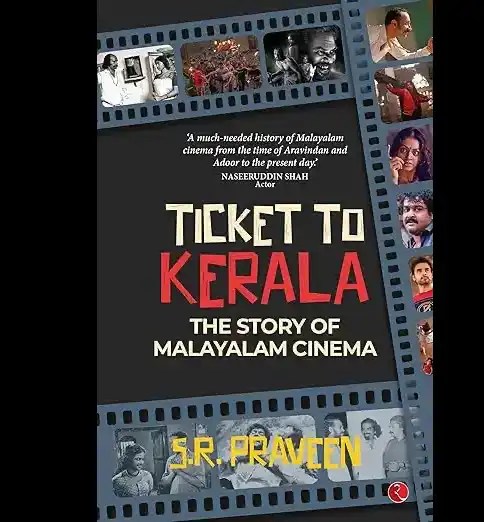
Ticket to Kerala – The Story of Malayalam Cinema by SR Praveen (Rupa Publications India Pvt. Ltd 2026, starts on a high note, with the promise that it will open eyes to what is now being called the golden age of Malayalam cinema.
It wants to explain why this small industry, long admired in fragments, has suddenly become the subject of wider Indian attention. But after the initial suggestion that the book will say something large and revelatory, it largely settles into something far more familiar: a summary-led passage through notable films, personalities and recycled interviews.
There is no doubt that Malayalam cinema is at an interesting juncture. Younger directors, writers, actors and technicians have challenged established stalwarts with new structures, tonal shifts, narrative risks and cinematic styles.
But that, in itself, is not new. Malayalam cinema has had several such turns before. The so-called discovery of Malayalam cinema says much about the ignorance and indifference of the ‘pan-Indian audience’ (read, Bollywood reviewers) about Malayalam cinema’s illustrious history.
For decades, Malayalam cinema shone at awards, walked away with national honours, produced some of India’s finest actors and filmmakers, and yet remained a footnote in the national film press.
At some point in time, Filmfare decided to set aside its last pages for South Indian cinema, and it was celebrated when Khalid Mohamed chose to interview Mammootty.
The fact is national film conversations used to hardly look beyond Bollywood’s own mirror. The preface to the book by Namrata Joshi is, therefore, useful because it exposes this blind spot. Even such learned critics who wrote seriously about Indian cinema often came late to Malayalam cinema, or saw it from the outside.
The need for a harder push
This is where Ticket to Kerala needed to push harder. Why did this discovery happen only now? Worse still, is there really a remarkable discovery other than a few Indian mainstream writers exploring beyond their usual turf?
It cannot be that Malayalam cinema suddenly became intelligent because viewers found it on streaming platforms during and after COVID. The fact is that it had long had literary depth, political anxieties, comic intelligence, formal restlessness and a stubborn relationship with realism. Only with social media, the conversations are amplified.
Meaning, what really changed is access: subtitles, OTT platforms, social media conversation, migration, young Malayalis living across Indian cities, Telugu and Tamil viewing circuits….
That is why the claim of pan-Indian acceptance needs better qualification. What has, in reality, emerged is less a clean national embrace of Malayalam cinema than a stronger pan-South circulation, with occasional breakthroughs elsewhere in the theatre circuit.
Films such as Premalu travelled in Telugu, while Premam had already shown how a Malayalam youth film could find deep affection in Tamil Nadu. But this traffic was never one-way.
Kerala has long been a receptive market for Tamil cinema, and Telugu stars such as Allu Arjun had already built a following in the state through dubbed releases. Malayalam cinema’s recent travel should be read as part of a wider South Indian exchange, not hyped into a sudden national conquest.

The strength and limitation
S. R. Praveen knows the world of Malayalam cinema, at least from the past decade plus. That is both the book’s strength and its limitation. He is eager to please the new brigade but shows shallow understanding of the industry’s past or its deeper nuances.
So, at its best, Ticket to Keralais an accessible map for readers who are arriving late and want to know where to begin. At its weakest, it becomes a curated watchlist.
The harder question remains underdeveloped: what, exactly, made this moment different from the earlier waves of Malayalam cinema? And more importantly, is there really a monumental shift?
The book’s claim of a new boldness, as a possible answer, is only partly true. Praveen writes of caste and gender surfacing in recent films in ways that question the misogyny and casteist abuse normalised by parts of the previous era. The claim, like many other arguments, is generic and convenient.
Malayalam cinema did not discover moral complexity in the 2010s. MT Vasudevan Nair, KG George, Adoor Gopalakrishnan, G. Aravindan, Padmarajan, Bharathan and Shyamaprasad had already made cinema that approached life with uncertainty, contradiction and unapologetic honesty.
That is why Shyamaprasad’s own observation in the book becomes more useful than some of Praveen’s conclusions. The best writers and filmmakers, Shyamaprasad suggests, were those who approached life differently and saw truth in a more nuanced manner.
So, the question is not whether new Malayalam cinema is bold. The question is whether it is genuinely modern. Much of it is alert to caste, gender, violence, masculinity and power. But many of them also carry the burden of political fashion and ready-made positions. Such films know what must be said but the directors are less interested in the contradictions beneath.

The more glaring omissions
There is another major absence in the book: the rise of genuine Muslim voice in Malayalam cinema. Malayalam cinema had represented Muslim life before, but often from the outside, or through the lens of social-problem melodrama.
Films such as Umma, Kuttikkuppayam and Ummachu brought Muslim households and community anxieties into the mainstream, but they still belonged to a period where the community was often being patronized or sentimentalised.
The contemporary shift is different. The newer films do not merely place Muslim characters inside Malayalam cinema. They allow Muslim worlds to generate the cinema’s rhythm, humour, language, music, masculinity, tenderness and contradiction. KL 10 Patthu, Sudani from Nigeria, Halal Love Story and Thallumaala are important because they make a region, a dialect and a cultural atmosphere speak in its own voice.
Football fields, Gulf memories, mosque-adjacent lives, family codes, wedding cultures, friendships, food, prayer and slang become part of the film’s inner life. That is one of the clearest changes in the period Praveen is evaluating. Yet the book does not give it the weight it deserves.
The inadequate past references
The same incompleteness appears in its treatment of Malayalam cinema’s past including the under-presence of many directors like Jayaraj. A filmmaker who moved from Desadanam and Kaliyattam to Karunam, Shantham, 4 The People, Ottaal and Bhayanakam cannot be treated as peripheral to the story of Malayalam cinema. He worked across art cinema, popular cinema, literary adaptation, spiritual drama, campus unrest, political anxiety and ecological fable. He is not easy to classify. That is why he belongs in the argument.
Blessy is another figure who needed fuller treatment. To underwrite him is to miss one of Malayalam cinema’s most important bridges between the older emotional-literary tradition and the contemporary revival. Kaazhcha, Thanmathra, Bhramaram, Pranayam and Aadujeevitham are not minor works in the industry’s evolution. They show a director working through memory, grief, illness, migration, ageing, masculinity, faith and survival with a seriousness that sits outside the new-generation vocabulary.
Ranjith, too, cannot be reduced to a footnote. He is a difficult figure to place because he represents both the problem and the transition. Yes, he helped script and sustain a strain of Malayalam cinema that lionised the wounded masculine ego, the feudal saviour, the cultured strongman and the aristocratic male fantasy.
But that is only one part of Ranjith’s place in the industry. He also wrote and made films that caught other registers of Malayali life: the devotional innocence of Nandanam, the cinema-memory of Thirakkatha, the historical and sexual violence of Paleri Manikyam, the comic self-delusion of Pranchiyettan and the Saint, and the social anxiety around alcoholism in Spirit.
Malayalam cinema’s revival was not built by a few approved films or a handful of preferred filmmakers. It came from a messy forest of contributors, including those whose work is ideologically or morally uncomfortable but historically unavoidable. The author’s high moral position, reflecting even in how he chooses to conclude his narration of KG George, shows lack of objectivity.

Again, Sreenivasan deserved far more than passing mention. He is one of the key architects of the Malayali middle-class self-image: insecure, clever, hypocritical, wounded, aspirational and politically exhausted. Sandesham is a case in point. To suggest that the film’s lampooning of intellectual discussions made critical analysis ‘uncool’ is to overstate the case and underread the film. Sandesham did not make thinking uncool. It made pretension visible and understood how ideology could enter the household.
One could argue that the book is not Malayalam cinema’s history. But these arguments would not have surfaced if Praveen stuck to his exploration of the period of cinema he wanted to talk about and not digressed to give us a history that Wikipedia would tell with no frills.
The book, too obsequious to some contemporary actors, writers and directors, also turns shock into progress. 22 Female Kottayam, a rather regressive film, might have been a shocker in its representation of female rage. Was Tessa’s radical act Bobbitting one of agency, or did it remain trapped within the same violent grammar that Malayalam cinema had long used against women?
The reverence for clear author-favourites appears elsewhere too. Fahadh Faasil’s performance in Aavesham is elevated in a way that seems to forget that uninhibited performance did not begin with him. Mohanlal built a career on precisely that quality: the ability to appear unprepared, unguarded and yet completely in control.

The Mohanlal narrative
The Mohanlal chapter is where the book’s imbalance becomes most visible. To begin a chapter on one of Malayalam cinema’s greatest actors through the sourness of his Hema Committee press conference response may be personally honest, but it is critically limiting. Mohanlal’s public response to an industry crisis is a legitimate subject. But should it become the emotional doorway into his artistic life?
The comparison with Mammootty is also too easy. Mammootty’s greatness lies in discipline, passion and the ability to disappear into selected roles. Mohanlal’s greatness lies elsewhere: in the collapse of performance into behaviour. To say he leaves a trace of himself in his roles only smacks of prejudice.
Then again, why no mention of Mohanlal’s Lucifer? Whatever one thinks of the film, it matters. Written by Murali Gopy (no mention in the book), directed by Prithviraj Sukumaran, it showed that Malayalam cinema’s contemporary transformation was not confined to restrained realism, small films, new faces and progressive themes.
It also included the reinvention of the star-led commercial potboiler. Lucifer proved that the old star system had not simply collapsed under the new wave. It could be repackaged for a changed audience.
The so-called ‘new’ Malayalam cinema is also the persistence of mass cinema, the recalibration of star image, and writers like Murali Gopy attempting to build a socio-political universe out of Malayalam cinema’s own anxieties.
A serious account of the period has to hold both worlds together: the intimate film and the spectacle, the new actor and the old star, the indie-coded breakthrough and the commercial wins.

Peripheral approach
A peripheral appraoch applies to the book’s treatment of women and institutional reform too. Parvathy Thiruvothu’s career, the WCC and the Hema Committee report are important, but a gender history of Malayalam cinema cannot begin there.
The exploitation of women in the industry has a much longer and darker history, including the case of Vijayasree (a well-known secret being how a renowned studio about which Praveen writes reams exploited her for the film Ponnapuram Kotta; unlike some of the celebrated cases of today, apparently there wasn’t even a fair investigation).
Nor is the narrative enough to invoke the Hema report without asking what happened after it, why its recommendations remained stalled for so long despite being ruled by a Left government, and how quickly institutions learned to absorb outrage without transforming themselves.
Ticket to Kerala is readable and way too skimmable. It opens the door but does not go deep enough into the house. In short, a great idea is left underexplored and stymied by author biases.


Leave a Reply