
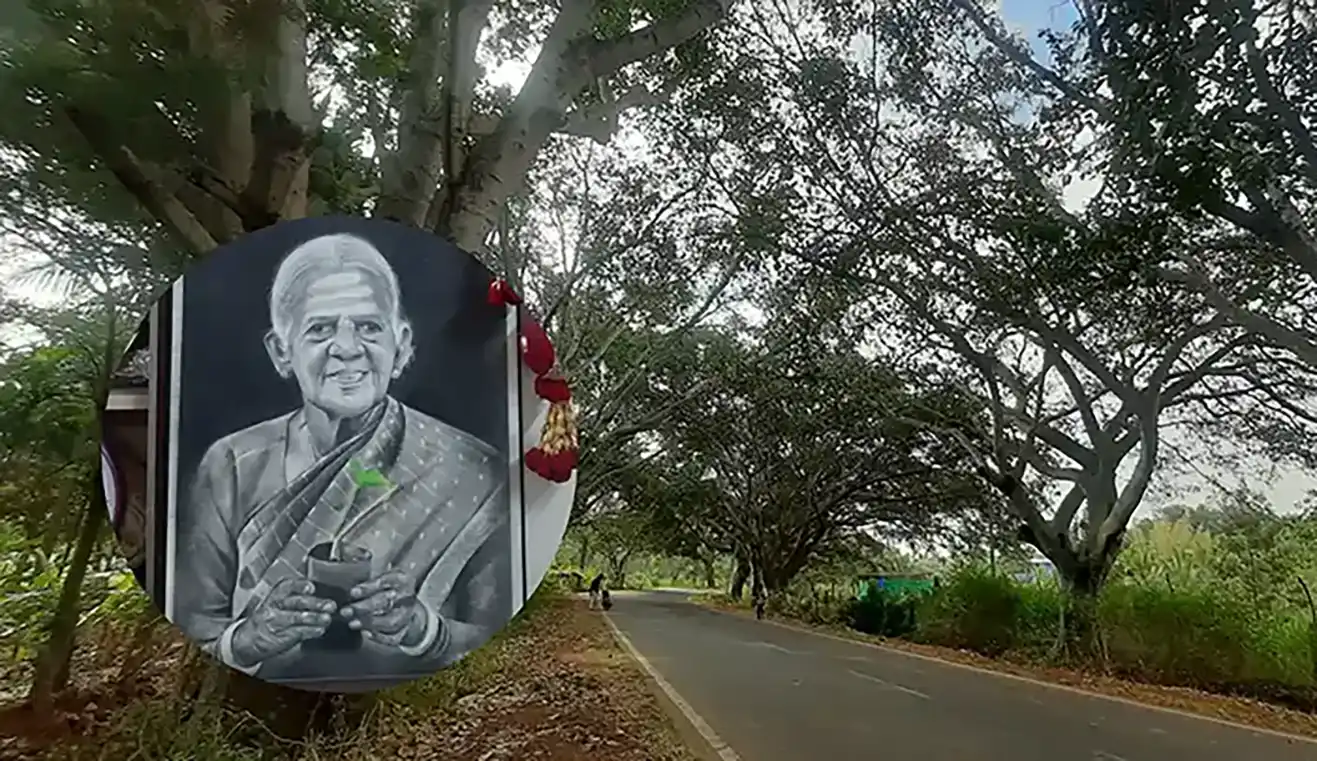
When I set out to meet the 385 odd trees that Saalumarada Thimmakka and her husband, Bikkala Chikkayya planted together, I followed an online map. The destination, now internationally renowned, is called “Saalumarada Thimmakka Tree-line.”
Its creator’s life story is the stuff of legends as countless films, reels, media reports and documents stand testimony. Chief Ministers quote her. Heads of state bow before her. People revere her.
Yet, when a Dalit couple eking a living by breaking rocks in a quarry chose to plant ten branches from a banyan tree outside their village along a treeless road – they simply saw shade where, then, there was scorching heat.

One day in 1948, well before dawn, they carried the carefully chosen branches to a dusty, open road where they’d seen other daily wagers walking under a blazing sun, seeking work. They dug ten holes and planted each branch. They rejoiced when the branches took root and sprouted leaves.
In the monsoon months of the years that followed, they planted more and more branches, forgetting to keep count but never forgetting to carry buckets of water uphill to nurture each growing tree. They fenced the young trees with thorny bushes to keep grazing animals away. Some put the number at 385 and others at 400 but the trees cover about 4 km of what is now a state highway between Hulikal and Kudur, in Karnataka.
Enroute the Saalumarada Thimmakka Tree-line
Saalumarada Thimmakka Tree-line is 59 km from the heart of Bangalore. As I entered the stretch of the highway that suddenly became cooler and thickly shaded by tree cover, I knew I had reached.
As a child, Thimmakka had known hunger from the inside. She had been beaten. She knew the life of an outcaste, having grown up in the ‘keri’ – the part outside a village, earmarked for historically marginalized communities. She had been sold into bonded labour. She had walked long distances to fetch water, find work and pluck leaves from tall forest trees – leaves she’d then craft into baskets and sell to make 8 or 9 paise in all.
No stranger to hard labour, she joined her husband as a quarry worker or worked in farms after her marriage at age 19. Her life held no mention or possibility of schooling though her life story is now in prescribed school books. Thimmakka was 114 years old when she died on 14th Nov, 2025 in a hospital in south Bangalore but only 37 years old when she and Chikkayya started planting trees to heal from the humiliation they faced for being childless.

“Trees are to be grown, not cut. If you grow trees, there will be rain. The country will thrive. Can there be a country if there is no rain? What will people eat?”
Saalumarada Thimmakka
Tracing back the legacy
The trees she continued nurturing even after her husband’s death in 1991 now bridge earth and sky. They are about 78 years old. Under those trees, I spent a long while walking, picking fallen leaves, taking photos and soaking in the shade. I thought about the countless trees she planted after these and the ones she inspired others to plant. I then went in search of her burial site to Kalagrama, a cultural hub housing an art and theatre school, near the Bangalore University campus.
After a short search, I found the site – freshly decorated with yellow flowers, a white bag containing saplings, kept by the mound. A young Indian Badam tree grew in close proximity. Students rehearsed a play in the amphitheatre nearby. There was hardly anyone around unlike the day she had been buried there with full state honours in the presence of, not just politicians across parties but also admirers, ecologists, writers, naturalists, doctors, students and others.

At her home near Tumkur road, Bangalore, I met Umesh Vanasri who Saalumarada Thimmakka legally adopted and called son. Umesh calls her “Ajji” (which is Kannada for grandmother) but looked after her for more than two decades “almost like a child,” he says, speaking of her long fight with illness, injury and old age in great detail.
Surrounded by innumerable trophies that filled the room instead of furniture, framed photographs of various sizes gifted to her by artists and stacks of Mysuru petas (a decorated turban awarded to distinguished people for their service, typically in Karnataka), Umesh spoke with much grief of the travails Saalumarada Thimmakka faced in her long life, yet breezed through, by choosing to stand in the shade of trees.
A bond fostered by nature
A tiny report in a local newspaper had set Umesh off in search of Saalumarada Thimmakka when he was around 12 or 13. He recalled the first time he went to her house in Hulikal after finding it with great difficulty and travelling all the way from Belur. She had welcomed him warmly, listening to his accounts about planting trees near his school and home with attention and appreciation. She had made him an impromptu dessert with avalakki and bella (beaten rice and jaggery).
In a couple of months, the bond between them grew stronger. She went to stay with his family in Belur and asked his parents if she could adopt him. “She was not famous then and had nothing to her name. My parents knew of her service and agreed without a second thought,” said Umesh. In the next few years, he moved to Hulikal to care for her as she was growing older. Health issues that erupted became serious from around 2007. He dropped out of college to care for her.

Battling ill health, upholding her task
He described her battles with death in the general ward of government hospitals; her subsequent transfer to better hospitals with support from the media, politicians and well-wishers; falls that left her injured, her spine damaged; a heart attack she survived; heart and hip surgeries she withstood well after she turned 100.
Alongside all of this, she kept up with the demands of a public life that came with being named Parisara Rayabari or Environmental Ambassador by the Karnataka Government. She planted trees she refused to count (“what does it matter,” she’d ask when reminded to keep track). She received visitors who sought her blessings and won awards galore that included the Padma Sri, India’s fourth highest civilian award.
In her memory, Umesh said he wishes to see a museum created on a dedicated land, where her life stories will be depicted, her trophies and photographs displayed – as also her work taken forward through more tree planting, more nurturing of saplings in a nursery. He expressed deep disappointment that the UN did not recognise her work in her lifetime.
A life devoted to trees
In 78 years, it is not just the trees that Thimmakka and Chikkayya planted along the Hulikal Kudur highway that have grown. Seasons have passed, governments fallen and changed. In the same years, the tree-line survived a road-widening attempt that would have shorn it clean of trees if not for Thimmakka’s plea to the government to reshape the project. Being an earth warrior, Saalumarada Thimmakka was used to standing up for trees, even if it meant fighting people who had feted her for planting them.
Saalumarada Thimmakka has been quoted as saying, “Trees are to be grown, not cut. If you grow trees, there will be rain. The country will thrive. Can there be a country if there is no rain? What will people eat?” As the earth’s climate declines due to human abuse of the planet and the prospect of an unsafe, unbalanced future is acknowledged, Saalumarada Thimmakka’s life is more than a message. It is a deep breath – a dense canopy of tree cover that offers hope and healing.

Charumathi Supraja is a journalist, writer and poet based in Bangalore, India. She created the Treevellers’ Katte – a holding space for people’s tree stories and tree memories around 2016. You can read more about her work with trees on her blog.




Leave a Reply