
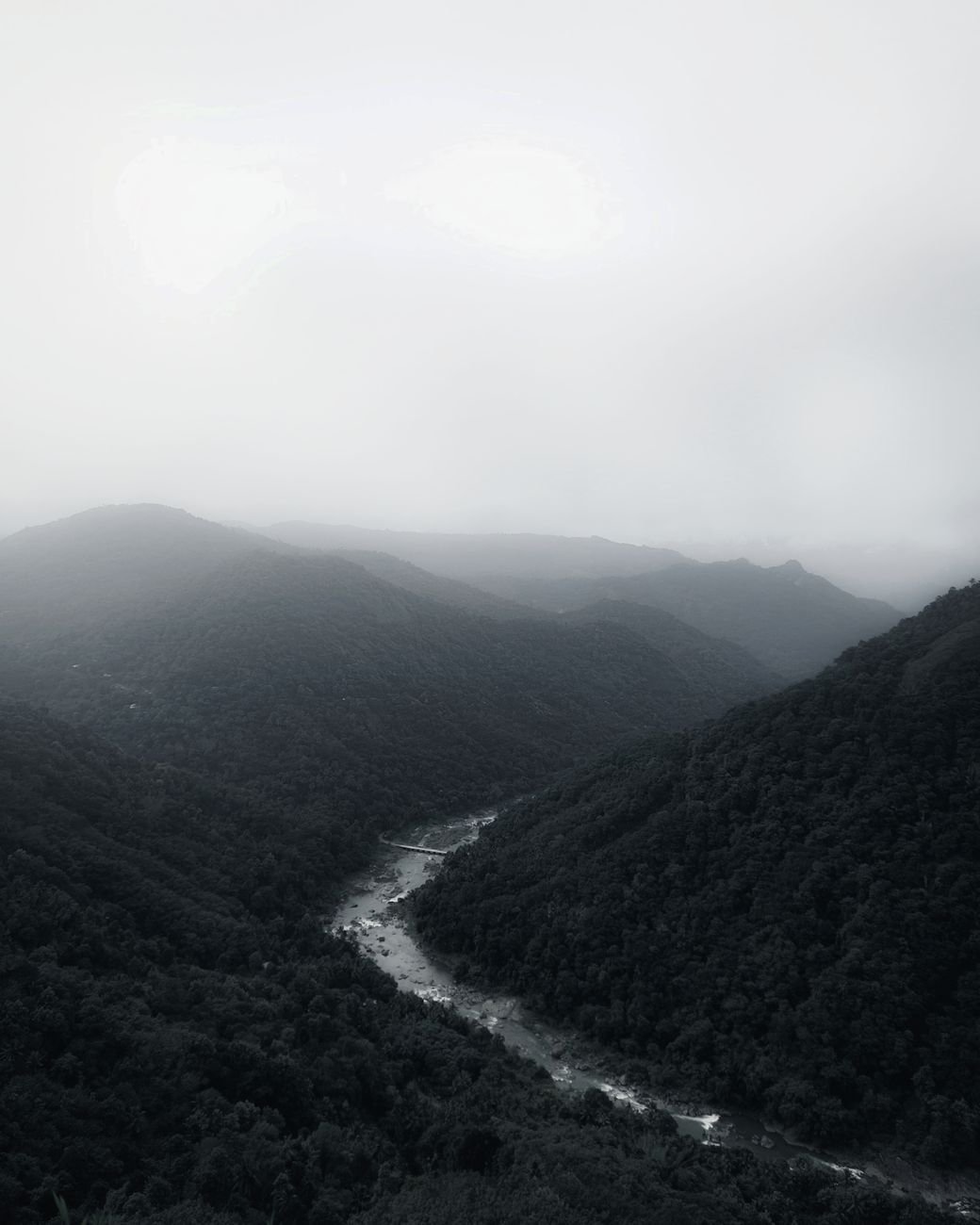
There has to be a first man from the “civilized” world. There has to be that one man, who walked hill and mountain, crossed stream and rivulet, rode over vale and dale, and stood awed and humbled in front of an amazing stretch of silence in the deep of the night.
It could have been a British man, an enterprising officer, perhaps, who realised that to wage the wars of the worlds for his Empire, he would need a steady supply of wood to lay out railway sleepers.
It could have been another, a la Ronald Forrester who sprang to life in Hari Kunzru’s The Impressionist to “fight the dust with trees.” Did he trek into the forested hills gifted without a thought by the local rulers searching for saplings?
Whoever he was, that man might have seeded the name for the hills: Silent Valley. The valley of silence. It is silent here because there aren’t any noisy cicadas. Those chirpy males that stridulate their noisy membranous wings against a resonating body to create sound decibels higher than 100 dB weren’t a natural inhabitant of the world’s oldest patch of tropical evergreen forest.
The valley, however, is anything but silent. Cutting through its bosom of hills is the gurgling, giggling river Kunthi, which continues to flow oblivious of the storm it had kicked up some years back. The Kerala state’s electricity board (KSEB) wanted to dam her and generate some quick electricity. They marked the dam site, started burrowing a tunnel, hung a suspension bridge and were ready to go, when the environmentalists stepped in.

They had the most unlikely hero for a cause: An endangered monkey, the lion-tailed macaque. The activists were ridiculed; one legislative assembly member wondered aloud why on earth these guys were bothered about a silly monkey. He couldn’t comprehend how forests caused rains either, and asked the people to check out how it rained on the tree-less deep seas.
The world-wide campaign of the environmentalists fetched rewards. The project was shelved; Silent Valley was declared a National Park. Today, a fresh controversy has erupted. A rebuffed KSEB is smartening from the bitter pill it was forced to swallow, and has identified another hydel project only 500 metres below the Silent Valley National Park boundary at Pathrukadavu. Oh yes, the action is heating up… and it will take its course.
Meanwhile, there is an awesome lot to be learnt at Silent Valley for the taxonomist, the ornithologist, the layman…
The journey could start from Manarcaud, the nearest town, 43 kms away, in Palakkadu district, Kerala. Hop into a bus, watch the comforts of modernity disappear as smaller settlements and then long patches of forests rush into your view. Not for long though… Huge hoardings of jewellers and textile shops would hit you again announcing the arrival of Agali.
This hub of some 187 tribal hamlets has, over the years, been altered in its socio-economic milieu through the influx of settlers from Kerala and neighbouring Tamil Nadu. Since then, the two states have been waging war of words over water that flows through river Bhavani, which originates in the hills of Tamil Nadu and flows eastward through Kerala. Tamil Nadu minces no deeds and words when it comes to water disputes and more recently had a brush with Kerala, when the state embarked on the Mukkali weir project across Bhavani.
Mukkali is the starting point for a trip to Silent Valley National Park. If you proceed further to Agali, do not miss a visit to the Attappadi Hills Area Development Society (Ahads), which has been working towards meaningful employment generation for the tribals, forest land conservation and socio-economic development programmes.
And if you watch aghast the barren patches of land, which were once pristine forests, remind yourself that what awaits you in Silent Valley is more or less what has been lost to mankind through utter greed and indiscriminate felling of trees thereof, callousness resulting in forest fires, and not but the least, bad soil conservation practises including indiscriminate grazing of goats.
To enter Silent Valley National Park, you need the permission of the wildlife warden. The office is walkable distance from Mukkali junction (a misnomer actually; it is just a few grocery shops and an imposing view of the Malliswaran Mudi, the ultimate pilgrim spot of the tribal population.)
Passes are to be obtained for vehicles, guides are allotted and off you go into the forest through a rugged road, catching glimpses of monkeys, squirrels and birds galore. Strange are the ways of ownership pattern here; if one stretch of the forest belongs to the government, on the other side, cutting a little inside, lies pristine property in private hands. Well, after all, you muse, you are in God’s own country…!
The 23-kilometre bumpy ride, environmentalists say, should stay the way it is. Any effort at improving the stretch would only hasten man’s unnecessary intrusion into nature. Slog. Work your way in. Be thankful that you can at least drive on. Guards often walk the distance.
It could be coincidental that one of the last glimpses of human life on the way to Silent Valley is that of the “cursed” tribal settlement, which inspired writer Malayattur Ramakrishnan to pen the acclaimed novel, Ponni. An age-old but illicit affair had resulted in the tribe’s explusion from the mainstream. The curse: “May you not see Malliswaran Mudi.” And yes, to this day, the only tribal settlement in the region that does not have visual access to the abode of their god is the one you pass on the way to the National Park.
Like most other tribal settlements, they too graze goats (a practice that is less encouraged these days). Their goats often line the narrow trail to Silent Valley, and if you are tempted to take one off as a trophy, be reminded that the ordinary looking dog that seems to loiter around can turn more ferocious than a German Shepherd. It is a trained watchdog and it makes sense not to mess with it.
Sairandri is the entry point to Silent Valley. An Inspection Bungalow, here, can serve as a resting place. If you are fortunate, you can get a meal of rice and dried fish (after the ride and occasional treks through the forest it would taste divine) from the forest officers who fan out to various check points in the National Park from here. You might also get to meet research scholars from the Salim Ali Centre for Ornithology and Natural History, who camp in the Park to study birds.
An observation tower has been built here, which gives you a bird’s eye view of the Park including an unobstructed view of Anginda, the highest peak at 2,383 m. And criss-crossing the hill ranges is Kunthi, which originates from the Nilgiri Hills, crystal-clear, perennial and wild as an uninhibited damsel.
Travel not to the Silent Valley project to spot animals galore. Venture not into Kunthi for the thrills of adventure sports. Trek not into this protected area to earn trophies – no, not even that gleaming, round stone from the depths of Kunthi.
Silent Valley’s Malabar rainforests are to be explored for the sheer richness of nature. To learn its adaptations, to marvel at the little diversities in creation that helps shrubs, creepers and even trees survive in that biological pyramid of existential battles.
Taxonomists have reported more than 1,000 species of flowering plants at Silent Valley, the core zone of the Nilgiri Biosphere Reserve. Add to it 107 species of orchids, 100 ferns and fern allies, 200 liverworts, 100 mosses, 325 fungi, 75 lichens and abut 200 algae… Most are endangered; some could be extinct as we talk, failing in their perennial war for survival. Silent Valley’s spread of flowering plants is even more than that reported in the Amazon.
Nature plays its own little games with the trees too. The thick canopy that the trees form does not tell the story of a ‘survival of the fittest’ battle they play out on ground. It starts from the seedling stage. They all want to live, and they all want space. The trees cut imaginative ways to find space by way of shaping its trunk and issuing branches.
Some trees take advantage of bat pollination and strike flowers on the underbelly of its branches; some creepers cut temporary clamps to climb and latch on to big trees; another makes knots on the tree trunk as it climbs. Beware of some innocuous looking plants though; one is capable of making elephants itch and is named so colloquially. Brush its leaf and you had it for life.
One of nature’s pranks had resulted in a huge tree turning hollow from inside. Further investigation led to the tree’s identification as a new species altogether, which has been named Cassine kedarnadii.
And then are the insects, birds, fishes, amphibians, butterflies, reptiles and animals… May their tribe increase! You will neither miss the lion-tailed macaques nor the reason for their preference for Silent Valley. They feast on a form of jackfruit, found abundantly in the region.
The forest department is currently fine-tuning an Interpretation Centre at Sairandri, which helps visitors understand the animals and birds better through pug marks, excreta samples, feeding habits, and other characteristic traits.
But of course, there is no greater fun than understanding the forest first hand. If it is raining as you venture into Silent Valley, make sure you are adequately protected against leeches. Not that anything helps. They simply latch on to you; lime is said to help pluck it out.
Silent Valley’s dense population of reeds is the breeding ground of the king of all snakes, the King Cobra, which forest guards describe graphically as standing up to your eye-level on its tail, ready to kill. Run man, run…don’t freeze in fright. But then, the snakes know the ways of men and try not to get into your way. Sloth bears are clumsier.
A veterinary doctor, who was out in a nearby protected forest tracking a wounded buffalo, bumped into one. The bear plucked his nose off, and gave him a painful embrace. He survived. So beware, bears are clumsy but dangerous.
Silent Valley comes to its true natural splendour during the rains. In summer, the trekking trail is still cool, though nights can get terribly chilly.
No trip to the Park is complete without wading through the coolness of the river Kunthi. Mythology says seven dips in holy water can wash all your sins away. What can be purer than gushing water untouched by man, caressed by nature’s bounty?
Kunthi refreshes; Silent Valley enlivens.
Return to your concrete jungles but take with you a slice of nature’s bounty, provided without any ruckus – in a silent vein.
And by the way, the cicadas have started coming in to Silent Valley. From Sairandri to Kunthi River, the trail reverberated to its resonance.
Perhaps it is time to call in the Japanese for another of their haikus inspired by cicadas:
In the cicada’s cry
No sign can foretell
How soon it must die.
– Matsuo Basho
Pics courtesy: http://silentvalley.gov.in/Userside/photogallery