
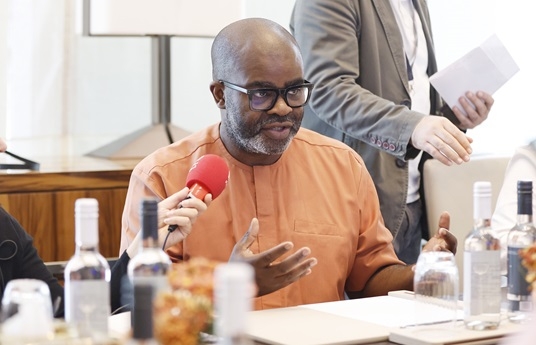
Six years ago, Misan Harriman’s wife handed him a camera for his 40th birthday. Today, he’s an Oscar-nominated filmmaker, a globally renowned photographer, and one of the most powerful voices documenting our turbulent times. But what makes his story remarkable isn’t just this meteoric rise – it’s how he’s chosen to use his platform in an era when, as he puts it, “the world is burning.”
“I always remind people it’s never too late to take the road less paddled,” Harriman says of his late start in photography. That gift from his wife would transform not just his life but how we witness some of the most significant moments of our time. His rapid ascent in the photography world wasn’t just about technical skill – which is self-taught – it was about bringing a lifetime of observed human experience to each frame.
“When you’re shooting something you love, you begin to understand the magic between the highlights and shadows of photography,” Harriman explains. “Robert Frank said the eye should learn to listen before it looks, and I think my eye, throughout the trials and tribulations of my life, has been listening to the human condition.”
The Black Lives Matter Moment
His breakthrough came during the Black Lives Matter protests, where his images captured the raw humanity of the movement in ways that distinguished them from thousands of others taken at the same events. What made his photos different wasn’t where he stood – often among dozens of other photographers – but how he saw.
“I’m shooting my own trauma,” he explains, describing his approach. “When I see someone utterly broken, I recognize their invisible scars, and then they give me that look because they see me, saying, ‘take my pain, take it, hold it for me and let the world see it.’ There’s this trust and the transference of little pieces of pain that I unfortunately recognize.”
His talent quickly caught the attention of the fashion world, leading to commissions from British Vogue, portraits of the royal family, and sessions with celebrities from Lewis Hamilton to Angelina Jolie. But Harriman made a conscious choice not to limit himself to the glamorous side of photography.
“I could have just been the guy who shot the Vogue cover, going from yacht to castle to party,” he reflects. “But what would I tell my daughters when they become young women? That I was just doing that when the world was burning?” Instead, he’s devoted himself to bearing witness to the world’s pain points, from the hunger crisis in North Africa to the migrant crisis in Sicily.
His journey to becoming a visual storyteller is deeply personal. As someone who struggled with dyslexia, Harriman credits his wife with helping him embrace the very parts of himself he once viewed as weaknesses. “My wife fell in love with the parts of myself that I was ashamed of,” he says, “and that is the biggest change.”
The After and thereafter
His venture into filmmaking brought new opportunities to tell deeper stories. His Oscar-nominated short film “The After” tells the story of a man of color dealing with grief – a narrative choice that was deeply intentional.
“I wanted to make something that let anyone that was going through something know that it’s okay to not be okay,” he explains, “and to also show a man of colour and men of colour are portrayed sadly in ways that do a disservice to us.”
The film’s success, including its Academy Award nomination, left him “dumbfounded:, a moment he describes as “immediately hugging the little boy in me.” Working with actor David Oyelowo, whom Harriman describes as “my brother now,” the film became more than just a story about grief – it became a testament to the power of authentic representation.

What We Seee
Through his media platform ‘What We Seee’, which he describes as a “Culture 3 phenomenon,” Harriman is working to reshape how stories are told in the digital age. He envisions a future where technology can help level the playing field for underrepresented voices, particularly from the global south. “We are now going to shape culture,” he says, speaking of communities traditionally marginalized in global media.
“We’re looking at the marriage between technology and culture, and also whether the playing field can be levelled,” he explains. “So somebody in Rajasthan, or Venezuela, or in my village, in Sapelewari, can have a voice because of the interconnected world, doesn’t have to worry about government blocking him or her in finding new ways to look for business or trade.”
Truth as Revolution
For Harriman, the revolutionary act isn’t just in capturing moments – it’s in telling the unvarnished truth about them. He’s particularly critical of how mainstream media often fails in its fundamental mission. “The social contract of journalism and writers is looking to me like it’s broken,” he observes, pointing to the disparate coverage of similar events in different parts of the world.
“We have to decide to decolonize our minds and look for the truth,” he insists. “In today’s world, simply telling the truth has become a revolutionary act.”
Drawing inspiration from Nina Simone’s assertion that an artist’s duty is to reflect the times, Harriman has positioned himself as more than just a photographer or filmmaker. He’s become a chronicler of our age’s most pressing humanitarian issues, using his lens to ensure that stories of suffering, resilience, and hope aren’t forgotten.
To aspiring artists, particularly those who are neurodivergent like himself, Harriman offers both inspiration and challenge. “To the mothers and fathers and kids dealing with neurodivergent kids,” he says, “I want to be an example that maybe the kids with different minds can actually give us the answers we need in this broken world.”
His message to the next generation of storytellers is simple: the world needs their unique perspectives, their courage to tell difficult truths, and their willingness to bear witness to both pain and beauty.
As he continues his own journey, Harriman demonstrates that it’s never too late to pick up a camera, find your voice, and use it to change the world.
“To the mothers and fathers and kids dealing with neurodivergent kids,” he says, “I want to be an example that maybe the kids with different minds can actually give us the answers we need in this broken world.”
Misan Harriman