
Google has unveiled new artificial intelligence initiatives designed to strengthen India’s agricultural sector and enhance the cultural representation of Indic languages in AI models, according to a company blog post published on July 10.
The tech giant announced the launch of its Agricultural Monitoring & Event Detection API (AMED API), which provides field-level crop data that can help monitor crops and detect agricultural events at individual farms across India. The new system builds upon Google’s existing Agricultural Landscape Understanding (ALU) Research API, which was launched last year.
“The AMED API details the type of crop on a given field, crop season, the field’s size, and also provides historical information about the agricultural activity on it for the last three years,” Google India Team stated in the blog post. Data is refreshed approximately every two weeks, providing partners with continuously updated information about field-level changes and agricultural events.
The development comes as Google seeks to address challenges in India’s agricultural sector through AI-powered solutions. TerraStack, a startup incubated at IIT-Bombay, has already begun using the ALU API to build rural land intelligence systems for lending, land record modernization, and climate risk assessment. The company is now exploring applications for the new AMED API in rural lending use cases.

According to the blog post, the technology enables the identification of farm boundaries and detection of potential encroachment and changes in land ownership, which Google describes as “a crucial factor in the support farmers avail from both the public and private sector.”
Language diversity initiative
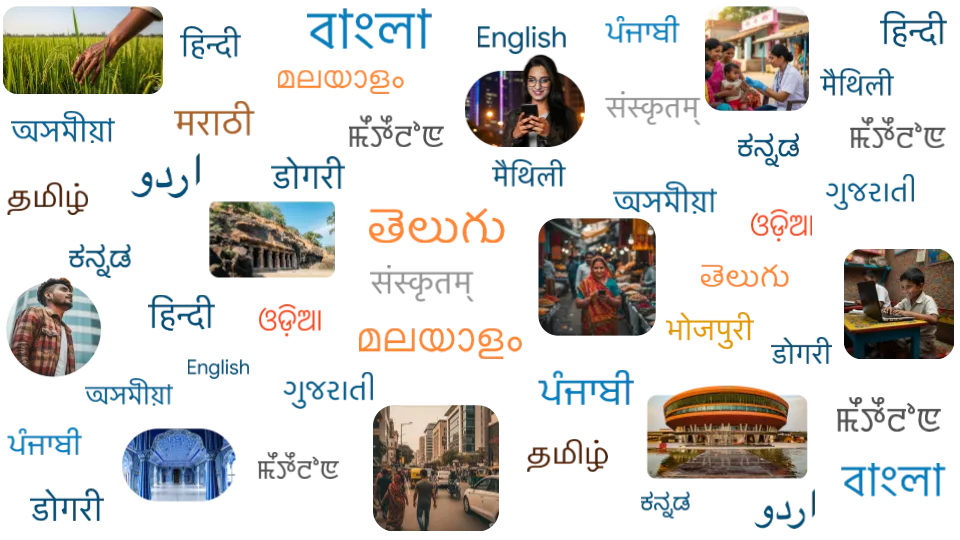
In parallel, Google announced its collaboration with researchers at IIT-Kharagpur to bring the company’s “Amplify Initiative” to India. The programme aims to create structured, hyperlocal datasets covering India’s linguistic and cultural diversity for use in large language models.
“This initiative aims to bridge knowledge gaps within Large Language Models with localized data – including different languages, dialects, and cultural nuances missing from current AI training,” the company stated.
The Amplify Initiative follows a community-centric approach where sector experts input information about local issues through privacy-preserving Android and web applications. Regional partners and research leads then translate, evaluate, and validate queries for local relevance and fluency.

The initiative was previously piloted in Sub-Saharan Africa in partnership with Makerere University’s AI Lab in Uganda, creating an annotated dataset of over 8,000 queries in seven African languages with contributions from 155 experts across topics ranging from chronic disease to misinformation.
Google’s language efforts in India also include Project Vaani, launched three years ago in collaboration with the Indian Institute of Science. The project has made available nearly 21,500 hours of speech audio and 835 hours of transcribed speech across 86 unique languages, reflecting contributions from over 112,000 speakers across 120 districts and 22 states.
Model improvements and applications
The company reported that its Gemini 2.5 model now requires significantly fewer tokens than Gemini 1.5 to process Indic languages while maintaining similar or better efficiency than competing models. This improvement translates to computational and cost benefits for developers building applications for India.
Several Indian organizations have already implemented Google’s AI technologies. Cropin has used Gemini to develop what it calls “the world’s first real-time agri-intelligence solution,” Cropin Sage, which has helped a US-based agri-processing company strengthen its supply chain against climate-related risks.
Manipal Hospital has deployed an assistive system built with Gemini that has reduced patient handover time between nursing shifts by more than half, according to Google’s blog post.
The company also highlighted that over 150,000 researchers across India are accessing the AlphaFold Protein Structure Database, built using AI systems developed by Google DeepMind. The technology, which earned Sir Demis Hassabis and Dr John Jumper a Nobel Prize, is being used by Indian researchers to address challenges in autoimmune diseases and cancer research.
Additionally, tens of thousands of expectant mothers across India are benefiting from machine learning models developed with pro bono support from Google DeepMind researchers, implemented through the non-profit ARMMAN’s health information programmes.
“The enthusiastic adoption of our foundational and fundamental research across India has been incredibly encouraging, affirming our sustained investments in AI over the past decade,” the Google India Team stated.
Originally published on Google India’s blog: https://blog.google/intl/en-in/company-news/new-milestones-in-our-journey-to-build-inclusive-and-helpful-ai-for-india/