
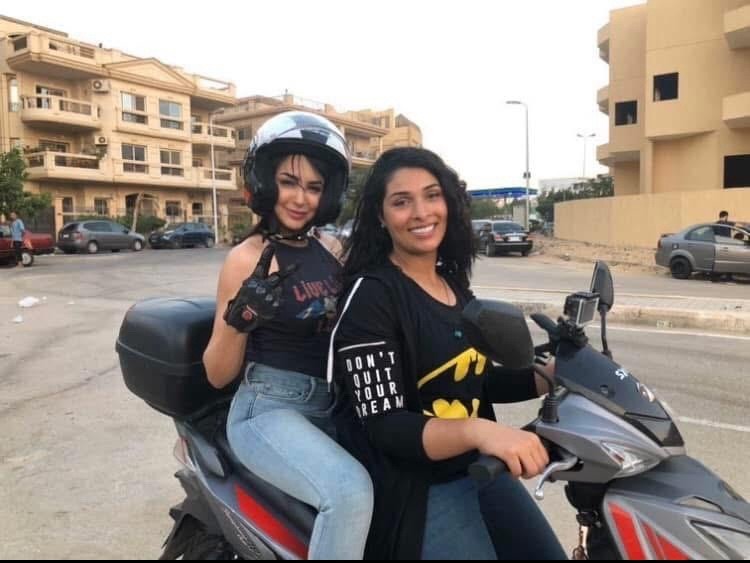
A physician-turned-entrepreneur is tackling gender inequality, one scooter at a time, in Cairo’s congested streets
Why must men have all the fun, while women endure harassment on public buses and face stigma simply for wanting to ride a bicycle? This question echoes across the Arab world, from the streets of Riyadh to the alleys of Cairo, where the simple act of a woman cycling remains a revolutionary statement.
In 2012, Saudi filmmaker Haifaa al-Mansour captured this struggle in Wadjda, her groundbreaking film about a young girl determined to buy a bicycle despite societal disapproval. The film’s protagonist enters a Holy Quran recitation contest to earn money for her dream bike, challenging deeply entrenched cultural norms that view women’s cycling as disgraceful. A decade later, the battles depicted in Wadjda continue to play out across the region, though increasingly, women are breaking the glass ceiling.

When Nouran Farouk M.Sc, MBBS, couldn’t find a female instructor to teach her how to ride a scooter in Cairo, she didn’t just accept the status quo. Instead, the young physician founded what would become Egypt’s first women-focused micro-mobility platform, training thousands of women to navigate the country’s notoriously chaotic streets on two wheels.
Five years after its launch, Dosy Bikes has emerged as an unlikely solution to multiple pressing challenges in Egypt: women’s restricted mobility, urban congestion in a country of 100 million people, and environmental degradation from fossil fuel dependence. The startup’s success story offers a blueprint for addressing similar issues across the developing world.
“We started on social media, and received lots of negative comments about how this wasn’t right for women,” Farouk recalls of Dosy’s 2019 launch. But by partnering with celebrities and social influencers, the platform quickly gained traction, having now trained 7,000 women and enabling many female delivery workers in Egypt’s male-dominated gig economy.

From Medical Practice to Mobility Pioneer
Farouk’s journey from Cairo medical school graduate to social entrepreneur began with a simple personal frustration. She and her journalist sister wanted to learn to ride scooters but found only one academy willing to teach women and it was far away. This experience illuminated a broader problem: the absence of a centralized platform connecting female customers with female instructors across Egyptian cities.
“Mobility is fundamental for women, not just for transportation, but for accessing healthcare, education, and economic opportunities,” Farouk explains. Her medical background proved unexpectedly relevant: without mobility options, women struggle to reach hospitals, clinics, and other essential services.
The timing was critical. In 2021, two years after launching, both sisters focus on Dosy Bikes. A solution for a country grappling with worsening traffic congestion and air pollution, with Egypt’s 100 plus million residents almost entirely dependent on fossil fuel-powered vehicles.


Navigating Cultural Headwinds
Operating in a conservative society where women riding bicycles or scooters face significant social stigma, Dosy Bikes confronted immediate pushback. Beyond cultural stereotypes, Egyptian women attempting to cycle face practical challenges: inadequate infrastructure, the absence of dedicated bicycle lanes, and widespread street harassment.
“These challenges are hindering women from having basic mobility needs met,” Farouk says. The startup’s solution was multifaceted: beyond basic riding instruction, Dosy offers self-defense training and maintenance workshops, addressing both the practical and safety concerns that deter women from two-wheeled transport.
The company’s approach to scaling proved innovative. Rather than establishing fixed training centers, Dosy brings instructors directly to customers’ neighborhoods across Cairo, Alexandria, and other governorates. This hyperlocal model eliminates the primary barrier of having to travel to distant training facilities. Dosy plans to expand into rural areas where mobility challenges are often more acute.

Economic Empowerment Through Entrepreneurship
Dosy’s impact extends beyond individual riders. By recruiting and training women as instructors, the platform creates income opportunities in a country where female workforce participation remains low. These instructors, or “captains” as Dosy calls them, earn flexible income while challenging gender norms in Egypt’s male-dominated transportation sector.
The economic model addresses a crucial demographic reality. While Farouk notes their target audience is women aged 18-40, demand spans generations, with older women equally eager to gain independence through affordable mobility. “Not all women can afford cars,” Farouk emphasizes. “We’re providing other options while promoting environmentally friendly transport to address negative environmental effects.”
Last December, Dosy launched the first version of its mobile application, with a major update scheduled for August this year. The app represents a significant evolution from the company’s social media origins, incorporating e-commerce features for buying, selling, and renting scooters, alongside ride-hailing services specifically designed for women.

Regional Expansion on the Horizon
Dosy’s ambitions extend well beyond Egypt’s borders. Farouk identifies India, Indonesia, and Jordan as priority markets, all facing similar challenges: restricted women’s mobility, high female unemployment and urban congestion. The expansion strategy reflects a growing recognition that the mobility challenges facing women in Cairo mirror those in Jakarta, Amman and New Delhi.
The startup’s growth has attracted international attention. Farouk has joined prestigious entrepreneurship programs including The Tony Elumelu Foundation and secured a Ban Ki-Moon Centre for Global Citizens fellowship, leveraging these networks to refine Dosy’s model for international scaling.

Measuring Impact Beyond Numbers
While the headline figures such as 7,000 women trained, tell one story, Farouk emphasizes the deeper transformation. “It’s about self-protection and self-esteem,” she explains. “Women want private mobility options it is not unusual for women to face harassment in public transport. We’re providing privacy, safety, and independence at affordable prices.”
The environmental impact, while harder to quantify, is equally significant. In one of the world’s most polluted and congested countries, every woman choosing a bicycle or electric scooter over a car represents a small victory in the fight against urban air pollution and climate change.
The Road Ahead
As Dosy Bikes prepares for regional expansion and technological upgrades, it faces the task of maintaining its community-focused approach while scaling operations. The August app update promises enhanced features, but the core mission remains unchanged: dismantling barriers that prevent women from moving freely through their cities.
Farouk believes that every woman learning to balance on two wheels represents a small strike against societal constraints. In a region where women’s rights often make headlines for setbacks rather than progress, Dosy Bikes offers a different narrative. That is one of women empowerment, which comes not through protest or policy, but through the simple act of teaching a woman to ride.
As urban centers across the developing world grapple with congestion, pollution, and gender inequality, the Dosy model suggests that solutions need not be high-tech or capital-intensive. Sometimes, transformation begins with something as simple as a bicycle, a willing instructor, and the courage to challenge the status quo.